Hi, what do you want to do?






NASA
Nasa: Vectors
This site from NASA provides an excellent tutorial on vectors and their use in physics to describe the motion of objects. Vector addition and resolution are illustrated.
Curated OER
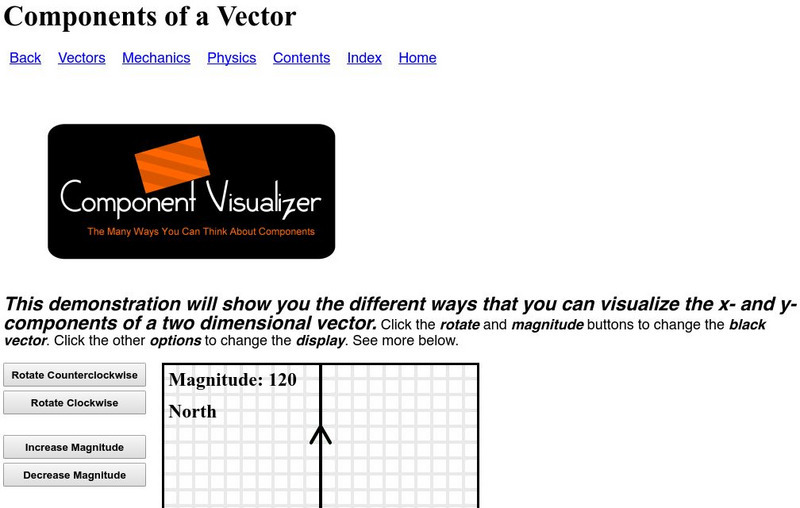
Zona Land: Components of a Vector
An interactive Java applet where users can rotate a vector about its tail and view the components of that vector. Magnitude of the components is updated on screen as the vector is dragged.

Physics Classroom
The Physics Classroom: Vectors: Resolution of Forces
This interactive tutorial helps students determine the components of a vector to better understand resolution of forces.
Physics Classroom
The Physics Classroom: Vectors: Net Force Problems Revisited
Through interactive examples and practice problems, this tutorial helps students understand net force-acceleration problems in which an applied force is directed at an angle to the horizontal.
Physics Classroom
The Physics Classroom: Vectors and Projectiles: Vector Addition Interactive
Explore adding vectors by dragging objects on a canvas. Adding vectors can be easy with this Vector Guessing Game Interactive. Students can improve their understanding and skill at adding vectors using the head-to-tail method.

Exploratorium
Exploratorium: Science Snacks: Vector Toy
Try this walking toy activity to learn about the directional forces that act on it to control its movements.
Physics Classroom
The Physics Classroom: Motion and Forces in Two Dimensions: Vectors/direction
The emphasis of this unit is to understand some fundamentals about vectors, and to apply the fundamentals in order to understand motion and forces that occur in two dimensions.
Physics Classroom
The Physics Classroom: Motion and Forces in Two Dimensions: Vector Components
Students examine examples of vectors that are directed in two dimensions- upward and rightward, northward and westward, eastward and southward, etc.
NASA
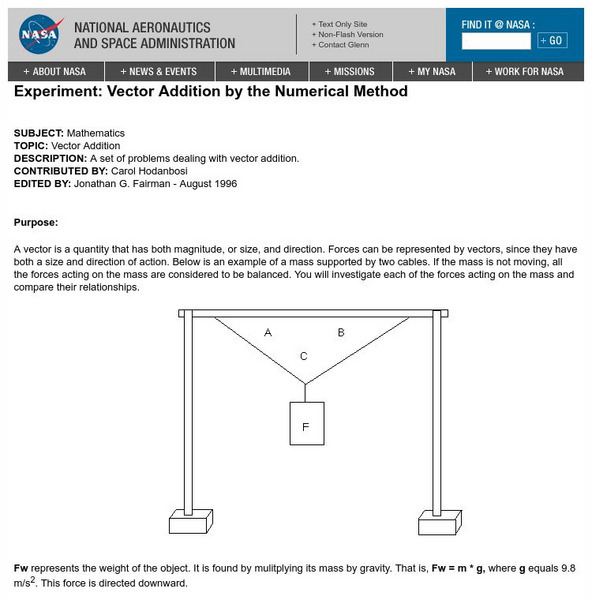
Nasa: Vector Addition by the Numerical Method
A lab experiment involving readily available materials. Students analyze three forces acting upon one point to determine the resultant force. Questions and accompanying answers are provided.
Physics Classroom
The Physics Classroom: Motion and Forces in Two Dimensions: Vector Resolution
In this unit, students learn two basic methods for determining the magnitudes of the components of a vector directed in two dimensions. The two methods of vector resolution students will examine are the parallelogram method the...
Physics Classroom
The Physics Classroom: Motion and Forces in Two Dimensions: Component Addition
In this physics tutorial, students learn how to approach more complex vector addition situations by combining the concept of vector components and the principles of vector resolution with the use of the Pythagorean theorem.
Physics Classroom
The Physics Classroom: Vectors and Projectiles: Name That Vector Interactive
Try these vector addition challenges where twenty-five vectors are displayed on a grid. Each challenge involves adding three of the vectors together to determine the resultant. The emphasis of the activity is on component addition.
Physics Classroom
The Physics Classroom: Vectors and Projectiles: Vector Guessing Game
Try this adding vector challenge. Two random vectors are displayed, and students must quickly decide on the size and direction of the resultant. The challenge is to solve as many correctly as possible in 20 seconds. Repeat, and beat your...
Physics Classroom
The Physics Classroom: Vectors & Projectiles: Vector Addition: Does Order Matter
Watch this short demonstration that focuses on a single question: Does the order in which vectors are added together affect the magnitude or the direction of the resultant?
Physics Classroom
The Physics Classroom: Vectors and 2 D Motion Table of Contents
Learners explore vectors, projectile motion, and forces in two-dimension. The tutorial consists of lessons and problems to check for understanding.

Open Curriculum
Open Curriculum: Vectors and Motion
Learn more about the properties of velocity, acceleration, and force vectors in this illustrated article.
Physics Classroom
The Physics Classroom: 1 D Kinematics: Vector Diagrams
Learn how to use vector diagrams to describe the velocity of a moving object during its motion.
Physics Classroom
The Physics Classroom: Vectors: Non Horizontally Launched Projectile Problems
In this physics tutorial on vectors, the use of kinematic equations to solve non-horizontally launched projectiles is demonstrated.

Sophia Learning
Sophia: Work & Vectors
Watch this video tutorial, and find out why work is not a vector. [4:48]
Texas Education Agency
Texas Gateway: 4.8 Extended Topic: The Four Basic Forces: An Introduction
By the end of this section, you will be able to understand the four basic forces that underlie the processes in nature: gravitational, electromagnetic, weak nuclear, strong nuclear forces.
Other
Montana State University: Line Integrals
A thorough explanation of line integration and how to represent force fields, include graphs and diagrams for visual reference and examples.
Science Education Resource Center at Carleton College
Serc: Centripetal Force Activity
In this physics activity, students will simulate a race car on a circular track. Velocity, acceleration, and force vectors will be analyzed at various places along the track. As the students progress in the activity, prompts for student...
Science Education Resource Center at Carleton College
Serc: Vectors: Lifting a Bowling Ball
Students experience and analyze two different methods of lifting a bowling ball. By using and understanding vectors, they create a useful free body diagram to explain why one person can lift the bowling ball easier than two people
Physics Aviary
Physics Aviary: Practice Problems: Radar Vector Problem
Students must find out the velocity vector for a plane based on readings they take from a radar screen. This video helps students solve the problem: https://youtu.be/y7jOBYseolU