Hi, what do you want to do?






TED Talks
Ted: Ted Ed: How Do Vaccines Work?
The first ever vaccine was created when Edward Jenner, an English physician and scientist, successfully injected small amounts of a cowpox virus into a young boy to protect him from the related (and deadly) smallpox virus. But how does...
University of Wisconsin
The Why Files: Flu Vaccine Shortage
A resource to help understand how the flu is different from other illnesses and how the flu vaccine can be considered important.

Centers for Disease Control and Prevention
Centers for Disease Control: Std Facts: Hpv Vaccine
CDC provides HPV vaccine questions and answers for young females and for their parents.

Other
The Wellcome Trust: Why Don't We Have a Malaria Vaccine?
This interesting site explains why trying to develop a malaria vaccine is more complicated than trying to develop a vaccine for measles.
Science Buddies
Science Buddies: Blas Ting Flu Viruses
Remember going to the doctor and getting vaccine shots? It's no fun getting poked with a needle, but fortunately, a vaccine gives you protection against a serious illness for years to come. This project will show you why.
Centers for Disease Control and Prevention
Centers for Disease Control: Preventing the Flu: Questions and Answers
Find simple answers to several common questions about the flu including: "How does the flu spread?" "What are the symptoms of the flu?" "How long is a person contagious?" "What is the difference between a cold and the flu?" "At what age...
World Health Organization
World Health Organization: Mumps
Site about mumps: who is affected, when the most cases occur, treatment, and vaccines.

University of Wisconsin
The Why Files: Enough to Go Around
Why? Files article posted on November 21, 2002, introduces the brave new idea of edible vaccines.
Other
Nfid: Facts About Rubella for Adults
This resource explains what rubella is, how to prevent it, symptoms, who should get the vaccine. Includes FAQ about rubella.
PBS
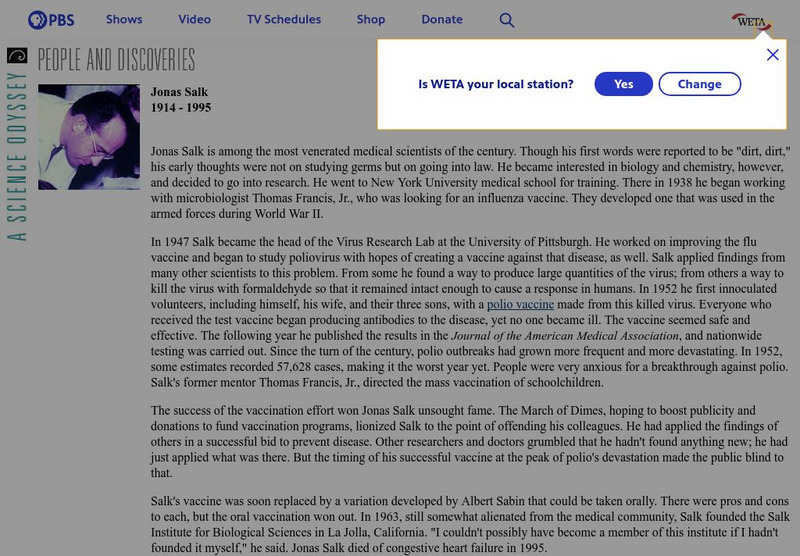
Pbs: Jonas Salk (1914 1995)
A Science Odyssey biography of Jonas Salk from PBS, noted medical scientist who discovered the vaccine for polio. Easy to read format with link to "Paralyzing Polio," a colorfully animated and interactive comic strip. Links also...
Other
Netdoctor: Whooping Cough (Pertussis)
Use this site to learn about the causes, symptoms, and treatment for whooping cough. Throughout this article, there are links to related information bacteria, complications and other diseases related to whooping cough. A section on the...
Robin Chew
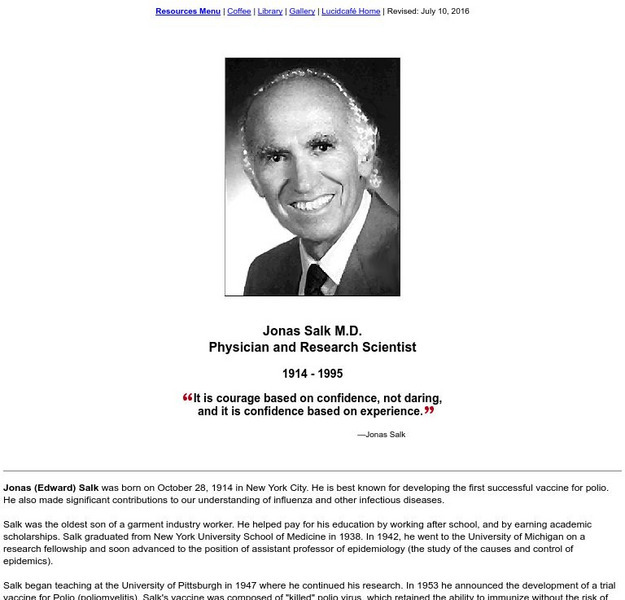
Lucid Cafe: Jonas Salk m.d.
This site provides a brief biography of Dr. Jonas Salk (1914-1995 CE), research scientist who is noted for his research and discovery of the polio vaccine. Links available to video and other biographical information on Salk, books...
Science4Fun
Science4 Fun: Louis Pasteur
Brief biographical sketch of Louis Pasteur, famous scientist whose discoveries include germ theory and vaccination.
American-Israeli Cooperative Enterprise
Jewish Virtual Library: Albert Sabin
A very brief yet informative look at the life of Dr. Albert Sabin. Discusses his work and research with the polio vaccine.
Centers for Disease Control and Prevention
Centers for Disease Control: H1 N1 Flu (Swine Flu)
The official website about Swine Flu from the Center for Disease Control and Prevention. Find out general information, an update on the current situation as of the day you are looking at the site, recommendations for vaccine, and what...
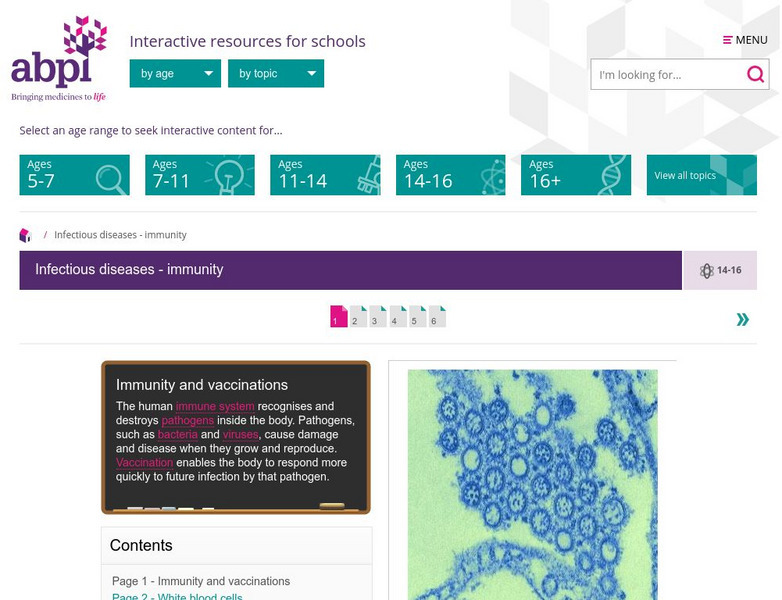
The Association of the British Pharmaceutical Industry
Abpi: Infectious Diseases: Immunity
An interactive, self-guided lesson on the function of the human immune system and how medical intervention prevents disease. This lesson has many descriptive animations as well as graphs and diagrams to help with understanding. There is...
PBS
Pbs Online News Hour: Extra: 2009 H1 N1 Flu: The Next Pandemic? (Lesson Plan)
This lesson plan focuses on viruses, particularly the Swine Flu, and allows students opportunities to simulate how viruses spread and the results.
OpenSciEd
Open Ed Sci: Covid 19 & Health Equity, Grades K 2
In this unit, students explore the basics of how Covid-19 affects people, and design investigations to explore how it spreads from person to person, and what we can do to prevent that spread.
Centers for Disease Control and Prevention
Centers for Disease Control: Typhoid Fever
This resource offers excellent information regarding the life-threatening illness, Typhoid Fever.
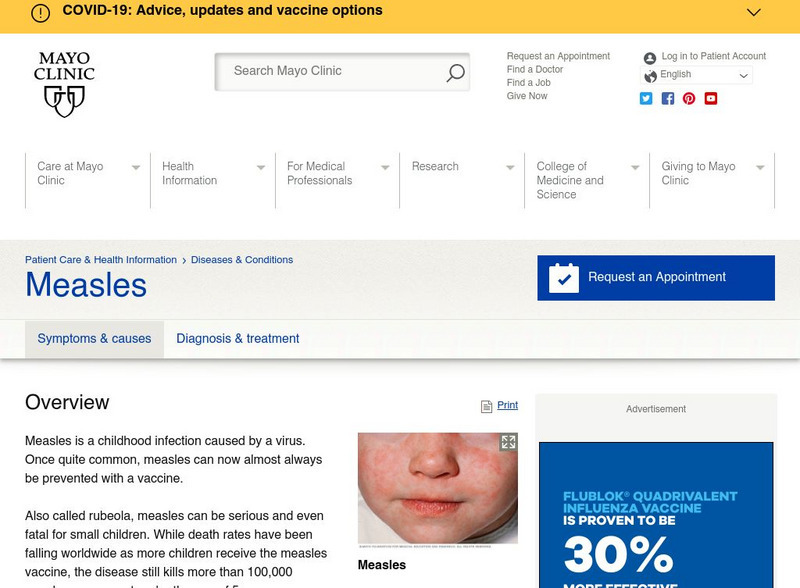
Mayo Clinic
Mayo Clinic: Measles
This site presents a detailed article which outlines the causes, risk factors, treatment, and prevention of measles.
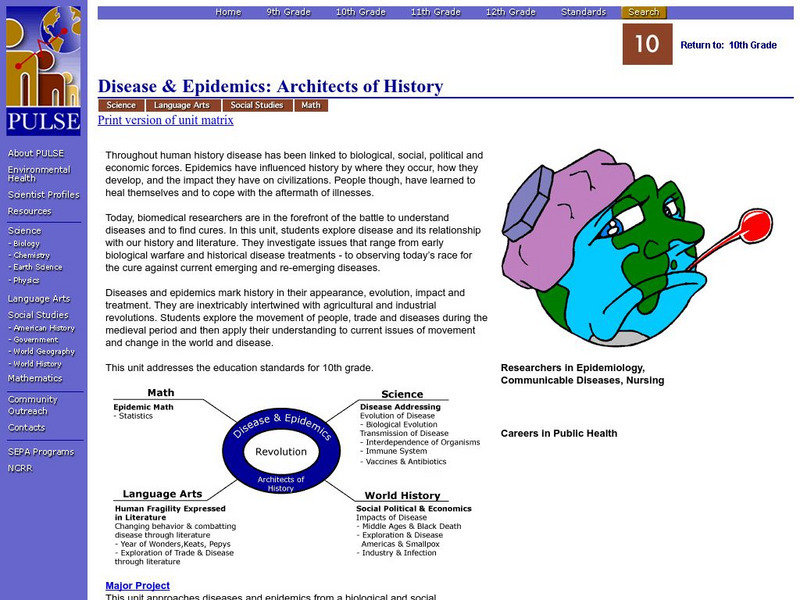
University of Arizona
Pulse: Disease & Epidemics: Architects of History
A 10 week interdisciplinary unit plan on disease and epidemics.
US Food and Drug Administration
Fda Kids Home Page
Learn about food safety and keeping healthy on the FDA Kids' Home Page. This site includes colorful graphics, great information, and it is easy to navigate.
OpenSciEd
Open Sci Ed: Covid 19 & Health Equity, Middle School Science
The unit focuses on the question How can people help end pandemics? It is designed to teach students about the COVID-19 pandemic, transmission of the COVID-19 virus, and the impacts of the pandemic on communities.
Aetna Intelihealth
Aetna: Inteli Health: What Is Allergy?
Extremely insightful article that explains what allergy is. Includes information on types of symptoms, how an allergy occurs, and common misconceptions about allergies.
Other popular searches
- Lesson Plans, Vaccines
- Smallpox Vaccines
- Vaccines and Hpv
- Vaccines Fda
- Vaccines and Antibiotics
- Microbiology, Vaccines
- Vaccines and Hov
- Small Pox Vaccines
- Anthrax, Vaccines
- Flu Vaccines
- Lesson Plans Vaccines
- Microbiology Vaccines