Hi, what do you want to do?






Utah Education Network
Uen: P H Changes in a Small Ecosystem
A pond water/hay infusion will be developed and observed. Student groups will add a range of acid and base solutions to look for changes.
Utah Education Network
Uen: Radioactive Decay
In this activity students will use a mathematical model to study the process of radioactive decay in order to help understand how it can be used to determine the age of ancient earth materials.
Utah Education Network
Uen: Investigating Convection
Students will plan and conduct an experiment that investigates convection currents.
Utah Education Network
Uen: Introduction to Climate Change
This is designed to be an introductory lesson to climate change. It covers the importance of the atmosphere, the basics of the "Greenhouse Effect" and an introduction to the human contribution to increased greenhouse gases.
Utah Education Network
Uen: El Nino in a Bowl
Students model formation of an El Nino current in a pie pan.
Utah Education Network
Uen: Composition of the Solar System
Students will use a reading selection to compare the solar system to a neighborhood and do some writing, drawing and make comparisons to reinforce their knowledge about the rocky planets, gas giants and amount of matter in the solar system.
Utah Education Network
Uen: Wavelength and Energy
Students will calculate energy, frequency, or wavelength. After calculating, students graph their data and answer analysis questions.
Utah Education Network
Uen: Successful Solutions
Students will accurately prepare two solutions and use them to perform a Briggs-Raucher (starch-iodine) reaction.
Utah Education Network
Uen: Solutions Everywhere
Students will discover how the percent concentration for solutions is widely used in foods and medicines.
Utah Education Network
Uen: Recognizing Chemical Reactions
Students will add 4 chemicals to a beaker and observe the changes that take place. They will classify them as physical or chemical changes.
Utah Education Network
Uen: We Are All Different in Many Ways!
This lesson celebrates students's unique physical and personality traits. After reading and discussing the children's book The Crayon Box That Talked by Shane Derolf and Michael Letzig, students will share create their own artwork that...
Utah Education Network
Uen: Investigation 2 Simulating Fossil Formation
This lesson plan includes directions for 5 different activities for making a variety of fossil types. The fossils included in all five activities are casts, petrification fossils, imprints and preserved fossils. The labs require a number...
Utah Education Network
Uen: Offspring Traits Hey, Where Did You Get That From?
Can you distinguish traits that are acquired from those which are inherited? Answer these online questions and find out.
Utah Education Network
Uen: How Are Soils Classified?
Students examine soil samples for this activity and decide classify them according to whether they are sandy, silty or clay.
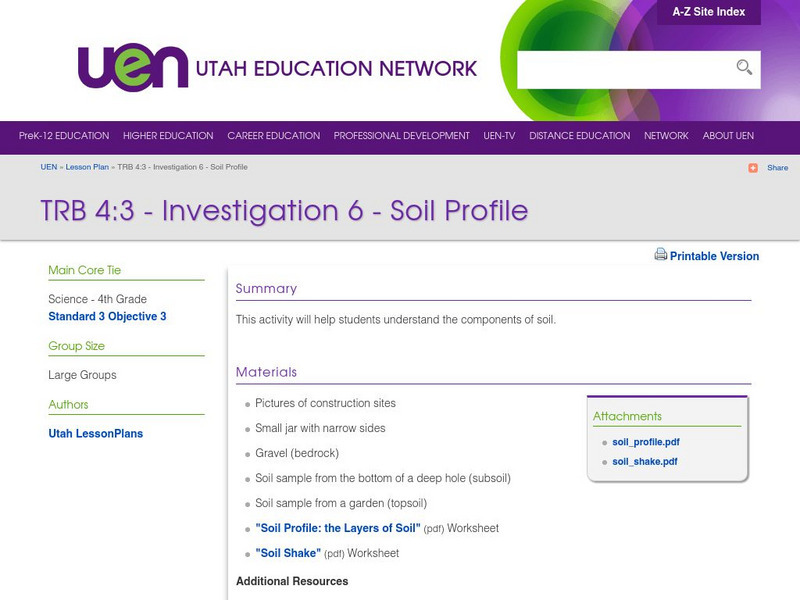
Utah Education Network
Uen: Investigation 6 Soil Profile
In this hands-on lesson, learners investigate the properties of different layers of soil.
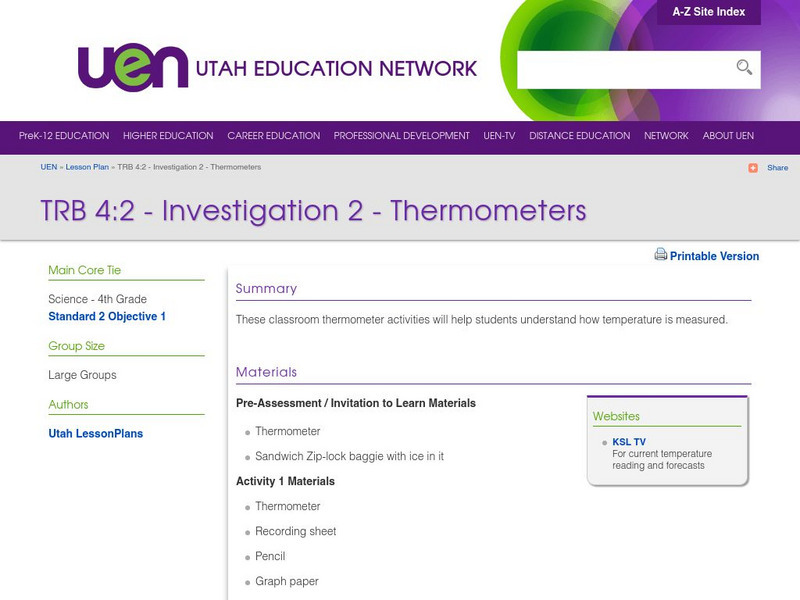
Utah Education Network
Uen: Trb 4:2 Investigation 2 Thermometers
Three activities are presented for fourth grade students to explore how thermometers work.
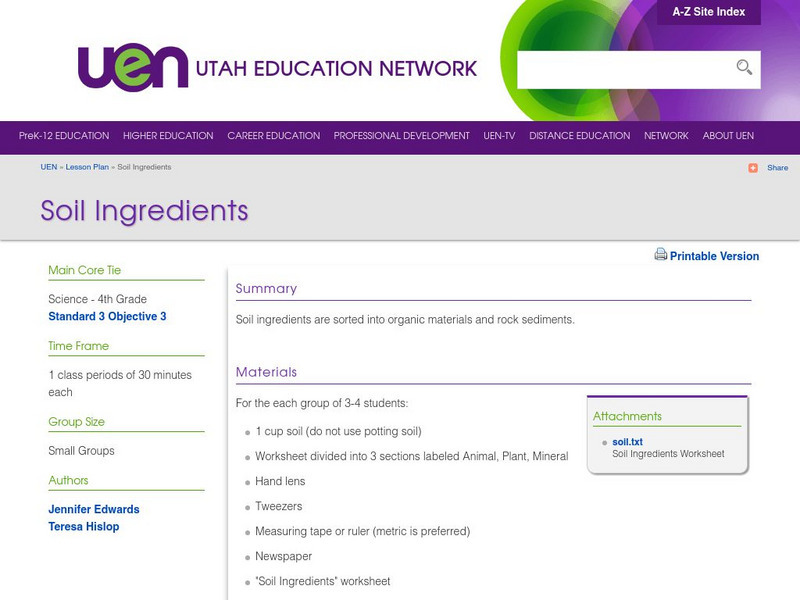
Utah Education Network
Uen: Soil Ingredients
Students are put into groups for this activity, and given a soil sample which they sort into rock particles and organic material.
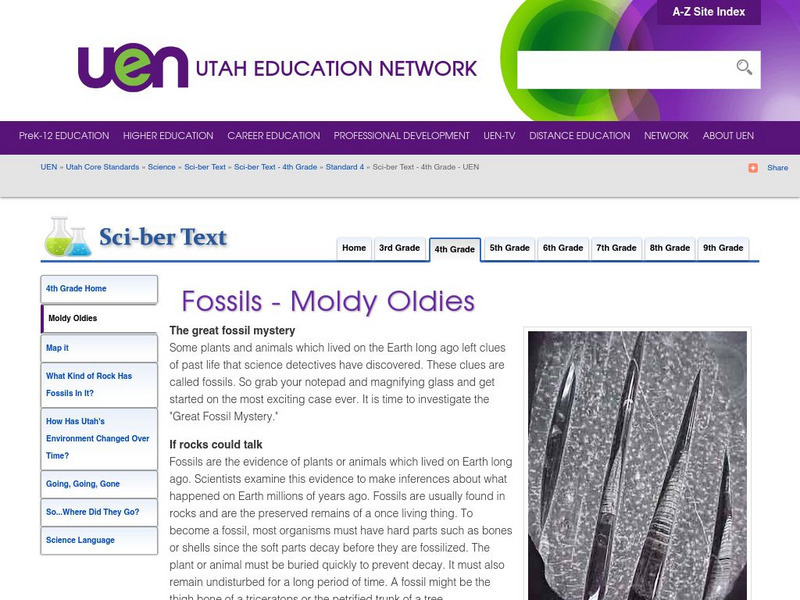
Utah Education Network
Uen: Fossils Moldy Oldies
A good introduction to different types of fossils and how they form. There are also directions for making three different models of fossils.
Utah Education Network
Uen: Animal Adaptations
In this engaging site, adaptations are defined and then a list of animals are provided along with adaptation-related questions to answer. Links to the animal sites are included.
Utah Education Network
Uen: Landforms in a Tub
For this activity, students create models in a tub or sandbox that simulate erosion caused by weathering.
Utah Education Network
Uen: Trb 3:1: Investigation 4: Day and Night
A lesson for third graders in which they learn about the rotation of the Earth on its axis and how this movement creates day and night. They also examine the orbit of the moon about the Earth and the Earth's orbit around the sun.