Hi, what do you want to do?






MENSA Education & Research Foundation
It’s Greek to Me: Greek Mythology
Designed as extension exercises in homeschool or classroom settings, as well as for individual work, the ideas in this packet are sure to engage learners in an investigation of Greek mythology.

Curated OER
Astronomy
Students complete a unit of lessons on our solar system, its stars, and astronomers. They record information in a space journal, design constellations, define key vocabulary, observe the phases of the moon, and create a group planet...

Curated OER
Our Solar System
Students study the Earth and Solar System through a variety of activities. They compile a coloring book show the characteristics of the Sun and nine planets.

Curated OER
Our Universe: Always Moving, Always Changing
Students explore the main concepts of astronomy through the eleven lessons of this unit. The past, present, and future methods of studying the science are examined in this unit.
CK-12 Foundation
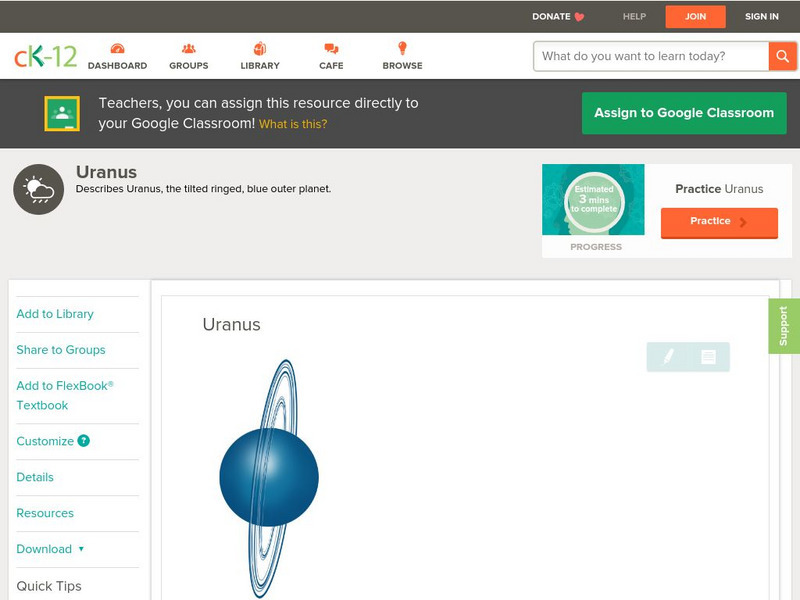
Ck 12: Earth Science: Uranus
[Free Registration/Login may be required to access all resource tools.] Describes the features of Uranus.
CK-12 Foundation
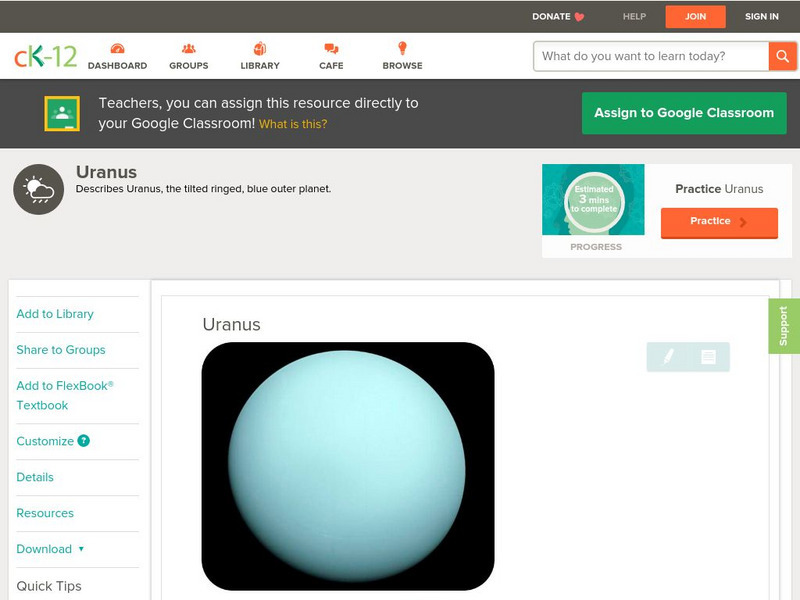
Ck 12: Earth Science: Uranus
[Free Registration/Login may be required to access all resource tools.] Describes the features of Uranus.
Georgia Department of Education
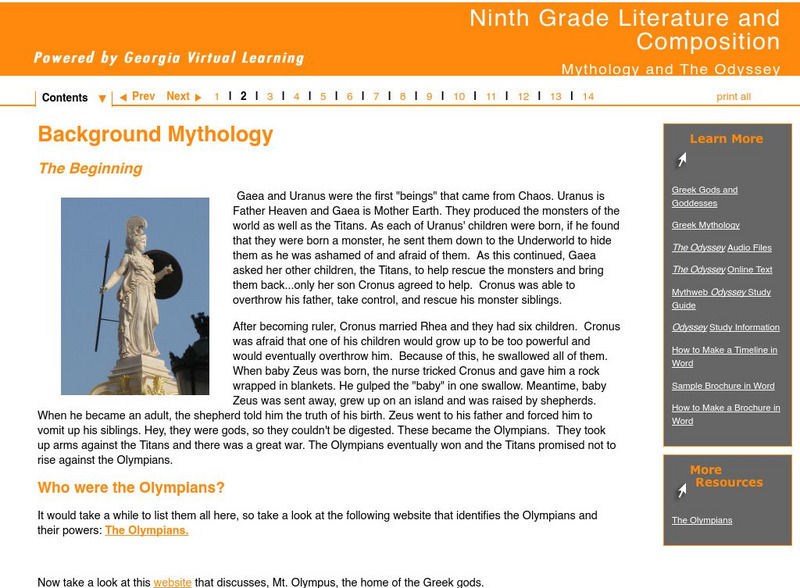
Ga Virtual Learning: Mythology and the Odyssey: Background Mythology
This lesson focuses on the story of the beginning of Greek Mythology. It tells the story of Uranus (Father Heaven) and his wife Gaea (Mother Earth) and their childen the Titans and the monsters. It follow the story through Zeus and the...
Scholastic
Scholastic: Study Jams! Science: Our Solar System: Outer Planets
A slideshow and a short multiple-choice quiz on the four outer planets of our solar system, which include Jupiter, Saturn, Uranus, and Neptune.
Georgia Department of Education
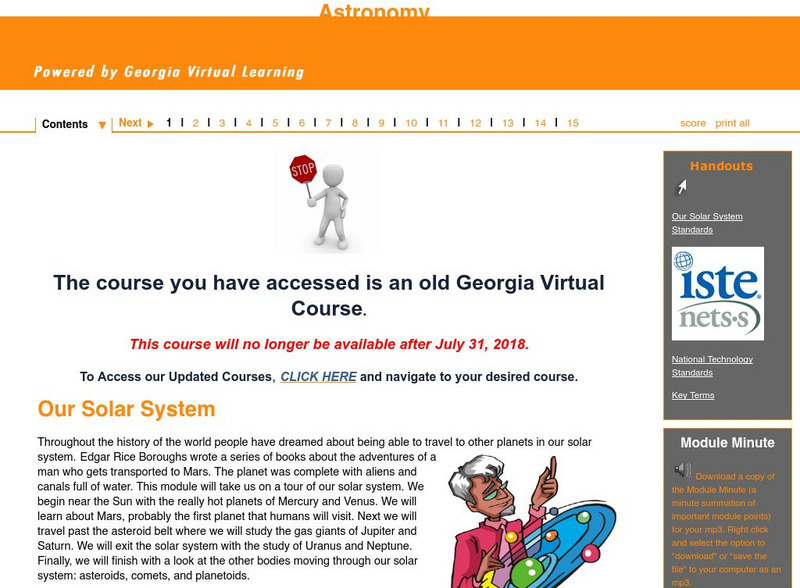
Ga Virtual Learning: Our Solar System
This interactive tutorial will take students on a tour of our solar system. Students begin near the Sun with the really hot planets of Mercury and Venus. They will learn about Mars, probably the first planet that humans will visit. Next...

Wonderville Media
Wonderville: Planets
There are eight planets in orbit around our Sun. These planets form our solar system. The eight planets are Mercury, Venus, Earth, Mars, Jupiter, Saturn, Uranus, and Neptune. There are also rocks, moons, comets, and other objects going...

Texas Education Agency
Texas Gateway: The Sun Is the Center of the Solar System
See what you know about the solar system by taking this brief interactive quiz and learning module.
NASA
Nasa: Solar System
This resource provides a general overview of all the planets in the solar system, as well as the sun, various comets and asteroids, the deep space network, and the latest solar system news.
NASA
Nasa: Solar System Exploration
Enter our solar system to interact with the planets, moons, asteroids, meteors, and more. Investigate with NASA scientists and explore missions related to space exploration. Read facts, compare statistics, look through resources, and...
NASA
Nasa: Space Place: Messenger: Planet Mass Comparison
Compare the masses of planets in this interactive animation. Simply pile a number of Earths on one side of the scale, to balance with the mass of one Jupiter. Then try this with all the planets.
NASA
Nasa: The Space Place
This site from NASA's Space Place is geared towards early elementary learners. It offers detailed instructions for crafts and activities related to space, games and a teacher resource area. Students can also ask an expert at this site.
Other popular searches
- Saturn and Uranus
- Uranus and Neptune
- Uranus Planet
- Closest Planet to Uranus
- Uranus Video
- 15 Moons of Uranus
- Imf on Uranus
- Uranus in Greek Mythology
- Imfo on Uranus
- Uranus Colour
- Uranus Co Lour
- Uranus Distance From Sun