Hi, what do you want to do?






Center For Civic Education
Center for Civic Education: Constitution Day and Citizenship Day
September 17 is recognized in the United States as Constitution Day and Citizenship Day. The purpose of Constitution Day and Citizenship Day is to commemorate the creation and signing of the supreme law of the land and to honor and...
National Endowment for the Humanities
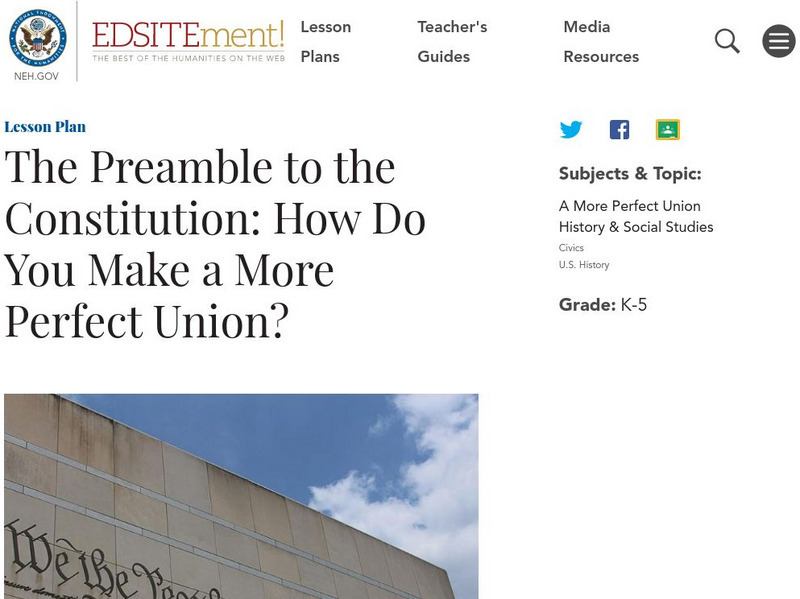
Neh: Edsit Ement:the Preamble to the Constitution
These step-by-step lesson plans help students understand the historical background to the U.S. Constitution. Students simulate a hypothetical situation where they must create their own rules and figure out how to work together. Links to...

Constitutional Rights Foundation
Constitutional Rights Foundation: The u.s. Supreme Court: Fdr Tries to "Pack" the Supreme Court
Lesson and activity in which students learn about the importance of the Supreme Court, balance of power, and judicial reform.
Bill of Rights Institute
Bill of Rights Institute: The Stolen Valor Act and False Speech
A lesson plan, including an extension opportunity, addressing whether the Stolen Valor Act violates the First Amendment to the U.S. Constitution.
Constitutional Rights Foundation
Constitutional Rights Foundation: The United States and the Barbary Pirates
Lesson and activity in which students analyze foreign policy challenges on paying ransom. Students study U.S. response to the Barbary pirates and apply their knowledge to modern day terrorism and foreign policy examples.
Constitutional Rights Foundation
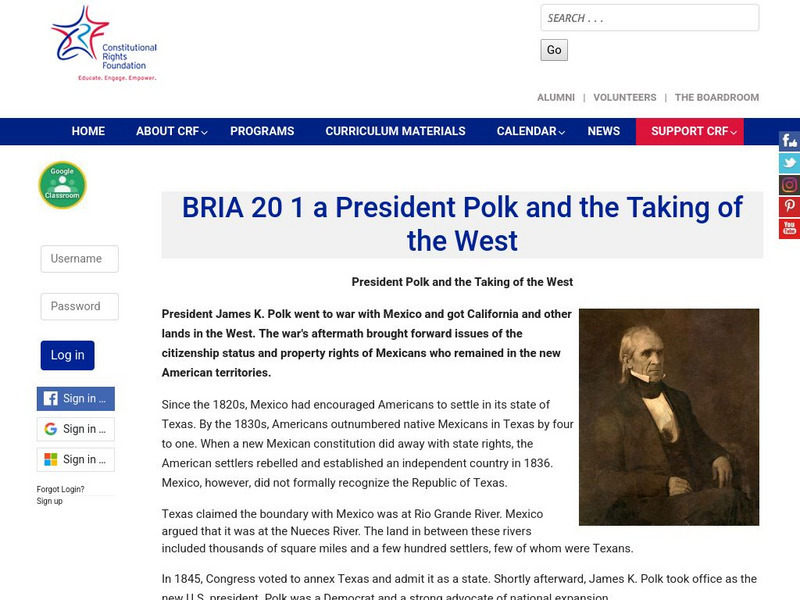
Constitutional Rights Foundation: Conflict of Cultures: President Polk and the Taking of the West
Lesson and activity on conflict of cultures in which students study U.S. overtaking lands of Mexico and California and form policy on property rights and citizenship of conquered cultures. Activity guidelines, questions for discussion...
The Dirksen Congressional Center
Congress Link: Lesson Plans
The Dirksen Congressional Center provides abundant lesson plans on all aspects of the US Congress and the US Constitution. All lessons contain time frames, objectives, and links to material, and are built around Bloom's taxonomy.
Center For Civic Education
Center for Civic Education: Independence Day: Fundamental Ideas About Government
In this lesson, students will examine some of the fundamental ideas about government that is contained in the Declaration of Independence and the Preamble to the U.S. Constitution. When the lesson is completed, students should be able to...
PBS
Pbs News Hour: Getting to Democracy, Lesson Plan
With the end of major military action in Iraq, what obstacles do the people of Iraq and the coalition face in rebuilding their country? With this lesson, students will compare what is happening in Iraq to what happened after World War II...
Bill of Rights Institute
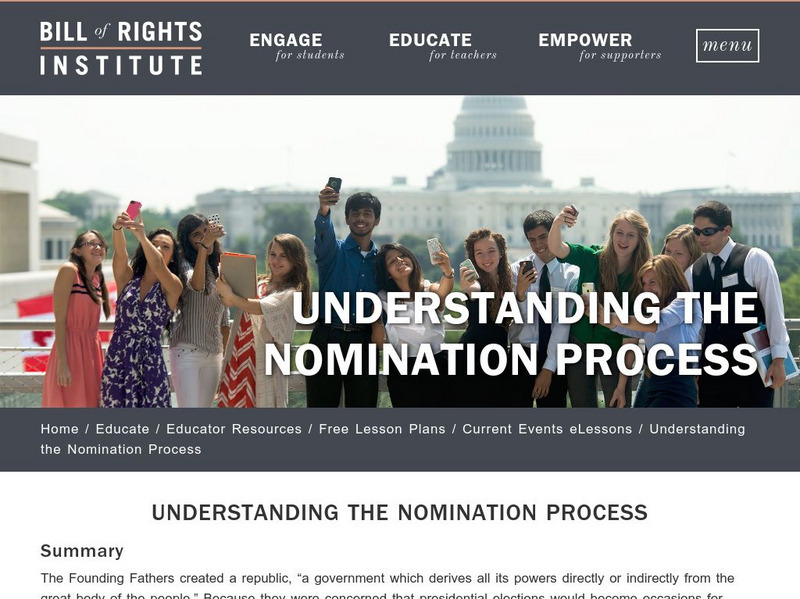
Bill of Rights Institute: Understanding the Nomination Process
From its conception in the United States Constitution, to necessary adjustments in the 12th Amendment, students will understand the nomination process and role of political parties in establishing a president with the aid of this lesson.
University of Nebraska Omaha
Ec Ed Web: How Has the Constitution Shaped the Economic System in the Us?
This lesson plan deals with how the U.S. Constitution has shaped our economic system. Provides standards, objectives, and materials.
iCivics
I Civics: Gibbons v. Ogden (1824)
This mini-lesson covers the basics of the Supreme Court's decision that interpreted the Commerce and Supremacy Clauses of the U.S. Constitution and affirmed the federal government's superiority with regard to its enumerated powers....
US National Archives
Nara: Teaching With Documents: Anti Railroad Propaganda Poster
From the National Archives and Records Administration site, this lesson, focusing on a poster circulated in Philadelphia in 1839 to discourage the coming of the railroad, relates to the struggle to define the powers of the national and...
PBS
Pbs Learning Media: Point of View: Who, Me? Biased?: Understanding Implicit Bias
In this interactive lesson plan, learners explore the extent to which society (and they themselves) may discriminate based on factors they're not even aware of, implicit biases. Why haven't laws been enough to eliminate discrimination?...

Khan Academy
Khan Academy: Ap Us History Period 3: 1754 1800: The American Revolution
This Khan Academy resource provides video lessons, detailed notes, and practice questions for the AP U.S. History Exam. The years 1754-1800 are covered.