Hi, what do you want to do?






Teach Engineering
Clay Boats
Clay itself sinks, but clay boats float. Why? Young engineers build clay boats to learn about buoyancy. They test the weight the boats can hold using washers and then tweak their designs to make improvements, following the engineering...

Teach Engineering
What Floats Your Boat?
Clay's as good a material as any to build a boat, right? An introductory instructional activity sets the stage for two activities associated with buoyancy. The first involves building boats out of clay, while the second uses these boats...

Curated OER
Inventions Change the World: The Enigma Machine
Third graders explore WWII by analyzing technological advances. For this invention lesson, 3rd graders discuss the use of the Enigma machine which decoded private German messages that communicated with U-boats. Students utilize a...

Institute of Electrical and Electronics Engineers
Fun with Speedboats!
After reading about marine engineers and naval architects, it's all hands on deck to design and test a speed boat. This lesson is designed for the Next Generation Science Standards in engineering and can be a centerpiece for a STEM...

Institute of Electrical and Electronics Engineers
Sail Away
Students examine what naval architects and marine engineers do. For this engineering lesson students work in teams and design a boat with a sail structure.

Curated OER
Boy Scout Badge: Small-Boat Smalling
In this Boy Scout Badge activity worksheet, students complete a form of required information in order to obtain the small boat sailing badge.

Curated OER
Transportation
In this transportation worksheet, students list the positive and negative aspects of different types of transportation. Students keep a diary of the different ways they used transportation for a week. This worksheet has 7 graphic...

Curated OER
Row, Tow, Pull Your Boat
Third graders use previous knowledge and research to analyze and solve a scenario relating to the use of simple machines and the Lewis and Clark Expedition. They present their findings to the class in oral presentations.

NASA
Space Shuttle Glider
Your charges will enjoy putting together this model of the space shuttle and completing the three challenge activities described in the lesson. The worksheets embedded in the plan that pupils use to cut out their gliders are beautifully...

Curated OER
Rollin' on the River: The McClellan-Kerr Arkansas River Navigation System
Middle schoolers take a close look at the McClellan-Kerr Arkansas River Navigation system. They study how the Army Corps of Engineers built and monitor the system. Learners discover how a lock and a dam work, and study three benefits of...

Curated OER
National Marine Sanctuaries Shipwrecks
Junior oceanographers access the Channel Islands National Marine Sanctuary Shipwreck Database and plot the locations of several shipwrecks. Shipwrecks are always an enthralling subject and this activity allows your learners to act as...

Global Oneness Project
Resiliency Among the Salmon People
Is losing cultural traditions the cost of social progress, or should people make stronger efforts to preserve these traditions? High schoolers watch a short film about the native Yup'ik people in Alaska and how they handle the shifts in...

Curated OER
Map that Habitat
Learners participate in an activity that replicates the creation of sea floor bathymetry by taking a simplified form of soundings in the classroom. They discuss sea floor mapping technologies, sonar, soundings, and remote sensing,...

Teach Engineering
Machines and Tools (Part 2)
Which pulley system will give us a whale of a good time? Teams compare the theoretical and actual mechanical advantages of different pulley systems. They then form a recommendation for how to move a whale from an aquarium back to the ocean.

Curated OER
Indian River Lagoon
In this science worksheet, students complete 7 sentences about the Indian River Lagoon. Students also locate 12 words in an estuary word search.

Curated OER
TE Activity: Pulley'ing Your Own Weight
Young scholars experiment with common objects such as spools, string and soap to determine how pulleys make it easier to move large objects. They look at the difference between fixed and movable pulleys. They examine the many uses...

Curated OER
Sea Level and the Terrapin
Students study the habitat of the terrapin. In this terrapin instructional activity, students create a diorama of the habitat of the terrapin. Students also simulate how it would look if people moved into the area and how predators can...

Curated OER
Ocean Word Search
In this environment instructional activity, students find the words related to the life found in the ocean and the answers are found by clicking the button at the bottom of the page.

Curated OER
How’s the Weather?
In this weather worksheet, students unscramble weather words that describe features of the weather. An answer key and website reference for additional resources are included.

Curated OER
User-friendly rivers
Young scholars explore and explain their connection to rivers through watersheds. They break into three groups. Each group needs: Blue enamel paint, Miniature objects to simulate a model river system, modeling clay, Tempera paint,...

Curated OER
Could a World of Swimmers Raise Sea Level?
Students determine the volume of water they displace. In this earth science instructional activity, students calculate the total water displaced by the world's population. They evaluate whether or not this value is enough to raise the...

Curated OER
Can You Make A Penny Float?
Students explore the concept of density by trying to make a penny and other materials float.
Other
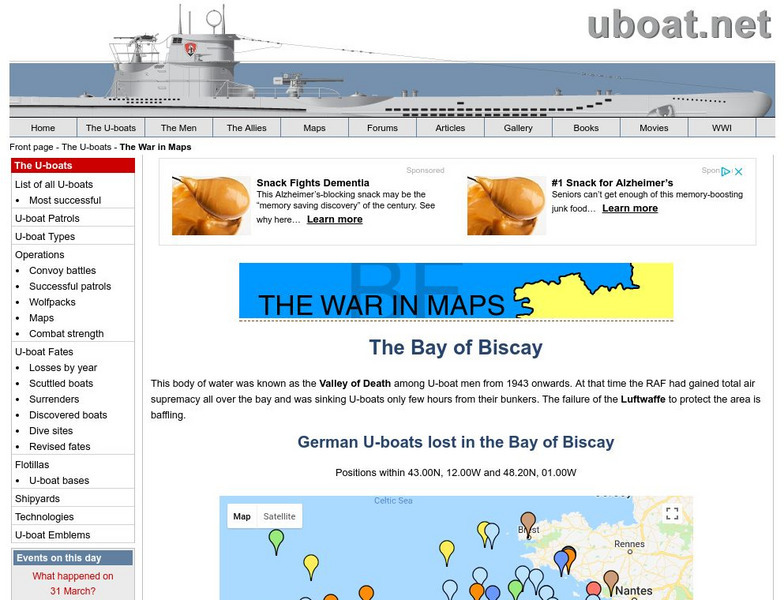
Uboat.net: The Bay of Biscay
This site from Uboat.net provides information about the sunken U-boats of 1939-1945 in the Bay of Biscay.
Other
Center for Alaskan Coastal Studies
This site advocates education through experience in the field. It offers hiking and boating tours, as well as teacher resources.