Independence Hall Association
U.s. History: The Impact of Slavery
See how the ideals of freedom and equality garnered from the American Revolution were reflected in the early abolitionist movement and the banning of slavery in many Northern state constitutions as the new country was forming.
US National Archives
Docsteach: Benjamin Franklin: Politician and Diplomat
In this activity, students will review and analyze the founding documents of the United States and understand Benjamin Frankin's contributions and connections to these founding documents. Franklin was the only man to help shape all of...
The Dirksen Congressional Center
Congress for Kids: Amendments
Read a brief synopsis of the Amendments to the Constitution and then complete the matching activity by clicking on the link at the bottom. Includes other links in the section titled "play more" at the bottom of the second page.

University of Minnesota
University of Minnesota: Rochin v. California (1952)
This page provides the background of the case and the Supreme Court's decision.
Independence Hall Association
U.s. History: Constitution Through Compromise
Read about how compromises were reached at the Philadelphia convention that dealt with issues between large and small states, and slave and free states. Take the quick quiz to assess knowledge about the writing of the Constitution.

Oswego City School District
Regents Exam Prep Center: Introduction to u.s. Government
Explore the ideas and principles of American government including its influences, foundation, and basic tenets (such as checks and balances and federalism).

Ducksters
Ducksters: Us Government for Kids: Constitution Amendments
Kids learn about the amendments in the United States Constitution. Seventeen not included in the Bill of Rights of the twenty-seven total.

Ducksters
Ducksters: Us Government for Kids: United States Bill of Rights
Kids learn about the Bill of Rights of the United States government. The first 10 amendments to the Constitution.
Other
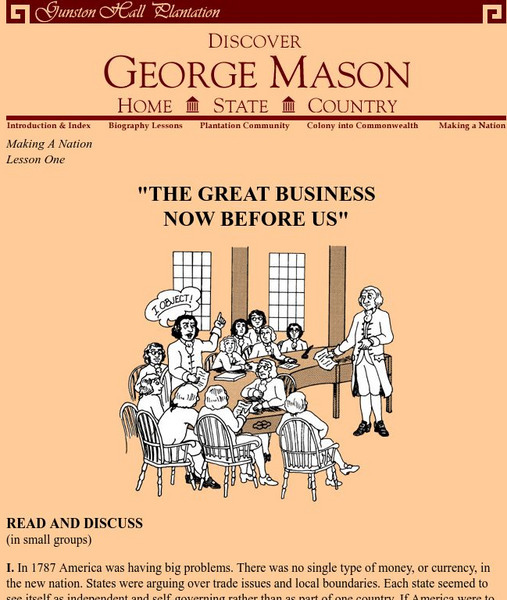
Gunston Hall Plantation: "The Great Business Now Before Us"
In 1787, America was having big problems. There was no single type of money, or currency, in the new nation. States were arguing over trade issues and local boundaries. Each state seemed to see itself as independent and self-governing...
Siteseen
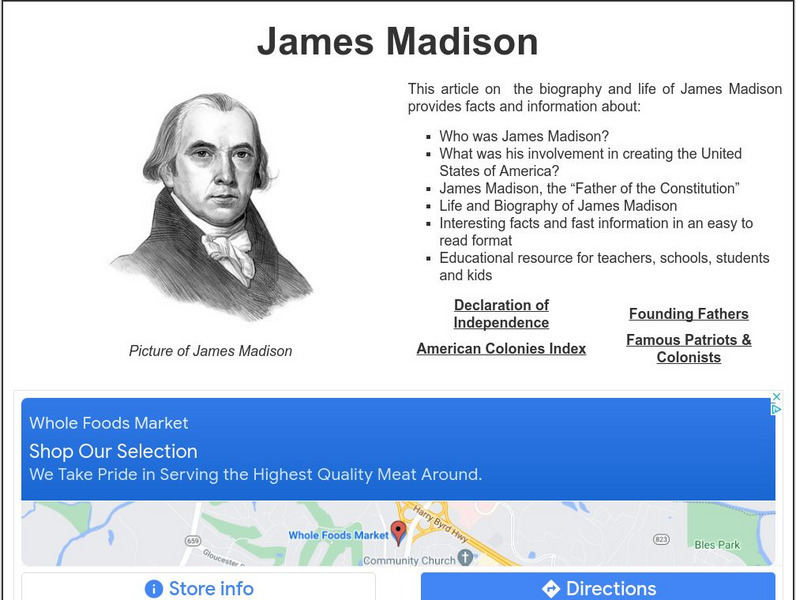
Siteseen: Land of the Brave: James Madison
Overview and biographical facts on the life of James Madison, the "Father of the Constitution".
Siteseen
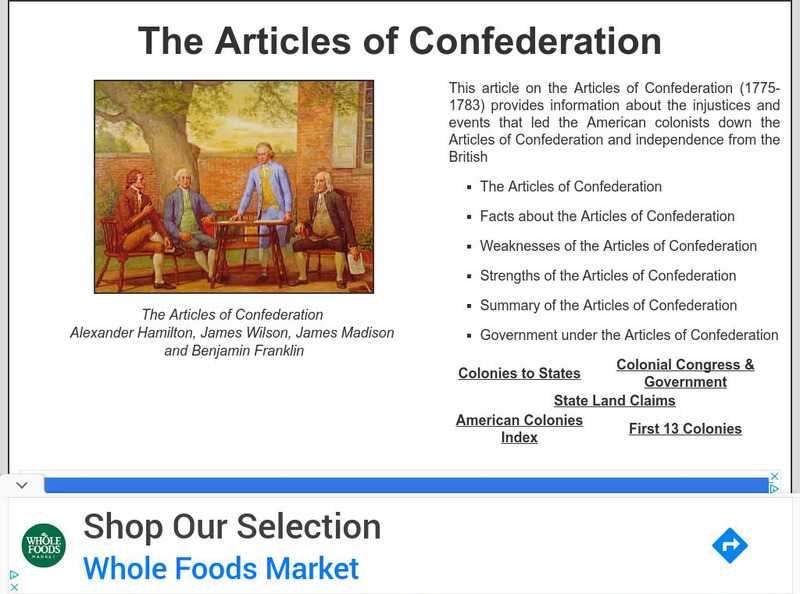
Siteseen: Land of the Brave: The Articles of Confederation
This article summarizes the Articles of Confederation, its strengths and weaknesses, and how it led to the Constitution.
Thomson Reuters
Find Law: Article Iii: Organizations of Court, Tenure, & Compensation
This resource covers Article III, Section 1, which focuses on the judicial branch of the United States government.
Thomson Reuters
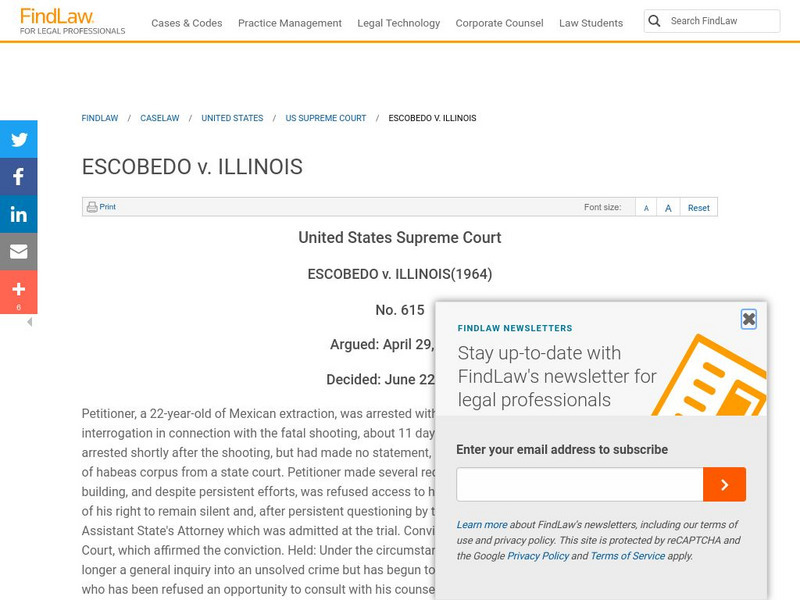
Find Law: u.s. Supreme Court: Escobedo v. Illinois (1964)
A detailed description of the United States Supreme Court decision on the appeal of the case Escobedo v. Illinois, which ruled on the right to have counsel under the 6th and 14th Amendments to the Constitution.
Thomson Reuters
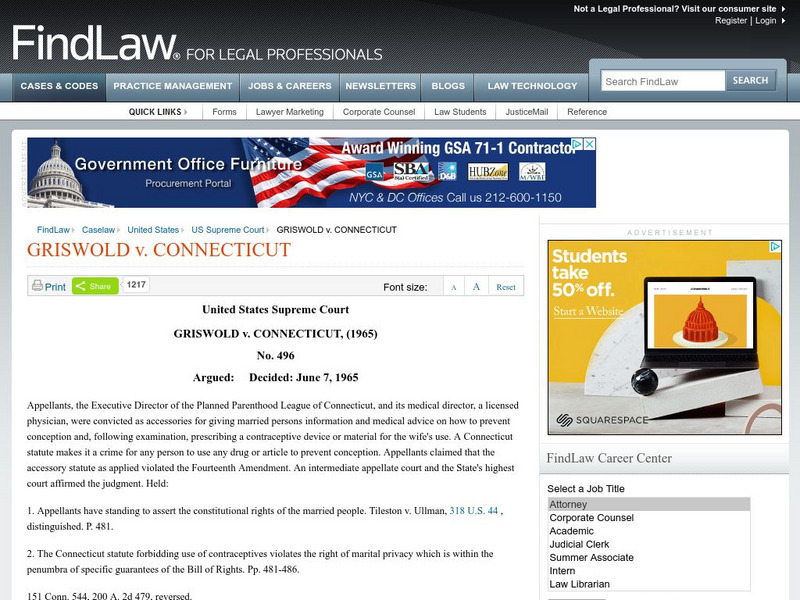
Find Law: u.s. Supreme Court: Griswold v. Connecticut (1965)
This Supreme Court case dealt with the issue of contraception. View the the Supreme Court opinion as delivered by Justice Douglas.

Thomson Reuters
Find Law: u.s. Supreme Court: Escobedo v. Illinois (1964)
This provides the full text of the oral argument and also links to cases citing the Gideon case in the Supreme Court and Circuit court levels.
Other
Touro Law Center: William Marbury vs. James Madison
Transcript of the landmark court case that established the constitutional principle of judicial review. Judicial review is the concept that the federal judiciary has final power as to whether an act of the Congress or the Executive...
Schools of California Online Resources for Education
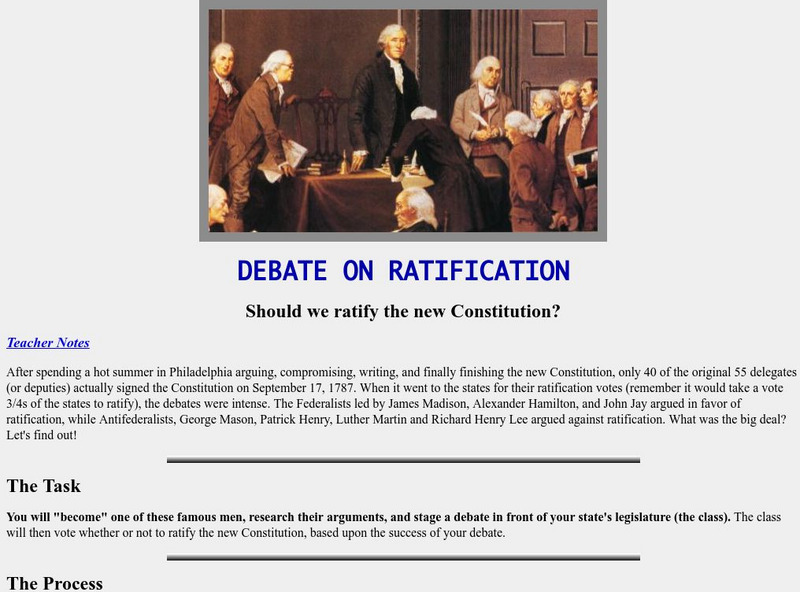
Score: Debate on Ratification
Students become one of the famous men who argued for or against ratification of the Constitution. They research and present their argumets to the class, who will then vote whether or not to ratify the new Constitution.
Thomson Reuters
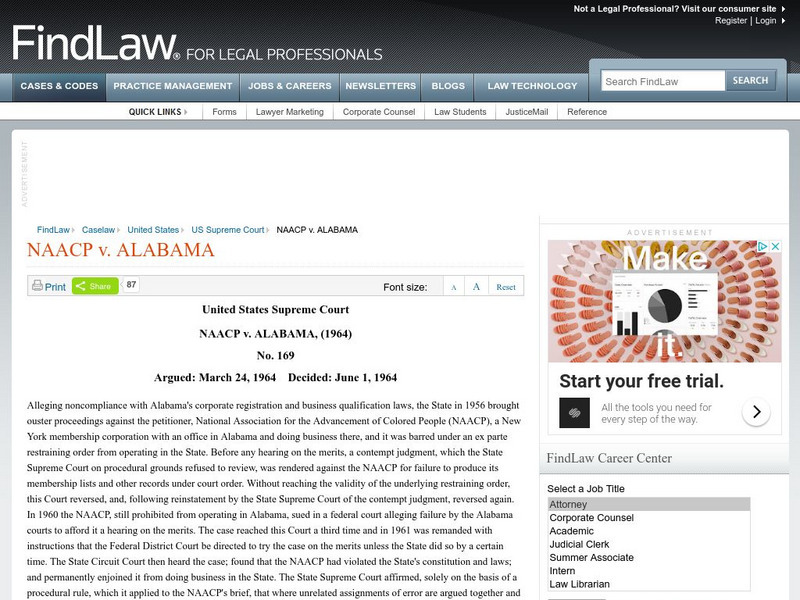
Find Law: u.s. Supreme Court: Naacp v. Alabama (1958)
Use this site to learn about this Supreme Court decision delivered by Justice Harlan in 1958 that dealt with the NAACP conducting business in Alabama and failure to reveal its membership lists.

Thomson Reuters
Find Law: u.s. Supreme Court: Mapp v. Ohio (1961)
Detailed account of the Supreme Court case of Mapp v. Ohio with the ruling that states are required to exclude evidence seized by illegal search and seizure in violation of the 4th Amendment.
Thomson Reuters
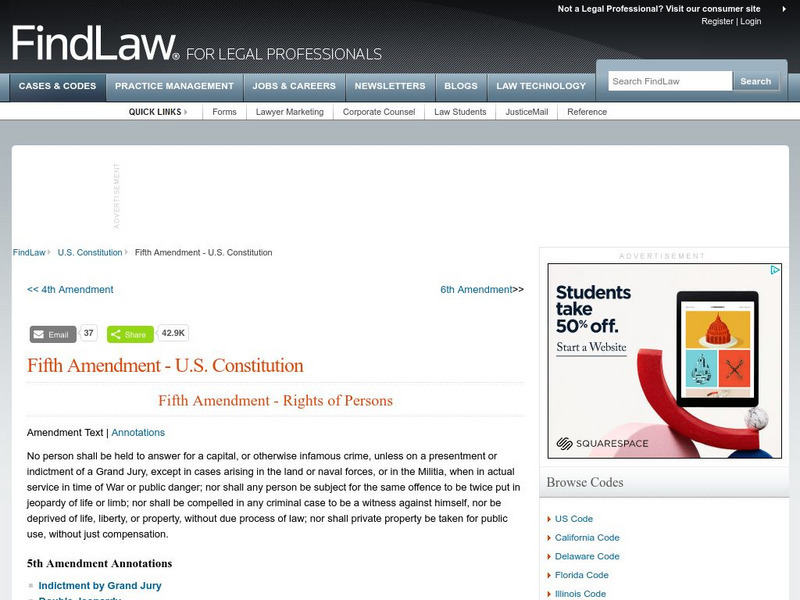
Find Law: Fifth Amendment
This resource provides both the text of the amendment and annotations as explanation of various words and phrases.

ClassFlow
Class Flow: Government Glossary
[Free Registration/Login Required] In this lesson Activotes are used to access student's prior knowledge of the principles of the US constitutional government. Student knows the essential principles stated in the US Constitution-...
Other
Justia: Hollingsworth v. Perry
The California Supreme Court held that limiting marriage to opposite-sex couples violated the California Constitution; state voters then passed a ballot initiative, Proposition 8, amending the state constitution to define marriage as a...
Other
U.s. Supreme Court: Miranda v. Arizona, 384 u.s. 436 (1966)
A complete and in-depth history of the 1966 U.S. court case of Miranda v. Arizona.
Curated OER
National Park Service: Andrew Johnson National Historic Site
The "Constitutional President," Andrew Johnson lived in this Tennessee historic site for 24 years. Peruse the history, culture, and photographs about the 17th president of the United States. Educators can take advantage of resources....
Other popular searches
- Amending the Us Constitution
- Forming the Us Constitution
- The Constitution of the Us
- Framing the Us Constitution
- Constitution of the Us