
SMART Technologies
Smart: Thirteen Colonies
Students will drag the name of each colony onto the map. Then drag the color coded stars to the New England, Middle, and Southern Colonies. Lastly, they will drag the important events to the colony in which it happened.
University of Groningen
American History: Outlines: The Colonial Period
The early settlers to the New World began to map strategy for their own system of government. This site details that strategy and what kinds of events spawned the idea of representative government.
University of Groningen
American History: Outlines: Second Generation of British Colonies
The religious and civil conflict in England in the mid-17th century limited immigration, as well as the attention the mother country paid the fledgling American colonies. In part to provide for the defense measures England was...
Read Works
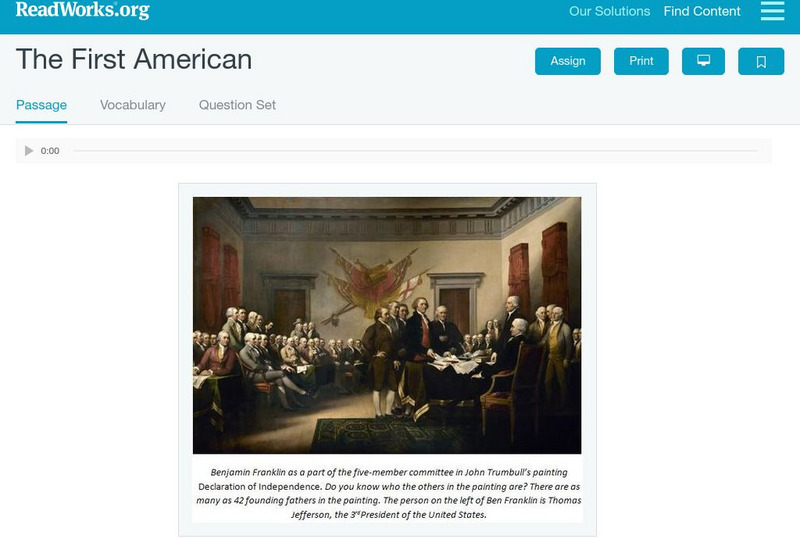
Read Works: The First American
[Free Registration/Login Required] This passage contains information on Benjamin Franklin and his earning of the title "First American" nickname. This passage is a stand-alone curricular piece that reinforces essential reading skills and...

Siteseen
Siteseen: Land of the Brave: Middle Colonies
Article on the Middle Colonies provides facts on religion, history, economy, and government of Pennsylvania, Delaware, New York, and New Jersey.
University of Groningen
American History: Outlines: The Land Is Settled
A brief look at the founding of the English colonies. This site is provided for by the University of Groningen.
University of Groningen
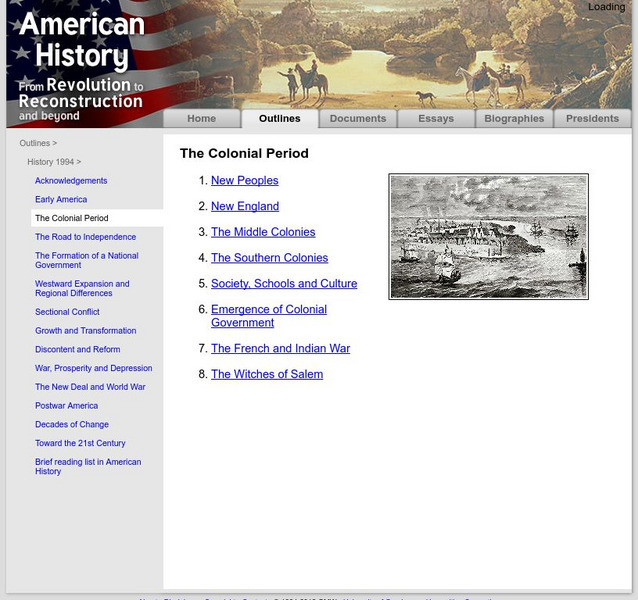
American History: Outlines: The Colonial Period
A brief discussion of the colonial period in the United States. Includes information on New England, the middle colonies, and the southern colonies. Also, find out about the early government, and the French and Indian War.
PBS
Wnet: Thirteen: Interactive Map: Manhattan in 1609: Dutch New York
Explore Dutch New York through this historical interactive map and learn what wildlife, landscape, and people lived there in 1609 compared with today. Click on 'Interactives' for additional resources, e.g., a 1626 letter from Peter...
PBS
Wnet: Thirteen: Freedom: A History of the u.s. Independence Webisode 1
Webisode 1-Independence. The history of the United States is presented in a series of webisodes, within each are a number of segments.Included are links to lesson plans, teacher guides, resources, activities, and tools.

Siteseen
Siteseen: Land of the Brave: Triangular Trade
Article on triangular trade in Colonial America explores routes (England to Africa to the Americas and back to England), the exchange of goods, and Slave Trade. A chart shows the goods traded by the Thirteen Colonies.

Siteseen
Siteseen: Land of the Brave: Salutary Neglect
Salutary neglect was a long-standing British policy in the thirteen colonies which allowed the colonists to flout, or violate, the laws associated with trade. There were no effective enforcement agencies and it was expensive to send...
Other
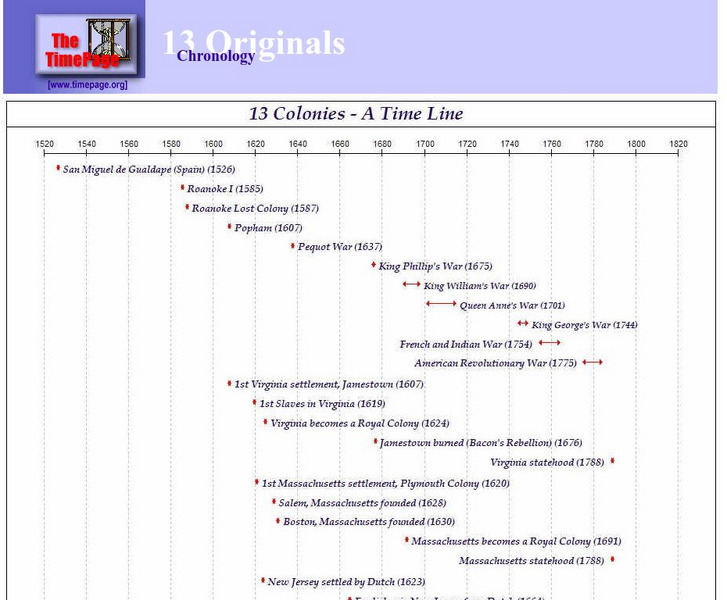
Time Page: 13 Colonies: A Timeline
This is a great timeline that shows what happens in America between 1520 and 1788 when all the colonies have become states. Lots of events are listed.
Other
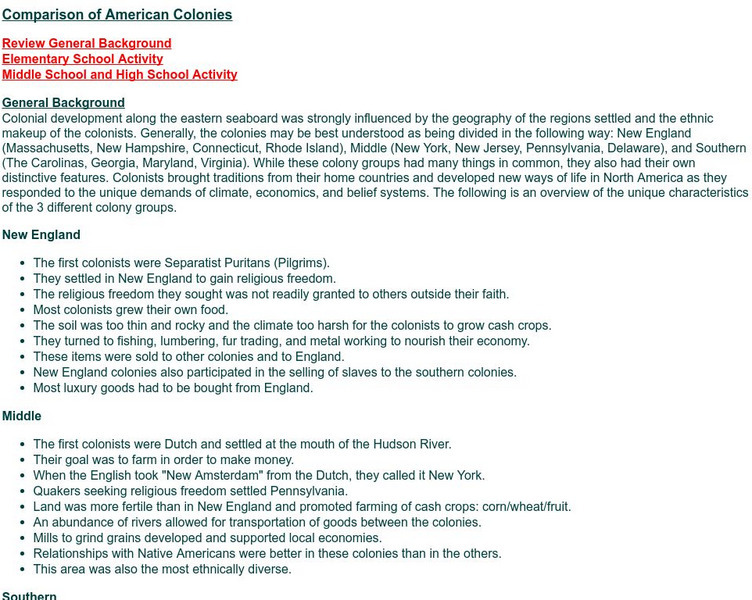
Sites Alive: Comparison of American Colonies
Lesson plan focuses on comparing and contrasting the unique characteristics of the original thirteen American colonies.
The History Place
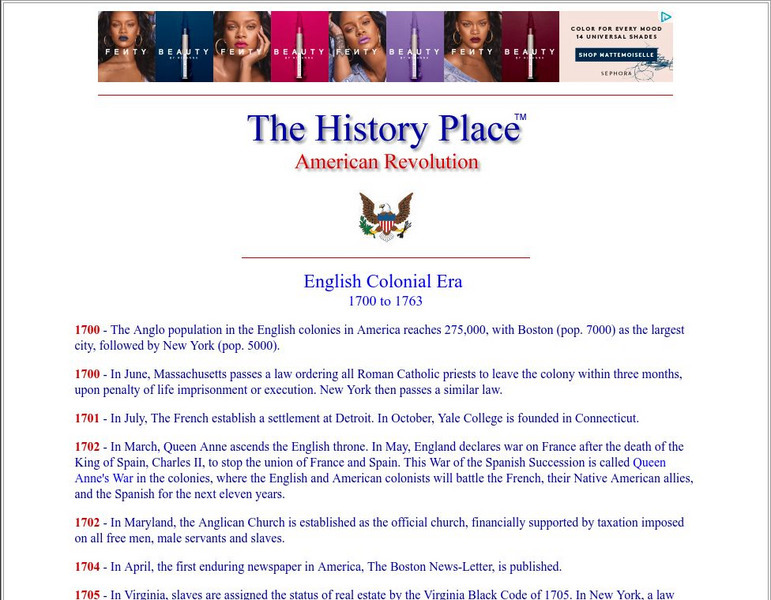
The History Place: English Colonial Era 1700 to 1763
This site from The History Place provides a timeline of important events that occurred in the United States during the early- and mid-18th century. The information provided is in-depth and worth checking out.

Library of Congress
Loc: American Revolution
The history of the American Revolution is the focus of this article. Divided into topics and time periods, it makes understanding this historical time easier for students for follow.

ClassFlow
Class Flow: 13 Colonies Map
[Free Registration/Login Required] This flipchart reviews the composition of the thirteen original colonies and asks students to identify the colonies on a map.
History Teacher
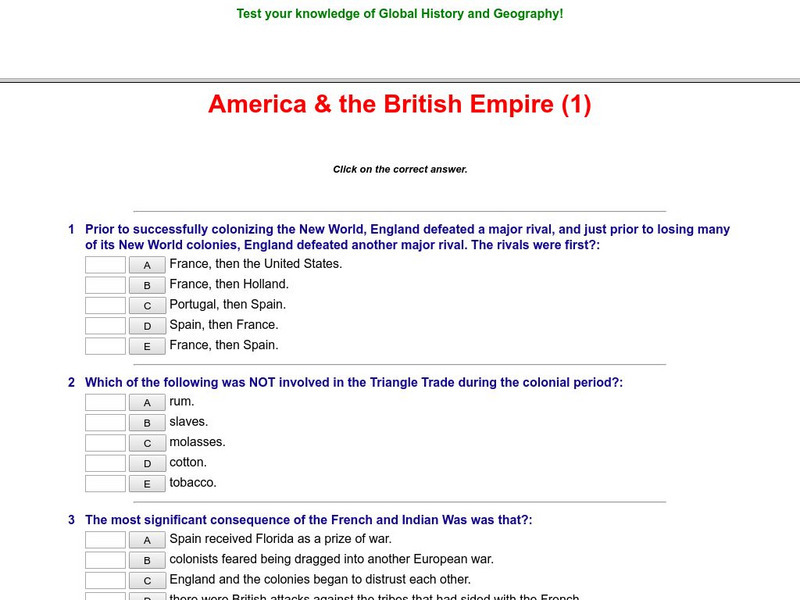
Historyteacher.net: America & the British Empire: Quiz (1)
10-question multiple choice quiz is scored immediately and covers the relationship between the American colonies and the British Empire.
Kidport
Kidport Reference Library: The British Colonies
A very brief description of the earliest English settlements in the New World followed by a list of the thirteen English colonies.
University of Groningen
American History: Outlines: New Peoples
Most settlers who came to America in the 17th century were English, but there were also Dutch, Swedes and Germans in the middle region, a few French Huguenots in South Carolina and elsewhere, slaves from Africa, primarily in the South,...
University of Groningen
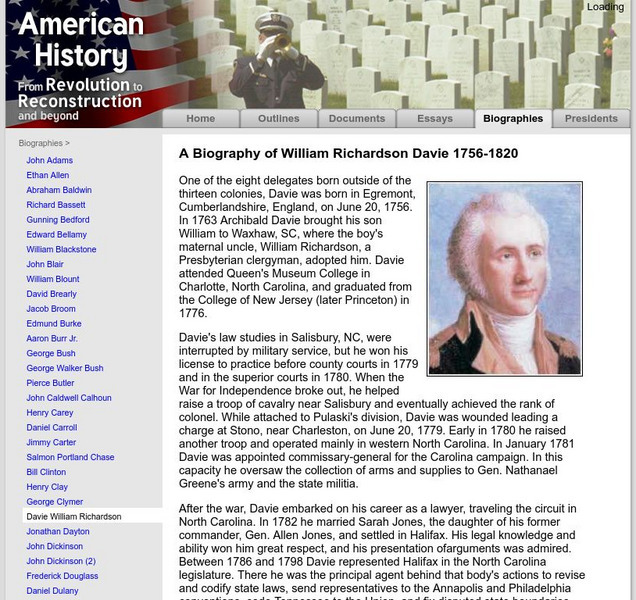
American History: Biographies: William Richardson Davie 1756 1820
One of the eight delegates born outside of the thirteen colonies, Davie was born in Egremont, Cumberlandshire, England, on June 20, 1756. In 1763 Archibald Davie brought his son William to Waxhaw, SC, where the boy's maternal uncle,...
Curated OER
Etc: Maps Etc: The Thirteen Colonies at the End of the Colonial Period, 1774
A map of the British Thirteen Colonies at the end of the colonial period in 1774. The map shows the boundaries of the colonies and notes the uncolored territory east of the Mississippi and south of the Great Lakes as claimed by Georgia,...
The Dirksen Congressional Center
Congress for Kids: Independence
Travel back in American history to the time of the thirteen colonies struggling to free themselves from the rule of the British monarch, and discover how the Declaration of Independence was created.

Siteseen
Siteseen: Government and Constitution: Preamble to the Constitution
This article contains the history, meaning, and words to the Preamble to the Constitution which encompassed the reasons why the thirteen original colonies separated from Great Britain to become an independent nation.

PBS
Wnet: Thirteen: Document: The Purchase of Manhattan Island 1626: Dutch New York
View this authentic letter written by Peter Schaghen documenting the acquisition of Manhattan Island for the Dutch from the Lenape Indians in 1626.