Hi, what do you want to do?





TeachEngineering
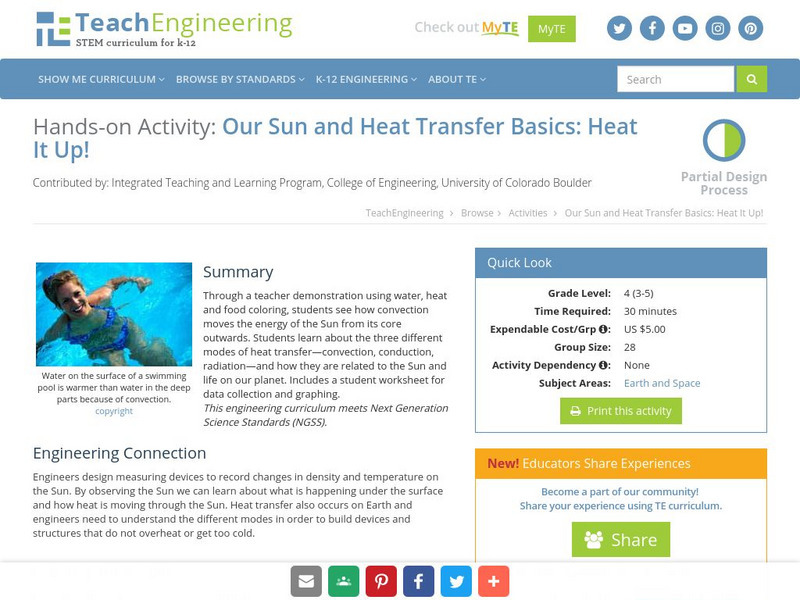
Teach Engineering: Heat It Up!
Through a teacher demonstration using water, heat and food coloring, students see how convection moves the energy of the Sun from its core outwards. Students learn about the three different modes of heat transfer (convection, conduction,...
TeachEngineering
Teach Engineering: Mercury and Venus
Students explore Mercury and Venus, the first and second planets nearest the Sun. They learn about the planets' characteristics, including their differences from Earth. Students also learn how engineers are involved in the study of...
Enchanted Learning
Enchanted Learning: The Earth's Atmosphere
The Earth's atmosphere is a thin layer of gases that surrounds the Earth. It composed of 78% nitrogen, 21% oxygen, 0.9% argon, 0.03% carbon dioxide, and trace amounts of other gases. This thin gaseous layer insulates the Earth from...
TeachEngineering
Teach Engineering: Blazing Gas
Students are introduced to our Sun as they explore its composition, what is happening inside it, its relationship to our planet (our energy source), and the ways engineers help us learn about it.

University Corporation for Atmospheric Research
Ucar: A Global Look at Moving Air: Atmospheric Circulation
Even with disruptions like weather fronts and storms, there is a consistent pattern to how air moves around our planet's atmosphere. This pattern, called atmospheric circulation, is caused because the Sun heats the Earth more at the...