Hi, what do you want to do?





University of Groningen
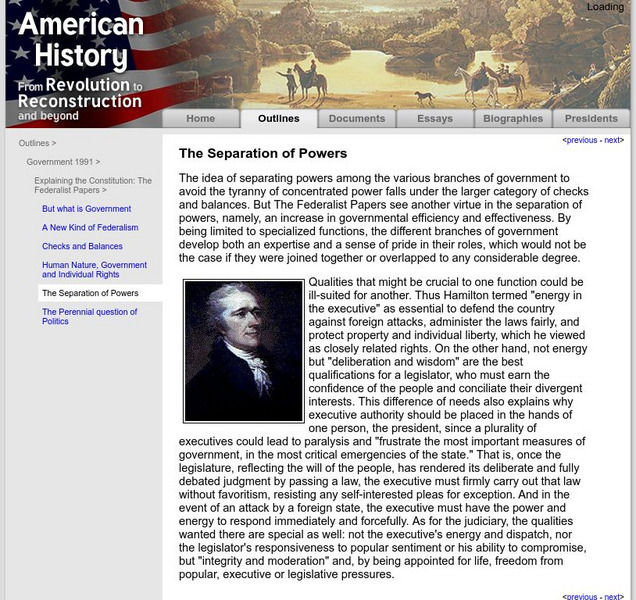
American History: Outlines: The Separation of Powers
Informative discussion of the ideas behind the Constitutional principle of Separation of Powers.

Harry S. Truman Library and Museum
Harry S. Truman Library & Museum: Three Branches of Government
Interactive teaching unit for Grades 5-8 that helps to explain the three branches of government and the the balance of power. Topics covered include balance of government, how a bill becomes a law, the amendment process, the Legislative...
Bill of Rights Institute
Bill of Rights Institute: The Defense of Marriage Act
A lesson plan addressing what happens when Congress passes a law or an act, but the law is unconstitutional.
US Government Publishing Office
Ben's Guide to u.s. Government: Constitution of the United States
Find background information on the Constitution of the United States of America, and learn the three basic principles upon which the Constitution was written. Additional content includes a look at the text of the Constitution, the events...

PBS
Pbs: How the Supreme Court Affects the Lives of Teens (Lesson Plan)
Objectives for this lesson include describing the structure and function of the Supreme Court, looking at important decisions, and discussing recent rulings and issues.
Digital History
Digital History: The Age of Constitution Writing [Pdf]
See how colonial and state constitutions differed and how the idea of a social contract between a government and its citizens is reflected in the state constitutions. The second half of this site gives an abbreviated text of the Articles...
TeachEngineering
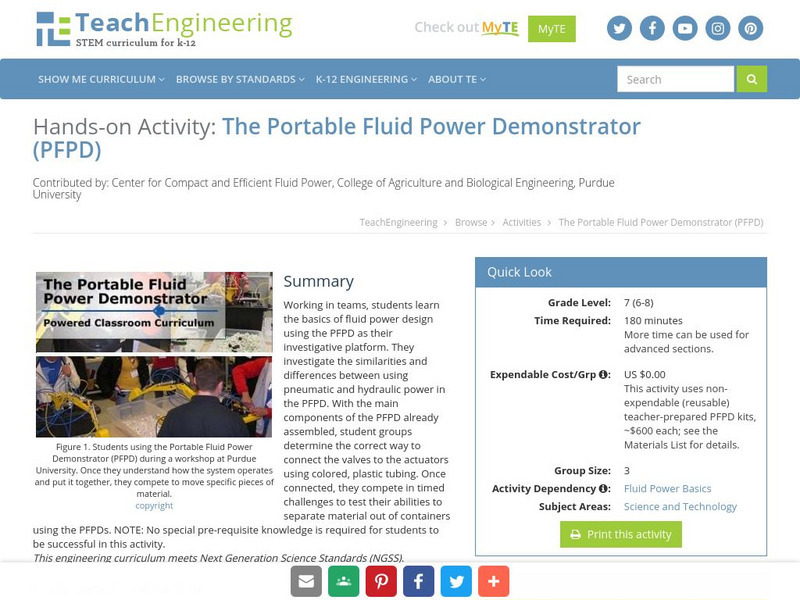
Teach Engineering: The Portable Fluid Power Demonstrator (Pfpd)
Working as teams, students learn the basics of fluid power design using the PFPD as their investigative platform. Students will investigate the similarities and differences between using pneumatic and hydraulic power in the PFPD. While...

ClassFlow
Class Flow: Constitution
[Free Registration/Login Required] This flipchart is an in depth Activote questionnaire relating to our Constitution. Students should understand the basic concepts of the Constitution, checks and balances, separation of powers, and...
C3 Teachers
C3 Teachers: u.s. History Module: Did Founders Want Government to Work? [Pdf]
A comprehensive learning module on the system of government established by the founders that includes three supporting questions accompanied by formative tasks and primary source materials, followed by a summative performance task....
Independence Hall Association
U.s. History: Malcolm X Amd the Nation of Islam
A brief biography of a leader for black power, Malcolm X. Read about his early life and conversion to the Nation of Islam. Find out what his goals were for blacks in America, and see how the means to the end was different from Martin...
Other
Bristol University: The Spirit of the Laws [Pdf]
This resource presents the complete text by the famous 18th century French economist (in English). In it, he advanced theories of democracy for the French monarchy. It is in PDF format and is a large file.
Indiana University
Center on Congress: Learn About Congress
Learn about the role of the US Congress, how it works, its history, and the principles behind its creation and operation. Wonderful set of resources including FAQs, short articles and video clips, "interactive learning modules" (i.e., a...

University of Groningen
American History: Outlines: The Federal Court System
Discussion of the structure, purpose, powers and Constitutional safeguards of the Federal Court System.

Cato Institute
Executive Orders and National Emergencies
The subtitle of this essay is "How Presidents Have Come to 'Run the Country' by Usurping Legislative Power." It discusses how the Constitution defines executive powers in a general way, with few limitations on the power of the President...
Annenberg Foundation
Annenberg Learner: Democracy in America: The Constitution: Fixed or Flexible?
This unit explores the timeless qualities of The U.S. Constitution, the opportunities to amend it, and how it is a pillar of the American identity, through these activities, videos, and outside resources.
University of Chicago
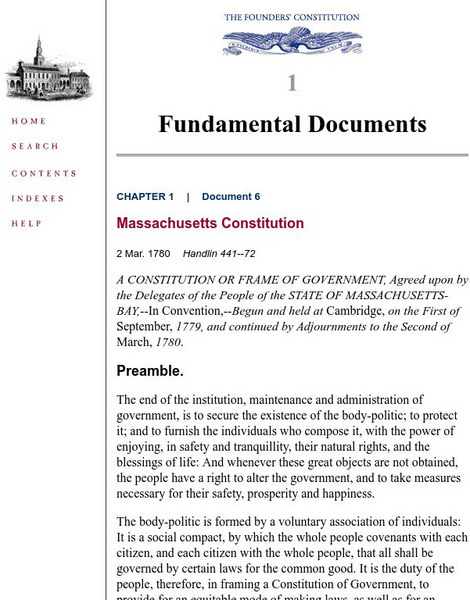
The Founders' Constitution: Massachusetts Constitution: 2 March 1780
The complete, original text of the Massachusetts State Constitution as adopted in March, 1780.
Bill of Rights Institute
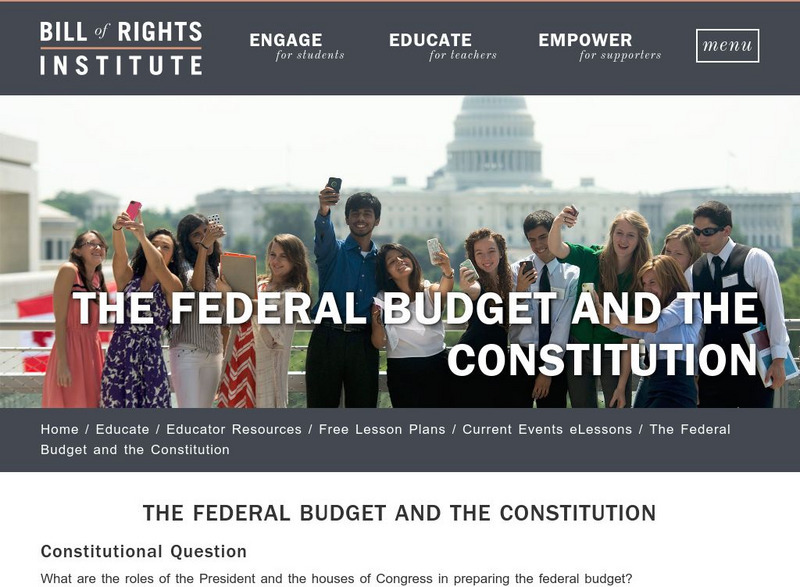
Bill of Rights Institute: The Federal Budget and the Constitution
What responsibilities belong to the U.S. President and the Congressional houses when it comes to establishing the federal budget? Take a look at these resources and incorporate this lesson into classroom learning.
Thomson Reuters
Find Law: Article Ii: Presidential Power to Use Troops
In-depth analysis of the use of presidential power to send troops abroad without consent of Congress.

Bill of Rights Institute
Bill of Rights Institute: Founding Principles
Below, you will find suggested definitions of each principle. Click here to read the words of James Madison, a primary contributor to the Constitution, and other Founders on these principles.
Independence Hall Association
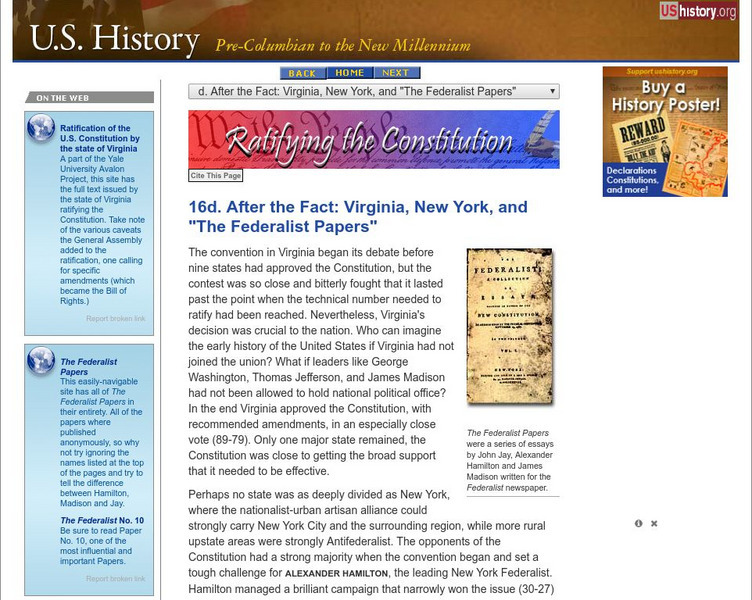
U.s. History: After the Fact: Virginia, New Yok, and "The Federalist Papers"
Read about the necessity for Virginia and New York to support the ratification of the Constitution. See what influenced the vote in Virginia and how the legislature of New York was finally convinced.
Energy4Me
Energy4me: Tower of Power
Young scholars will learn that heat is needed to separate crude oil/petroleum into useable substances to make the products we use every day.
Bill of Rights Institute
Bill of Rights Institute: Constitutional Principles
James Madison knew that a key challenge of maintaining just government was framing it in such a way that the government would be forced to control itself. How does a system of separated powers-and the checks and balances built into those...
Bill of Rights Institute
Bill of Rights Institute: Constitution of the United States of America (1787)
The Constitution was written in the summer of 1787 in Philadelphia, Pennsylvania, by delegates from 12 states, in order to replace the Articles of Confederation with a new form of government. It created a federal system with a national...
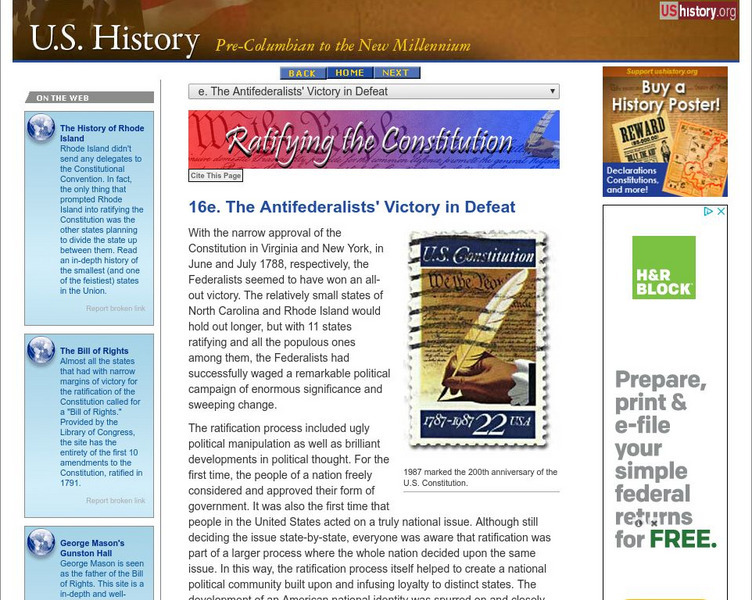
Independence Hall Association
U.s. History: The Antifederalists' Victory in Defeat
By 1788 eleven states ratified the Constitution, more than enough to put it into effect as the document establishing rules for the nation. Read about the goals of the Federalists in estabilishing a national government and find out how...