Hi, what do you want to do?






Curated OER
Find a Character, Tell a Story
Fourth graders choose a character from a magazine, complete a character sketch, and develop a short story placing this character in a situation. They utilize a worksheet imbedded in this plan which guides them through creating their...

Curated OER
Group Foraging
Young scholars explore co-operation by researching ocean life. In this fish science lesson, students identify many vocabulary terms associated with oceanography and discuss what group foraging means among fish. Young scholars utilize...

Curated OER
Geo-Vistas
Young scholars create a geometric cardboard sculpture covered with personal drawings.

Curated OER
Flowering Philanthropy
Students plant flowers for others. They care for flowers. They summarize experiences through drawing, discussions and writing.


Curated OER
Silly Nilly
Fourth graders create their own stories with a life lesson and illustrate them.

Curated OER
Encoded Meanings
Students explore symbols in art and complete related activities. In this art symbols lesson plan, students compare symbols they recognize to those of an African culture. Students create a collaborative work of art with symbols that have...

Curated OER
Visual Learning: A Slow, Press-ious Process
Young scholars observe a photograph and make inferences. In this investigative lesson students study how to find facts in pictures and draw inferences from them.
University of Washington
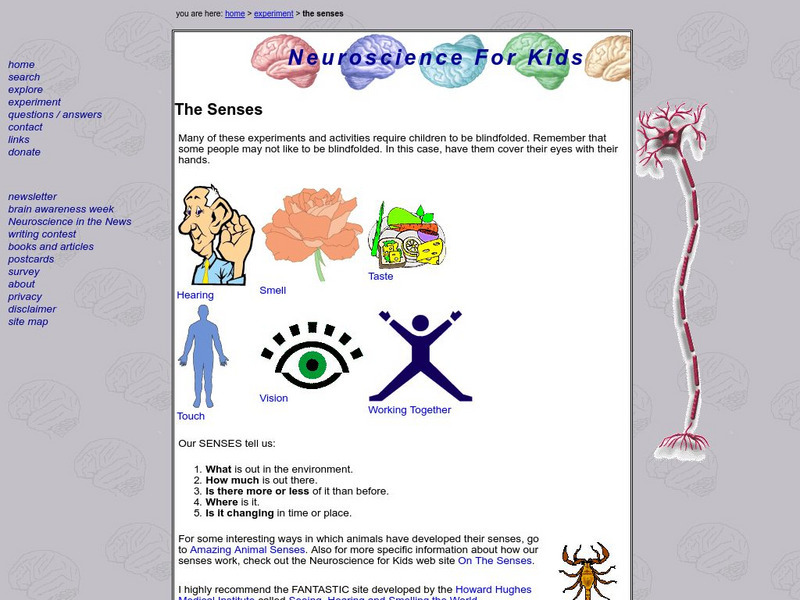
The Senses
This site has a collection of learning activities, games, experiments, and lesson plans on the five senses. Organized by grade level and topic, this site is packed with an assortment of interactive and engaging activities, that would...

eSchool Today
E School Today: Your Revision Notes on the Five Senses
Learn how the sense organs are structured and how they function to provide you with five senses.
Frontiers Media
Frontiers: Seeing With Your Ears: A Wondrous Journey Across the Senses
For dozens of years it has been believed that the brain is organized into "sensory areas": that is, that there is a "visual area," an "auditory area," and so forth, and that the visual area can only process visual information. It has...

Scholastic
Scholastic: Study Jams! Science: The Human Body: The Senses: Touching
Self-playing slideshow, with an accompanying quiz, explains how the skin, as a sense organ, allows us to touch and feel.
University of Washington
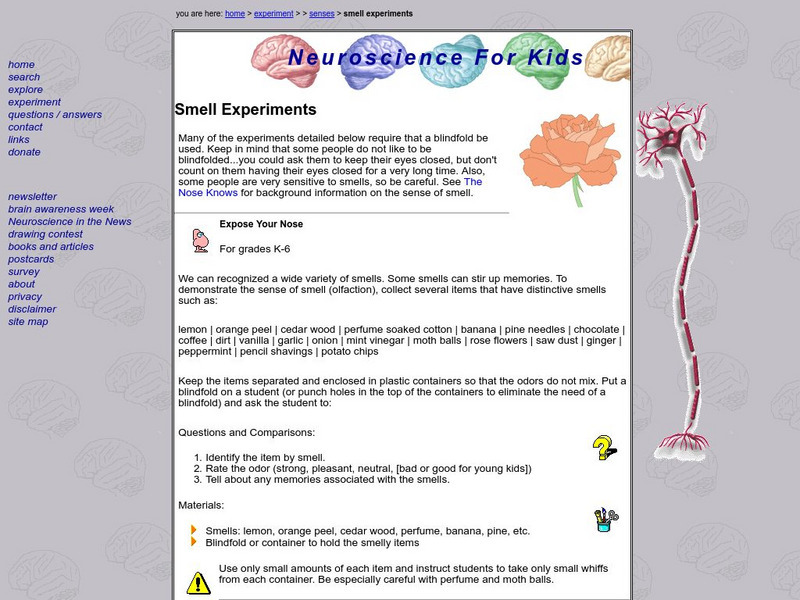
University of Washington: Neuroscience for Kids: Smell Experiments
Describes experiments students can do to investigate the sense of smell. The experiments target either grades K-6 and 3-12.
McGraw Hill
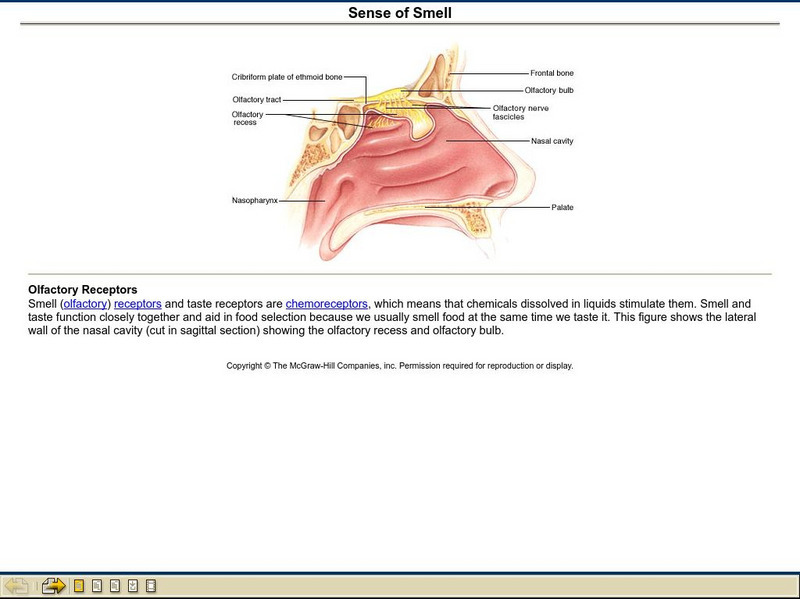
The Mc Graw Hill Companies, Inc.: Sense of Smell
This informative site provides information on the olfactory receptors, olfactory epithelium, and olfactory bulb. Detailed drawing supplement the text along with an animation that depicts the movement of molecules through the nose.

Mind My Education
Mind My Education: The Life of Environments
This extensive lesson plan covers various topics about how animals interact with their environment. Topics include how animals sense their environment, how environments and organisms change together, and how animals use their senses to...
University of Washington
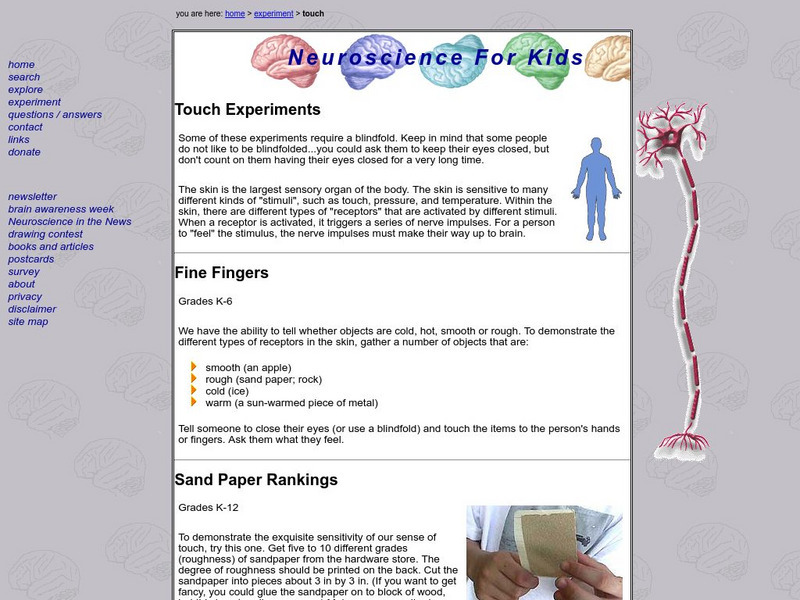
University of Washington: The Senses Touch
Do you know what the largest sensory organ of the body is? Use this site on skin and its sense of touch to learn more.
Better Lesson
Better Lesson: Senses
Young scholars will engage in a lesson that teaches them to associate certain expressions and words with specific feelings. Included are a senses PowerPoint, a model of a graphic organizer, and a video and picture of the students engaged...
BioEd Online
Bio Ed Online: The Brain: Control Central
What do you know about the brain? In this early learners lesson, students will explore the basic functions and characteristics of the brain and skull, and also learn about three major structures in the brain: the cerebrum, cerebellum and...
California Institute of Technology
Infrared Zoo Lesson 2: Dinner in the Dark
After exploring the scenario of how a pit-viper may get his midnight snack, students learn about the infrared sense of a pit-viper. They then discuss how infrared technology has helped in our society.
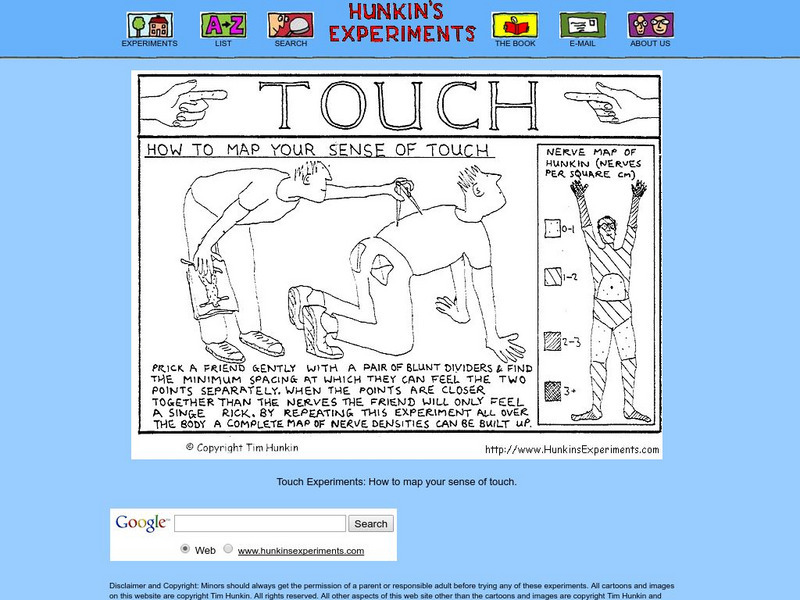
Hunkins Experiments
Hunkin's Experiments: How to Map Your Sense of Touch
Hunkin's Experiments is a group of simple cartoon illustrations of scientific principles. Some would work well in the classroom, but others have little value beyond entertaining students. All of the projects are easy to do. This would be...
Other
Reading Quest: Making Sense of Social Studies
Teaching students to read well in areas other than language arts requires teaching and reinforcing the kinds of reading strategies taught here. There are 27 strategies, ranging from brainstorming to word mapping. The site includes PDF...

TeachEngineering
Teach Engineering: Sensing Air Pollution
Students learn about electricity and air pollution while building devices to measure volatile organic compounds (VOC) by attaching VOC sensors to prototyping boards. In the second part of the activity, students evaluate the impact of...

PBS
Nova: The Hunt
Learn more about the six senses that sharks use to hunt. Descriptions and pictures of each sensory organ are provided.
Common Sense Media
Common Sense Media: Education: Story Elements Retelling
In this instructional activity, young scholars will learn to retell a story using story elements to improve their comprehension of the story. The students will actively listen to a story and complete a graphic organizer to share and...