Hi, what do you want to do?






NASA
Blinded by the Light!
Pupils learn of multiple ways astronomers look for planets outside of the solar system. By completing a hands-on activity, scholars discover that trying to see the planets directly because of the glare from the nearby star is nearly...

NASA
Water Works on a Blue Planet
Keep within a water budget. Learners find out that less than 2.5% of Earth's water is available to drink—and that there is a fixed amount of water. Scholars read an interesting article comparing the available water to a game of Monopoly...

NASA
Taking a Cold, Clear Look at the Universe
Take a look with another perspective. Pupils read to find out what portion of the electromagnetic spectrum a space telescope sees and the difficulties of viewing infrared radiation from other objects in space. Individuals discover how...

NASA
Taking Apart the Light
Break down light into spectra. Scholars learn how atoms emit and absorb photons and come to understand how this process allows scientists to identify different atoms based on either absorption lines or emission lines. Learners then...

NASA
Catch a Gravitational Wave, Dude!
It is cowabunga time! Pupils read an article about the NASA LISA mission on gravitational waves and conduct additional research on them. The class participates in a science bowl type competition about gravitational waves. Panels of four...

NASA
Packing for a L-o-o-o-ng Trip to Mars
Pack just enough to fit. Crews determine what personal items to take with them on a trip to Mars. Each team must decide what to take with them on a two-and-a-half year trip to Mars and whether their items will fit within the allotted...

NASA
Nasa: Huge Springtime Storms Hit the Planet Uranus
Describes in detail the devastating storms that occur on Uranus.Also includes an .mpeg movie showing the rings of Uranus up close. (Mar. 29, 1999)
DOGO Media
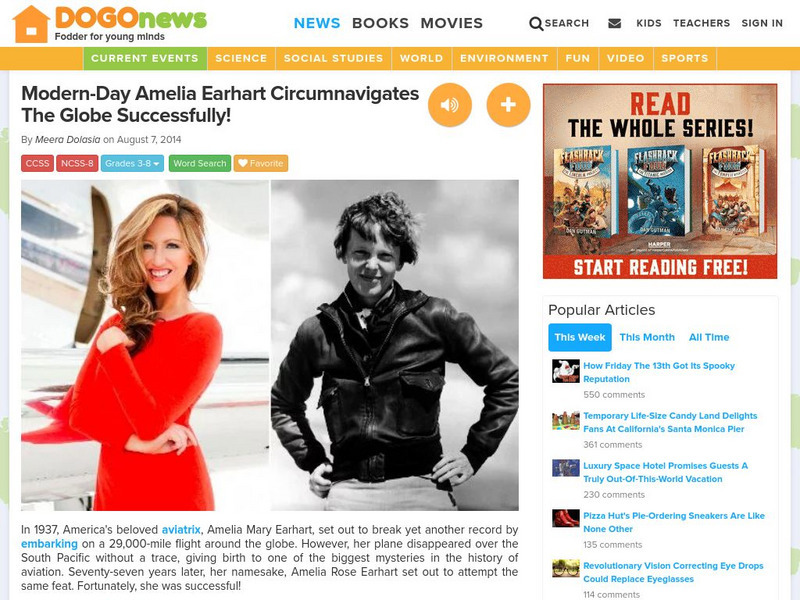
Dogo News: Week of 8 11 14: Modern Day Amelia Earhart Circumnavigates the Globe!
Find out about Amelia Rose Earhart, the namesake of the 1930's pilot, and her successful flight around the planet.
University of Texas at Austin
The University of Texas Mc Donald Observatory: Uranus
Learn interesting facts about the planet Uranus and its unique history.

Khan Academy
Khan Academy: What Is the Biosphere?
This article explains that as our knowledge of life on the planet evolves, we've come to use the word biosphere as a way of explaining the entire intertwined network of life on Earth. This concept combines an understanding of geology,...
NPR: National Public Radio
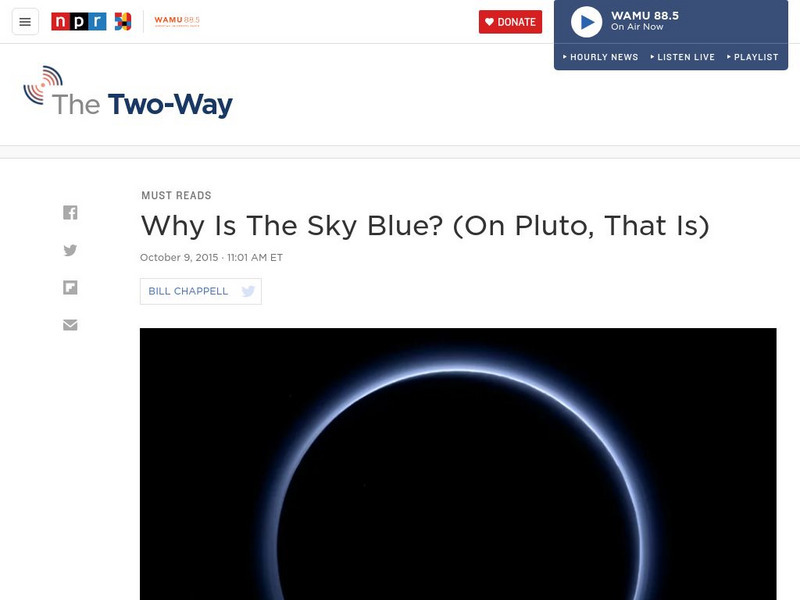
Npr: Why Is the Sky Blue? (On Pluto, That Is)
Read about the atmosphere of Pluto.
American Institute of Biological Sciences
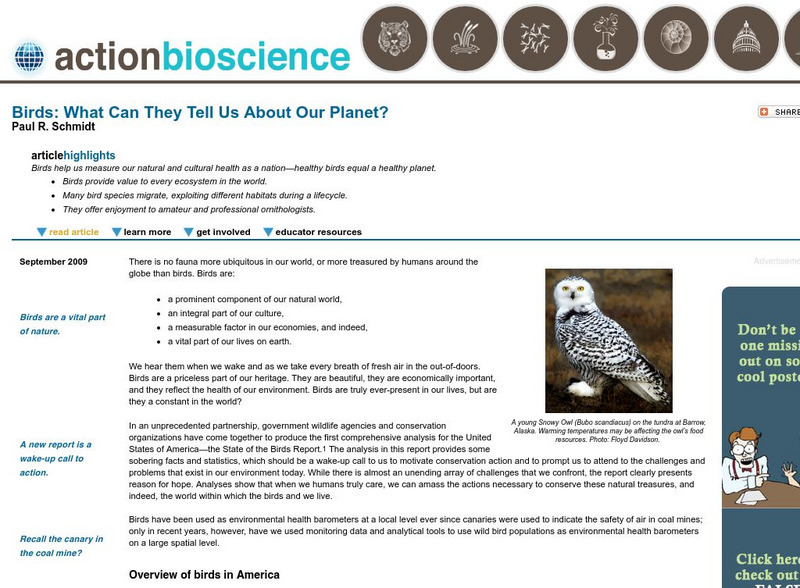
Action Bioscience: Birds: What Can They Tell Us About Our Planet
Birds can offer hints to the health of the planet as they are found everywhere, migrate to many new environments, and play a role in our culture with their vibrant shades and sounds. Identify specific ways we can learn about our own...
University Corporation for Atmospheric Research
Ucar: The Greenhouse Effect
Students will learn how greenhouse gases temporarily trap heat within Earth's atmosphere, warming the planet via the greenhouse effect.
University of Texas at Austin
The University of Texas Mc Donald Observatory: Mars
Discover interesting facts about Mars, the furthest planet from the sun.
University of Texas at Austin
The University of Texas Mc Donald Observatory: Earth's Moon
Discover interesting facts about Earth's partner, the moon, which is more like a double planet than a planet and a moon.
University of Texas at Austin
The University of Texas Mc Donald Observatory: Venus
Discover interesting facts about Venus, the hottest planet and the second planet from the Sun.
University of Texas at Austin
The University of Texas Mc Donald Observatory: Mercury
Discover interesting facts about the tiny planet Mercury, the closest planet to the Sun.
University of Texas at Austin
The University of Texas Mc Donald Observatory: Earth
Learn interesting information about the Earth, the largest of the "terrestrial" planets.
University of Texas at Austin
The University of Texas Mc Donald Observatory: Neptune
Discover interesting facts about Neptune, the fourth-largest planet.
University of Texas at Austin
The University of Texas Mc Donald Observatory: Pluto
Discover interesting information about Pluto, a member of the Kuiper Belt and no longer a planet since 2006.
University of Texas at Austin
The University of Texas Mc Donald Observatory: Jupiter
Discover interesting facts about Jupiter, the largest planet in the solar system.
University of Texas at Austin
The University of Texas Mc Donald Observatory: Saturn
Discover interesting facts about Saturn, the second-largest planet in the Solar System.

Other
Animal Planet: Top 10 Animal Moms: Polar Bears
This article describes the mother polar bear's pregnancy, birth, and motherhood. She is number four of the top10 animal moms.
Australian Broadcasting Corporation
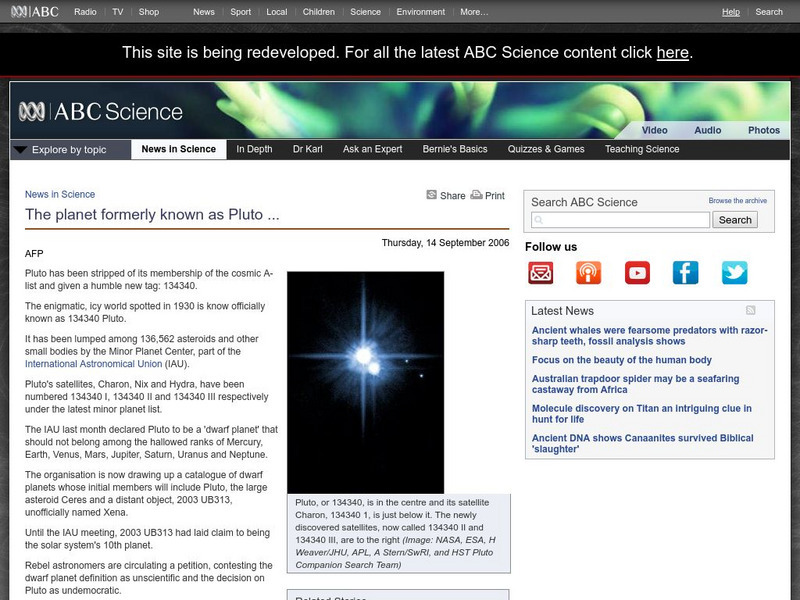
Australian Broadcasting Corporation: News in Science: The Planet Formerly Known as Pluto
From ABC News in Science, this article discusses issues related to Pluto its removal from planetary status. The brief article also touches on the renaming and re-listing process of Pluto.
Other popular searches
- Order of the Planets
- Name the Planets
- Orbits of the Planets
- Holst the Planets
- Distance of the Planets
- Reading About the Planets
- The Planets Facts
- Science and the Planets
- Modelling the Planets
- The Planets Suite
- Gustav Holst the Planets
- Label the Planets