Hi, what do you want to do?






SciShow
How the Manhattan Project Gave Us Today's Air Filters
HEPA filters are the basis of modern filtration - but they also represent a straight line from the Manhattan Project to your living room!
SciShow
The Manhattan Project
Some of the greatest advances in science have come from humanity's more destructive impulses. This is not the fault of science - when we discover powerful truths about the universe it's up to us to decide how to use them because...
Encyclopaedia Britannica
Did You Know? The Manhattan Project
Learn more about the Manhattan Project.
Weird History
What Life Was Like While Working on the Manhattan Project
What was it like to live at Los Alamos during the Manhattan Project? As thousands worked to build a top-secret atomic device, the US military tried to keep the entire city secret. All mail was screened and sent through a fake address at...

Curated Video
STEM Ask the Expert- The Manhattan Project
In this video, STEM Ask The Expert visits The National WWII Museum to learn more about The Manhattan Project. To learn more, visit The National WWII Museum <a href='http://www.ww2sci-tech.org/' target='_blank' rel='nofollow'>here</a>ref='http://www.ww2sci-tech.org/' target='_blank' rel='nofollow'>here
Crash Course
The Atomic Bomb: Crash Course History of Science
The story picks up where we left off last time, with Einstein writing the president of his new homeland, the United States, urging him to build a nuclear weapon before Hitler. This is the tale of the most destructive force humans have...
Curated Video
Manhattan Project Human Experiments
When scientists at the top secret 'Manhattan project' wanted to discover how radioactive bomb materials could affect the human body – they secretly injected terminally ill patients with uranium to find out.
Curated Video
How Robert J. Oppenheimer became the ‘Father of the Atomic Bomb’
Robert J. Oppenheimer, born on April 22, 1904, is known as the father of the atomic bomb. Oppenheimer was awarded a PhD in theoretical physics and was interested in the emerging field of quantum physics. As a scientist at the University...
Science ABC
How Robert J. Oppenheimer became the ‘Father of the Atomic Bomb’
Robert J. Oppenheimer, born on April 22, 1904, is known as the father of the atomic bomb. Oppenheimer was awarded a PhD in theoretical physics and was interested in the emerging field of quantum physics. As a scientist at the University...
Curated Video
Chien-Shiung Wu: The First Lady of Physics
We hear a lot about famous scientists like Marie Curie and Albert Einstein, but have you ever heard of Chien-Shiung Wu and her work on the Manhattan Project?
Curated Video
The Legacy of the Atomic Bomb: From Hiroshima to the Cold War
This video provides a concise yet comprehensive overview of the impact of the atomic bombings of Hiroshima and Nagasaki during World War II, the subsequent nuclear testing at Bikini Atoll, and the development of nuclear weapons through...

Curated Video
Rare Home Movies of the Secret Manhattan Project Grounds
When physicist Hugh Bradner was brought to work on the Manhattan Project in 1943, the level of secrecy was unparalleled. One surprising exception was that he was allowed to document his experience on film. From the Series: America in...
Espresso Media
Garwin: Inside the Historic Site of Nuclear Weapon Assembly
Garwin part 4/11: This video provides a glimpse into the historical significance of Los Alamos, the site where the first atomic bomb was assembled during the Manhattan Project. The video also touches on the transition from the Manhattan...
Curated Video
Network Charts: What's the Difference between PERT and CPM?
New ReviewPERT and CPM are two forms of Network Chart that are represented differently, and take different approaches to calculating schedules. For both, the roots lie in the 1940s and the way the Manhattan Project was planned.
Curated Video
Election of 1948: The Underdog
The suspenseful 1948 presidential election exposed the consequences of flawed polls, as Truman's astonishing victory upended expectations and forever changed how pollsters make predictions.
SciShow
Glenn Seaborg: Shaking Up the Periodic Table
Hank synopsizes the life and work of Glenn Seaborg, pioneer of synthetic elements, member of the Manhattan Project, and the architect of the last great shake-up of the periodic table.
SciShow
Glenn Seaborg: Shaking Up the Periodic Table
Hank synopsizes the life and work of Glenn Seaborg, pioneer of synthetic elements, member of the Manhattan Project, and the architect of the last great shake-up of the periodic table.

SciShow
Glenn Seaborg: Shaking Up the Periodic Table
Hank synopsizes the life and work of Glenn Seaborg, pioneer of synthetic elements, member of the Manhattan Project, and the architect of the last great shake-up of the periodic table. ---------- Like SciShow? Want to help support us, and...
SciShow
Richard Feynman, The Great Explainer: Great Minds
Like SciShow? Help support us, and also get things to put on your walls, cover your torso, or hold your liquids!
Cha
pters
View all
G
REAT EXP
LAINERS
0:26<
br/>
QUANTUM MECHANICS
...
Cha
pters
View all
G
REAT EXP
LAINERS
0:26<
br/>
QUANTUM MECHANICS
...
Curated Video
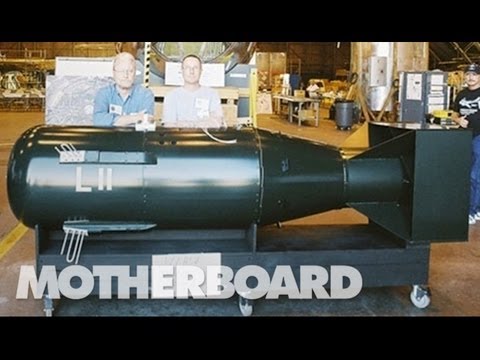
How a Truck Driver "Rebuilt" the Atomic Bomb
John Coster-Mullen is a truck-driver with minimal college education who taught himself how to build the most detailed replica of an A-bomb ever made. "The secret of the atomic bomb is how easy they are to make," admits Coster-Mullen....
Curated Video
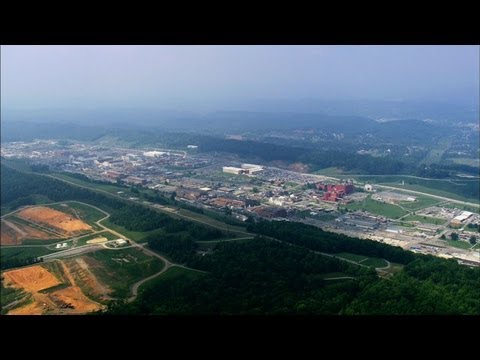
A Rare Look at the Secret Site of the Atomic Bomb
In 1942, one thousand families were pushed out of Oak Ridge, Tennessee as part of The Manhattan Project - the US government's top secret initiative to engineer an atomic bomb. From: AERIAL AMERICA: Tennesseehttp://bit.ly/1rj8Uoi'...

HowStuffWorks
The Wetsuit: Where did it come from? | Stuff of Genius
Today wetsuits are considered essential equipment for most divers -- but this wasn't always the case. Tune in to learn how a brilliant physicist created this Stuff of (underwater) Genius. -- Behold…the wetsuit. But where did it come...
Curated Video
How Atomic Bombs Work—and Why Few Nations Have Them
At 5:30AM, dawn on July 16, 1945 near a small town called Alamagordo New Mexico, the course of human history was changed. The first atomic bomb was detonated that day, and sealed the fate of humanity....