Hi, what do you want to do?





World History Encyclopedia
World History Encyclopedia: Archimedes
Illustrated entry provides an account of the life of Archimedes, a pioneer in the fields of mathematics and engineering.

Other
U of North Dakota: Fundamental Theorem of Algebra
A historical overview of the Fundamental Theorem of Algebra. Links to historic mathematicians and the development of this theorem.
University of Cambridge
University of Cambridge: Maths and Sports: Olympic Starters
How do you compare to these results from Olympic Games in the past if you try similar running and jumping activities? This activity uses the history of the Olympic Games to introduce ideas about measuring time and distances in standard...
National Council of Teachers of Mathematics
The Math Forum: Ask Dr. Math: History of Numbers
Dr. Math tackles the question of man's first use of numbers by relating the work of Denise Schmandt-Bessarat and her studies of "'tokens' found all over the Middle East.
The History Cat
The History Cat: Islamic Science and Math
Describes the major accomplishments of Islamic civilizations in the fields of Science and Math, i.e., the Islamic calendar, astronomy calculations, windmills, irrigation with gears, and mathematical theories.
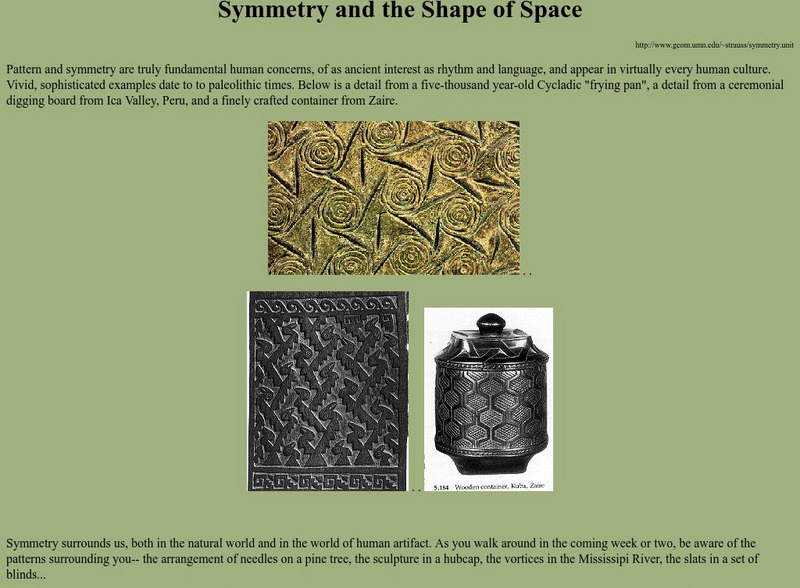
Other
Univ. Of Arkansas: Symmetry and the Shape of Space
This University of Arkansas site applies symmetry to the world of history and artifacts. Includes images.
Stanford University
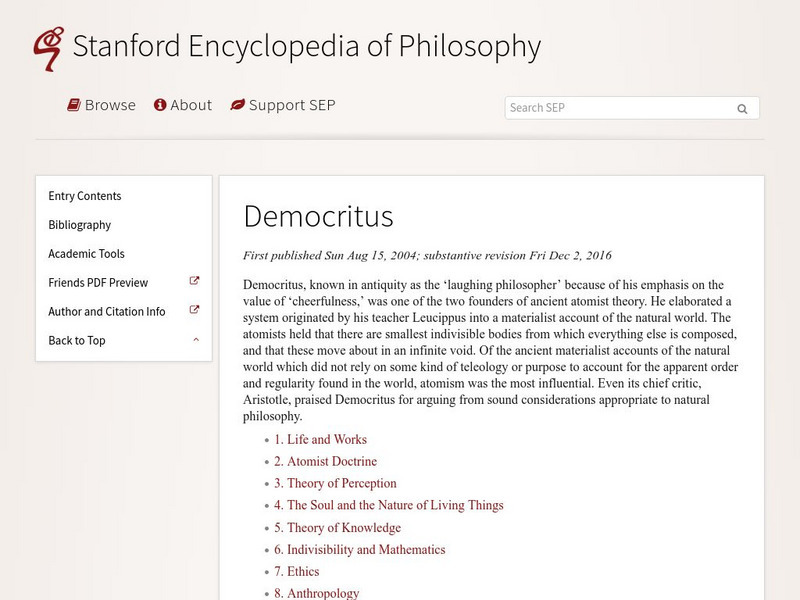
Stanford Encyclopedia of Philosophy: Democritus
A look at the life of Democritus of Abdera. He helped to develop a theory of atomism, explained in detail here. Other significant ideas he had included his theory of perception, a theory of the soul and its relationship to living things,...

ibiblio
Ibiblio: How Many? A Dictionary of Units of Measurement
The Center for Mathematics and Science Education at the University of North Carolina at Chapel Hill provides an interesting and easy-to-use dictionary of the history and meaning of many measurement terms. Metric, International, and...
Islami City
Islamic History: Arabic Numerals
Considers the origin of our "Arabic," system of number notation as probably having originated in India. Has illustrations demonstrating how much less cumbersome this system is than Roman, Egyptian, or Greek numeration.
Agnes Scott College
Alphabetical Index of Women Mathematicians
Read the biographies of dozens of women mathematicians who were important in the 1700's, 1800's, and 1900's.

Library of Congress
Loc: Rome Reborn: The Vatican Library & Renaissance Culture
This page chronicles an exhibit hosted by the Library of Congress of manuscripts and documents from the Vatican Library. Includes manuscripts of both a secular and religious nature as well as a detailed history of the Vatican Library....
Other
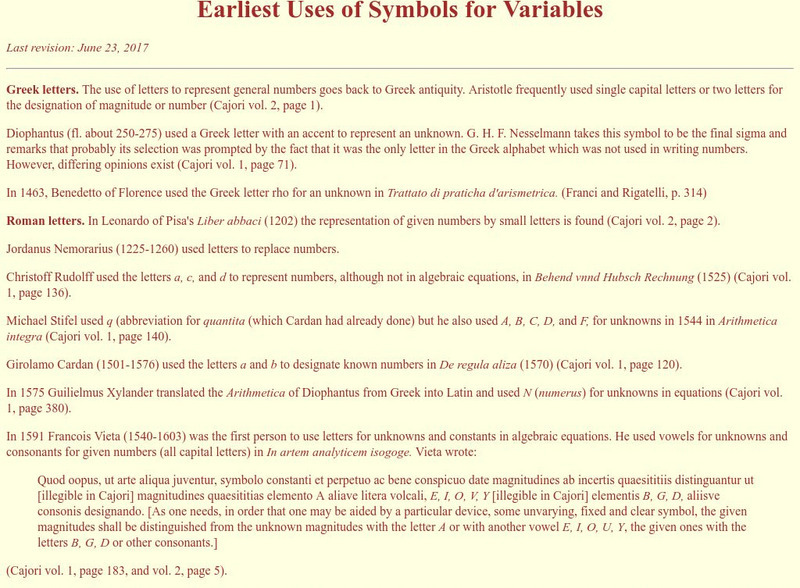
Jeff Miller: Earliest Uses of Symbols for Variables
This personal site explains how variables began and who were the first to use them.
University of St. Andrews (UK)
University of St. Andrews: Nicolaus(ii) Bernoulli
This site, which is provided for by the University of St. Andrews, gives a brief biography of Nicolaus Bernoulli.
Trinity College Dublin
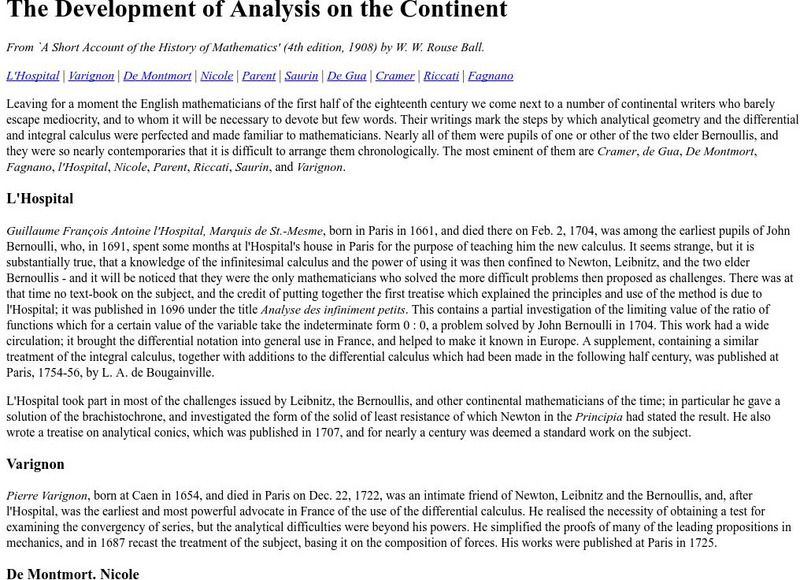
Trinity College: Development of Analysis on the Continent
This page of brief biographies taken from "A Short Account of the History of Mathematics," includes a paragraph on the life and work of Gabriel Cramer of "Cramer's Rule," fame.
New York University
Institute for the Study of the Ancient World: Before Pythagoras
Exhibition of cuneiform tablets dating from 1900 B.C. demonstrates the mathematical knowledge of the ancient Mesopotamians.
Other
Frieze Patterns: Mathematics and the Liberal Arts
Provides a listing of books that are useful in research on this topic.
Trinity College Dublin
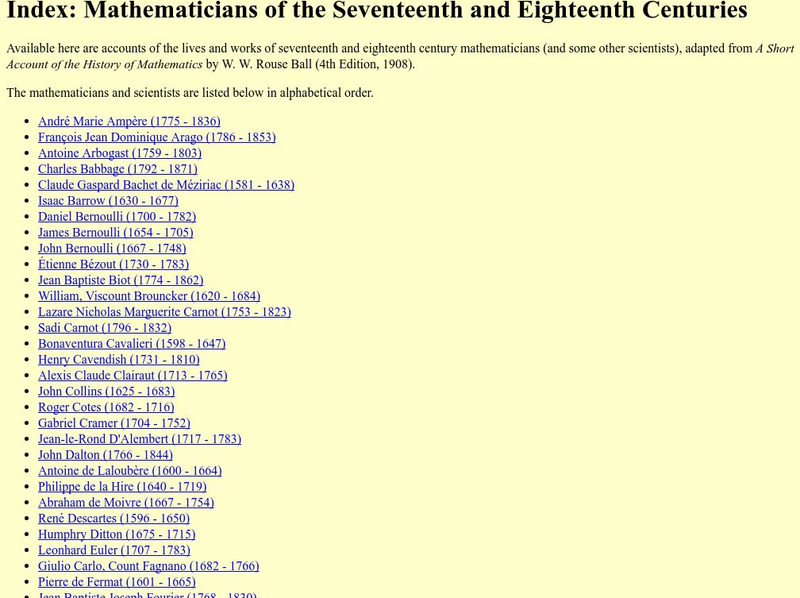
Mathematicians of the Seventeenth & Eighteenth Centuries
Read accounts of the lives and works of seventeenth and eighteenth century mathematicians, including Sir Isaac Newton and Rene Descartes.

University of St. Andrews (UK)
University of St. Andrews: James Clerk Maxwell
Research resources for James Maxwell (1831-1879), who did revolutionary work on electricity and magnetism and on the kinetic theory of gases.

University of St. Andrews (UK)
University of St. Andrews: Thomas Young
A short biographical sketch of Thomas Young's (1863- 1942) life as a mathematician and a scientist. Gives an account of his birth and the final years of his life.

University of St. Andrews (UK)
University of St. Andrews: Lissajous Curves
Gives a brief history and lists the parametric cartesian equations.

University of St. Andrews (UK)
University of St. Andrews: Nicomachus of Gerasa
Many people have used a multiplication table, but most are oblivious that Nicomachus made the first multiplication table in Greek text.
Other
History World: Greek Science Timeline
A timeline of scientific discoveries and theories of the ancient Greeks. It covers the period from 585 BC to 150 AD, with three additional entries for related events in the 1900s. Each entry has links to additional content on the website...
Trinity College Dublin
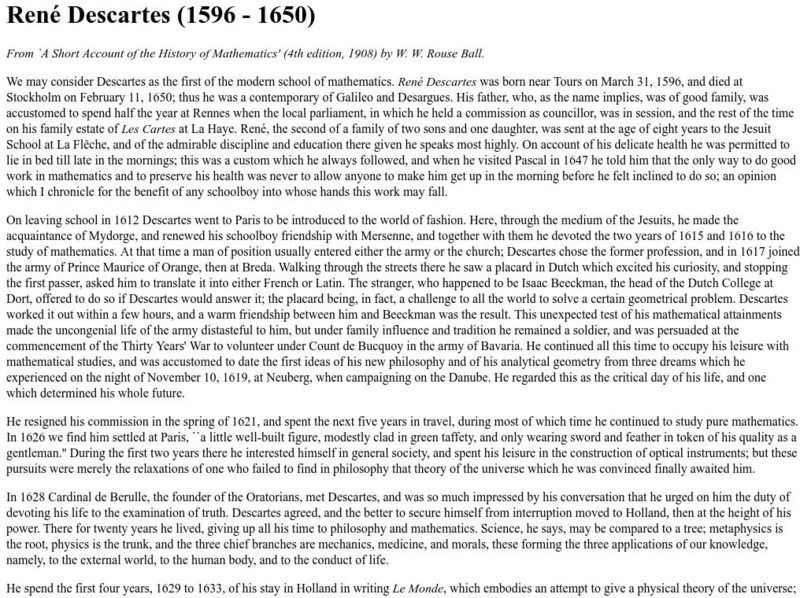
Trinity College: Rene Descartes (1596 1650)
Events of Rene Descartes' life are presented in a timeline form. The biographical information is taken from "A Short Account of the History of Mathematics" by W. W. Rouse Ball (4th Edition, 1908).
University of Virginia
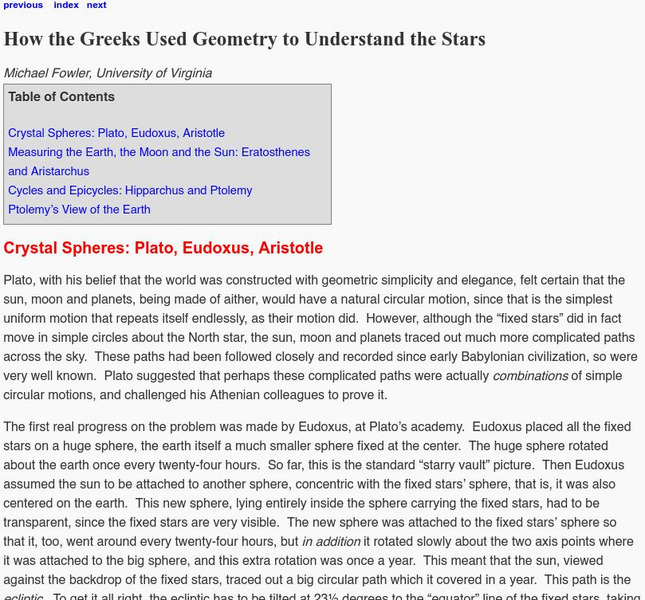
University of Virginia: How the Greeks Used Geometry to Understand the Stars
An article explaining how the Greeks were able to use their science and mathematics to predict where astronomical objects such as the Planets could be found in the nighttime sky even though their underlying premise was that the earth did...