Hi, what do you want to do?





Computer History Museum
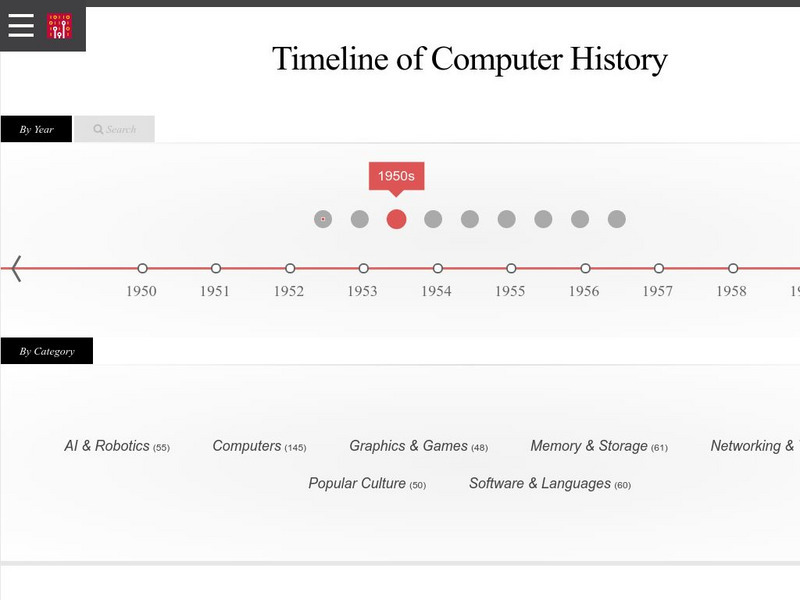
Computer History Museum: Timeline of Computer History
This site presents an interactive timeline of computer development from 1939 through 1994. Upon selecting a year, the site presents all of the major computer hardware and software developments that occurred during that year.

TED Talks
Ted: Ted Ed: A Brief History of Video Games (Part I)
Video games are everywhere these days, but where did they actually come from? The history of video games is a complicated story that involves giant computers in science labs, the founder of Chuck E. Cheese and billions of dollars in...

The Franklin Institute
Franklin Institute: The Case Files: Early History of Computing
Computers are ubiquitous today. Step back in time and meet some of the early inventors of precursors to computers, and of the first computers.
BBC
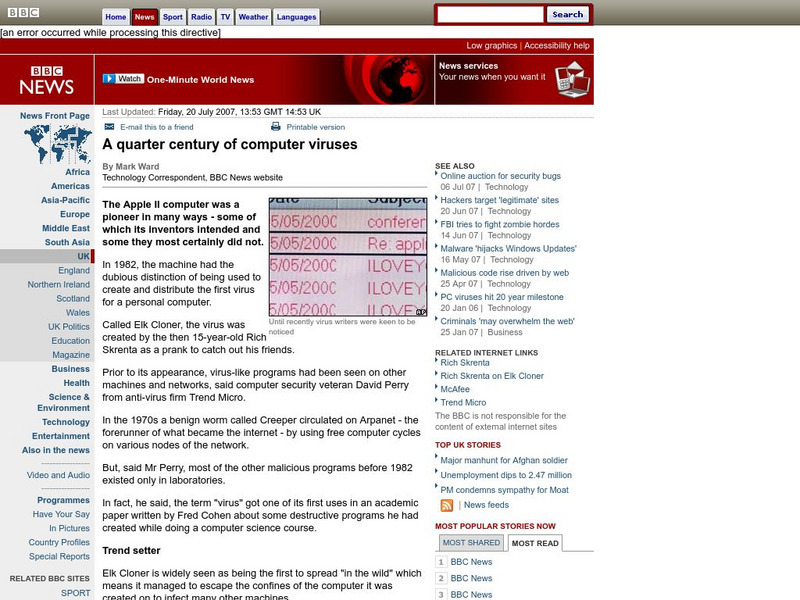
Bbc: Science & Nature Hot Topics Computer Viruses
This BBC "hot topic" contains a description of the types of computer viruses. It also provides different ways to prevent or eliminate computer viruses.
National Women’s History Museum
National Women's History Museum: The Women of Nasa
Learn about the women who have played an essential role in the functions of NASA for almost a century.
Columbia University
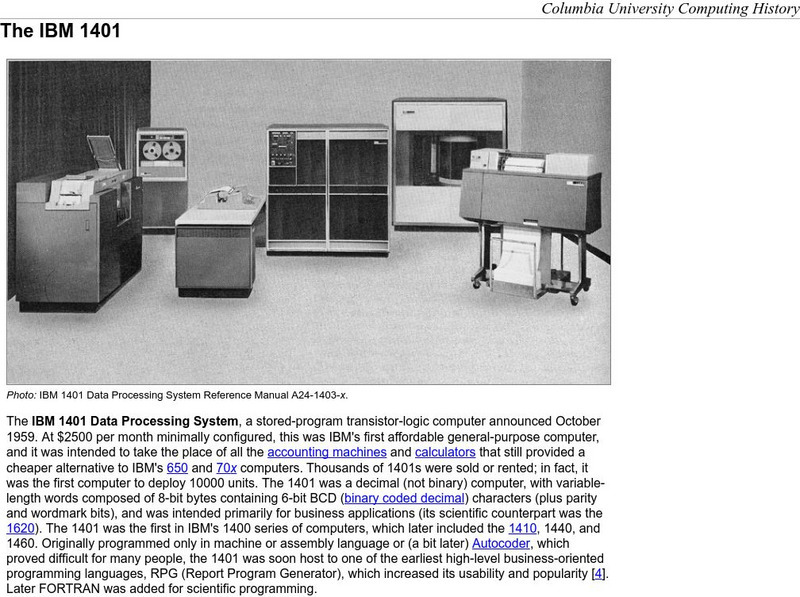
Columbia University: The Ibm 1401
The IBM 1401 Data Processing System was IBM's first affordable general-purpose computer. It was introduced in 1959 and was IBM's first computer to sell over 10,000 units. This site describes the history of the 1401, the technology that...

University of St. Andrews (UK)
University of St. Andrews: St. Andrews: History of the Four Color Theorem
The University of St. Andrews offers a brief history of the first math problem to be solved with computers.
Other
Internet Learning Tree: A Brief History of the Internet
An anecdotal history of the people and communities that brought about the internet.
Other
U. S. Army Research Laboratory: The Eniac Story
This site provides a detailed history of ENIAC, the world's first digital computer developed by Army Ordnance to compute World War II ballistic firing tables. Includes specifics on how the computer performed its calculations.
Smithsonian Institution
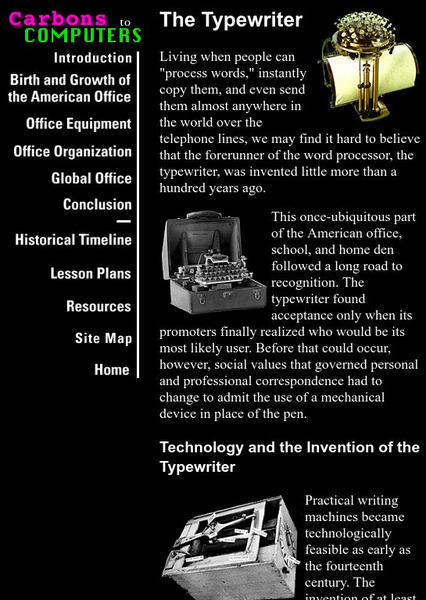
Smithsonian Education: Carbons to Computers: The Typewriter
Created a little less than 150 years ago, the typewriter was the forerunner for the computer. This page offers a detailed history of the birth of the typewriter along with several visual examples.

National High Magnetic Field Laboratory
Magnet Academy: Magnetic Core Memory 1949
At the dawn of the computer age, magnetic core memory helped make data storage possible, and showed surprising staying power in a field where components are constantly being replaced by new and improved products.

University of St. Andrews (UK)
University of St. Andrews: Grace Brewster Murray Hopper
This site from the University of Saint Andrews discusses the life and accomplishments of Grace Brewster Murray Hopper, pioneer in computer software.
History of Computing Science
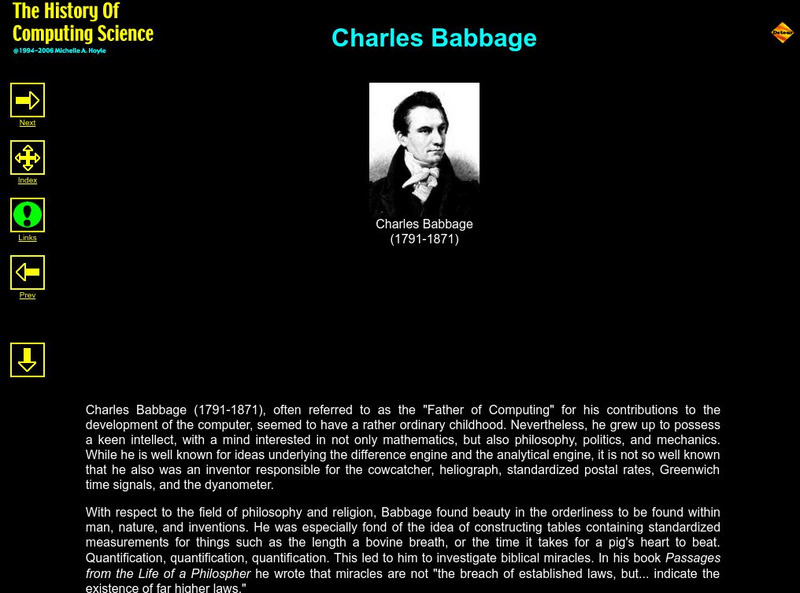
History of Computing Science: Charles Babbage
This is a brief biography of Charles Babbage, also known as the "Father of Computing".
Rock and Roll Hall of Fame
Rock & Roll Hall of Fame: Sti Lesson 15: The Changing American Landscape
The rise of American cities between 1865 and 1900 was spawned by the industrial revolution. Technological advancements in industry and transportation fathered the enormous growth of large cities across the United States. This led to the...

National High Magnetic Field Laboratory
Magnet Academy: Timeline of Electricity and Magnetism: 1940 1959
Defense-related research leads to the computer, the world enters the atomic age and TV conquers America.

National High Magnetic Field Laboratory
Magnet Academy: Timeline of Electricity and Magnetism: 1960 1979
Computers evolve into PCs, researchers discover one new subatomic particle after another and the space age gives our psyches and science a new context.
Encyclopedia Britannica
Encyclopedia Britannica: 300 Women Who Changed History: Grace Murray Hopper
Encyclopaedia Britannica provides a biography of Grace Murray Hopper (1906-1992 CE), the noted mathematician, computer scientist, and military officer.
Computer History Museum
Computer History Museum: Charles Babbage
Considered by some to be the "father of the computer", Charles Babbage was a 'gentleman scientist'. Learn interesting facts about his personal life and his career.
Computer History Museum
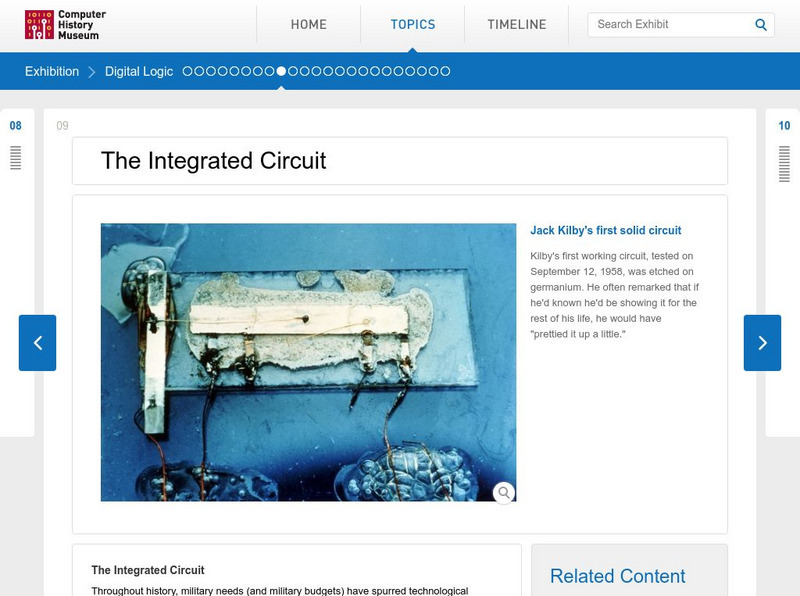
Computer History Museum: Integrated Circuits
Brief description on the design of Integrated Circuits along with images showcasing the assorted types. The various Integrated Circuit artifacts are on display at the Computer History Museum. This site provides a glimpse into the...

National High Magnetic Field Laboratory
Magnet Academy: Giant Magnetoresistance: The Really Big Idea Behind a Very Tiny Tool
This itsy-bitsy phenomenon makes your iPod and hard drive tick.
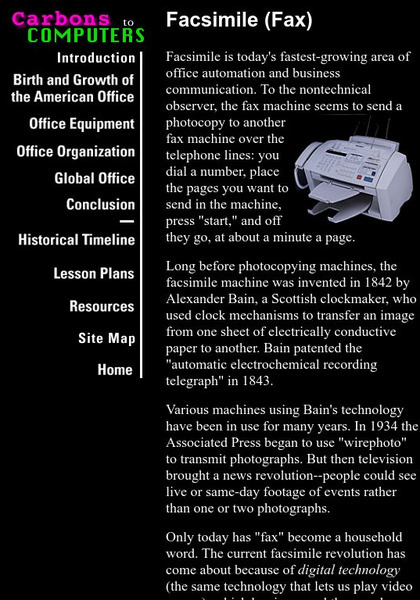
Smithsonian Institution
Smithsonian Education: Carbons to Computers Fax
The Smithsonian Institution provides the lifeline of the fax machine and of its uses in the business world.

Other
Sdsc: Ada Byron, Countess of Lovelace
Ada Byron, Lady Lovelace (1815-1852), was one of the most picturesque characters in computer history. The daughter of the poet Lord Byron, she was raised to be a mathematician and scientist and contributed to the work of Charles Babbage.
Smithsonian Institution
Lemelson Center: Silicon Valley: Success, Failure, and a Bit of Luck
An account of the historic growth of the famous high tech California region known as the Silicon Valley! Read as circumstances placed creative people, and business in the right place at the right time allowing them to come together to...
Science Museum, London
Science Museum: Ada Lovelace
Some say that Ada Lovelace was the first programmer because she wrote instructions for a computing device designed by Charles Babbage. This site presents a brief history of Ada's life and the important role she played in the history of...