Hi, what do you want to do?






PBS
Pbs: A Science Odyssey
Website for the PBS series "A Science Odyssey." Numerous opportunities to explore the people and discoveries of science.

Ducksters
Ducksters: Astronomy for Kids: Constellations
Kids learn about the constellations in the science of astronomy. These stars that form patterns when viewed from the Earth have been studied since ancient times.

Ducksters
Ducksters: Astronomy for Kids: Space Exploration Timeline
Kids learn about the timeline of the history of space exploration including early astronomy, astronauts, spacecraft, planets, and the Moon.
NASA
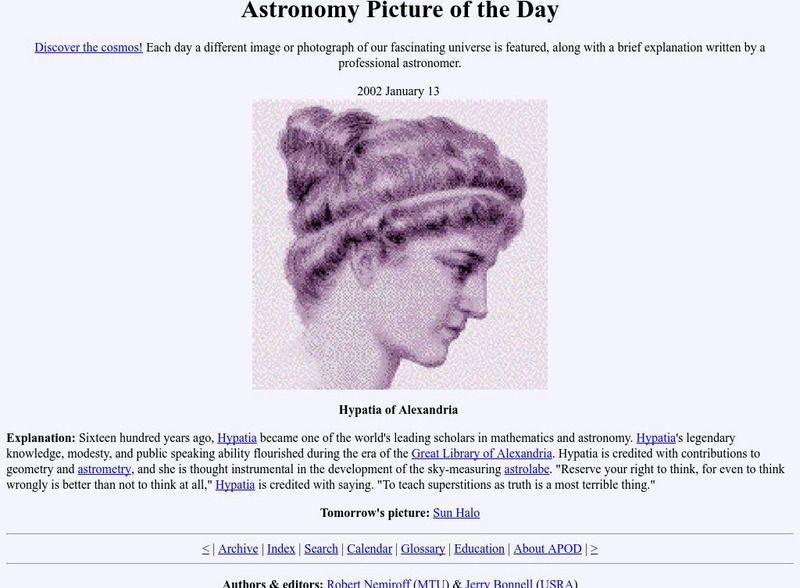
Nasa: Astronomy Picture of the Day: Hypatia
Learn more about Hypatia when you check out this resource. This site features a picture and a brief synopsis of this famous scientist.

Other
U.s. Space and Rocket Center: About Space Camp
Read about the history of the original space camp at the U.S. Space & Rocket Center in Huntsville, Alabama. Find out the lasting impact of space camp on alumni who attended this camp as children.
Harvard University
Harvard Smithsonian Center for Astrophysics: 1.2 Meter Millimeter Wave Telescope
Describes the collection of 1.2m millimeter wavelength radio telescopes that are operated by the Millimeter Wavelength Group at Harvard Smithsonian. It details some history of radio astronomy and of the telescope itself, gives great...
Other
Ellinogermaniki Agogi: Eratosthenes Experiment
A profile of the ancient Greek mathematician, geographer, and astronomer, Eratosthenes. Looks at his many accomplishments, including measuring the circumference of the Earth and the distance to the Moon and the Sun. Includes links to...
Trinity College Dublin
Trinity College: Rene Descartes (1596 1650)
Events of Rene Descartes' life are presented in a timeline form. The biographical information is taken from "A Short Account of the History of Mathematics" by W. W. Rouse Ball (4th Edition, 1908).
Science Buddies
Science Buddies: Which Stars Can You Use for Navigation
A great science project from Science Buddies that examines how ancient peoples navigated without the benefit of a GPS. Find out which stars are important in navigation in the northern and southern hemispheres. The Science Buddies project...
Other
Lowell Observatory
Lowell Observatory homepage describes the history and current work done at the Lowell Observatory. Contains basic information about the telescopes and the results of work done by staff scientists. It is a national landmark.
American Museum of Natural History
American Museum of Natural History: Ology: Milky Way Galaxy
How big is a billion? Find out some interesting facts about our galaxy, the Milky Way, and its billion stars.
American Museum of Natural History
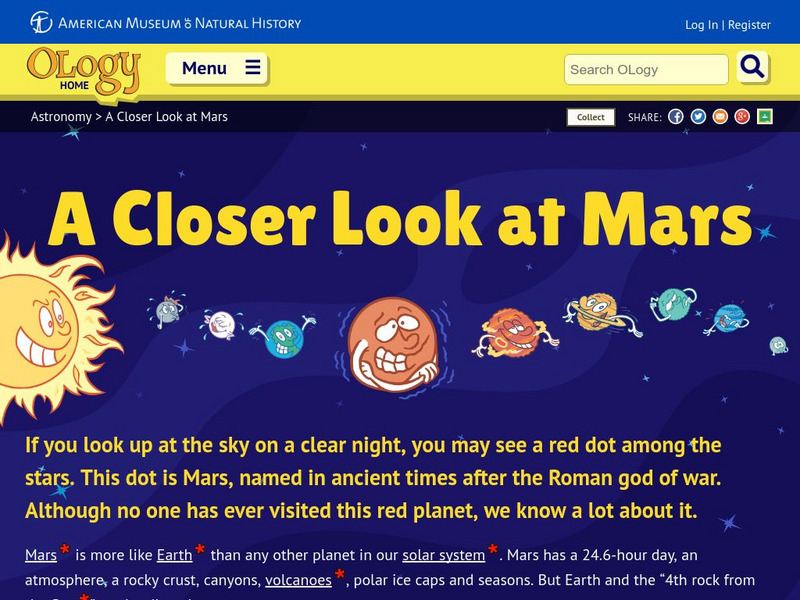
American Museum of Natural History: O Logy: A Closer Look at Mars
If you look up at the sky on a clear night, you may see a red dot among the stars. This dot is Mars, named in ancient times after the Roman god of war. Although no one has ever visited this red planet, we know a lot about it. This site...
American Museum of Natural History
American Museum of Natural History: O Logy: Stuff to Do: Space Travel Guide
What makes science fiction so exciting? Read some examples of the genre and then create your own science fiction story about space travel. Use the supplied "travel guide" to generate ideas and structure your plot.

Enchanted Learning
Enchanted Learning: Zoom School: Uk of Great Britain and Northern Ireland
Use this site to explore the United Kingdom. Learn about the UK's flag, geography, map, explorers, animals, scientists, explorers and more.

A&E Television
History.com: The Space Race: Interactive Universe
A virtual journey through space offers photos and facts about Earth and its neighboring planets, comets, other celestial bodies of the Solar System, and the Milky Way and Andromeda galaxies.
American Museum of Natural History
American Museum of Natural History: Profile: Georges Lemaitre
Find out about the life and work of the father of the Big Bang theory, Georges Lemaitre. This article describes the origin of the cosmology theory and its growing acceptance among scientists. This is an excerpt from COSMIC HORIZONS:...
National High Magnetic Field Laboratory
Magnet Academy: Edward Purcell
Edward Mills Purcell was an American physicist who received half of the 1952 Nobel Prize for Physics for his development of a new method of ascertaining the magnetic properties of atomic nuclei. Known as nuclear magnetic resonance...

Ducksters
Ducksters: Space Science: Astronomy for Kids
Kids learn about astronomy, the study of outer space including the stars, planets, comets, black holes, and the Solar System. History and astronomers in this astronomy for teachers and kids section.
Institute and Museum of the History of Science
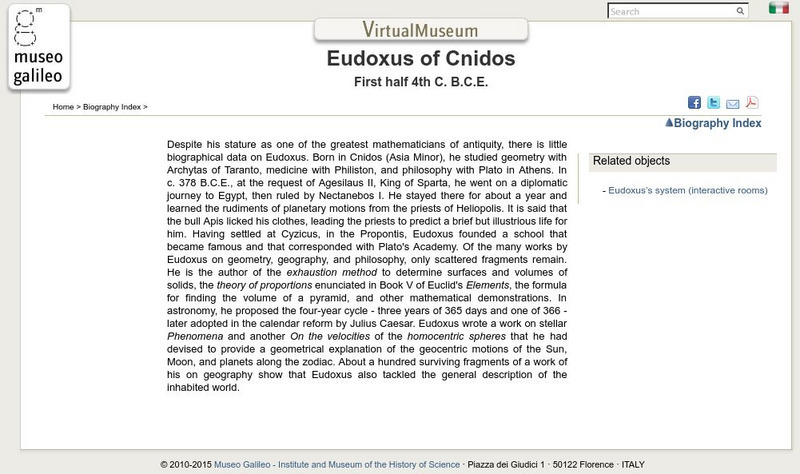
Museo Galileo: Eudoxus of Cnidos
Not much is known about the life of Eudoxus, a famous Greek mathematician. This is a brief description of what we do know about him.
PBS
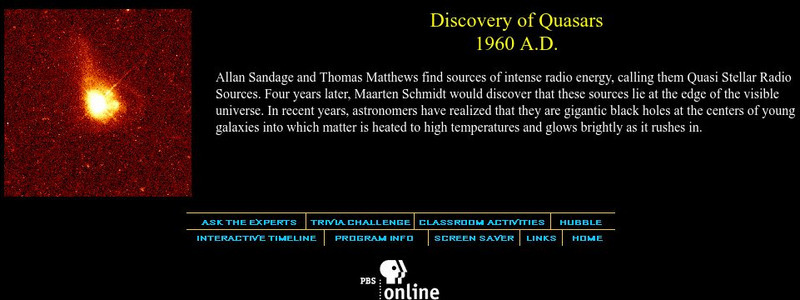
Pbs: Discovery of Quasars 1960
PBS offers a brief history of the discovery of quasars and the people involved.
Other
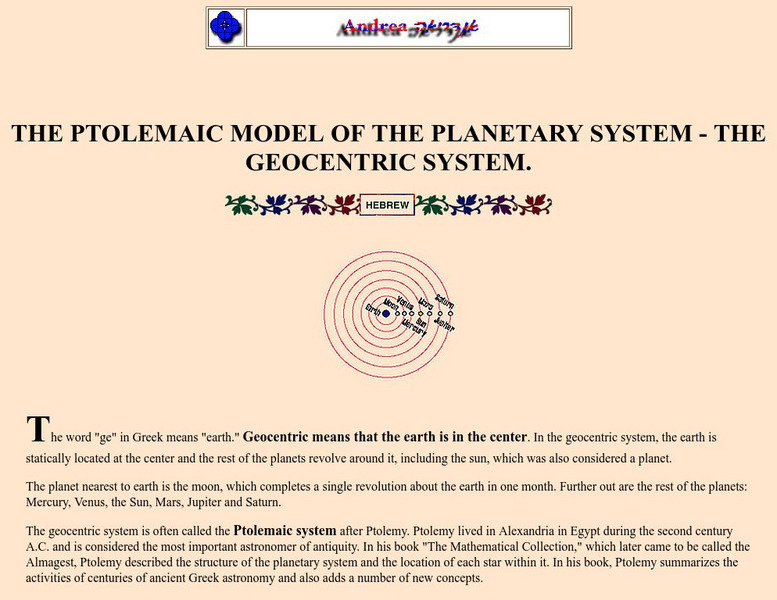
The Ptolemaic Model of the Planetary System
An easy-to-read description and history of Ptolemy's geocentric model of the universe. Geocentric means that Ptolemy believed the Earth was the center of the universe.
NASA
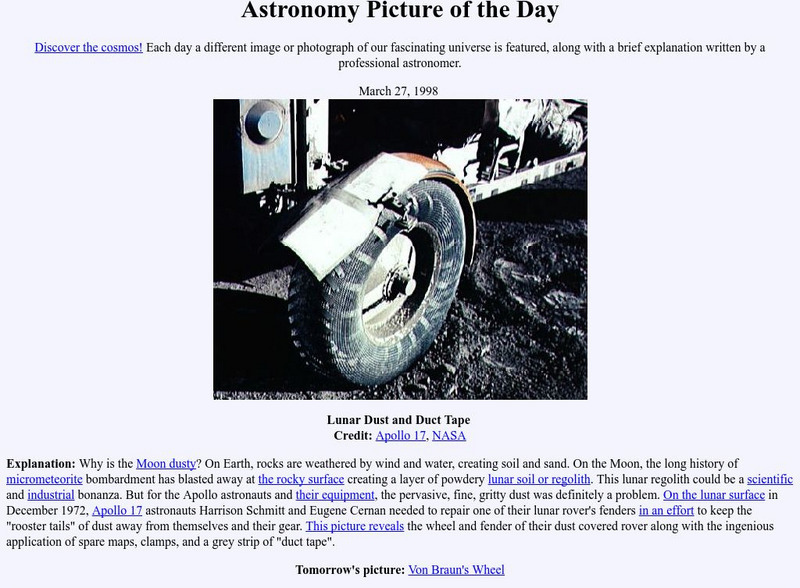
Nasa: Astronomy Picture of the Day: Lunar Dust and Duct Tape
Dust, a common and usually minor problem on Earth, presented a major challenge for the Apollo astronauts on the Moon. Here's an interesting solution created by the Apollo 17 crew.
Other
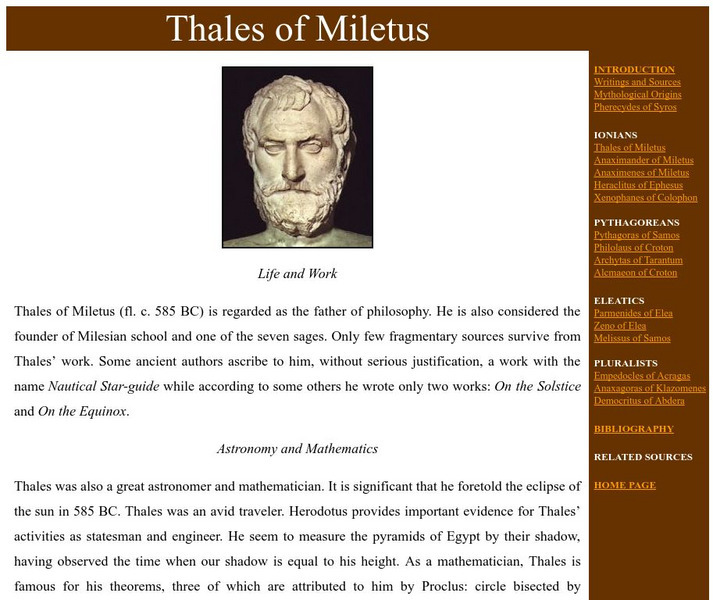
Ancient Greek Philosophy: Thales of Miletus
Includes a short summary of the life and work of the Greek philosopher Thales of Miletus. Discusses his life, work in Astronomy and Mathematics, and view of water and pantheism. Also includes a couple of quotations that make reference to...
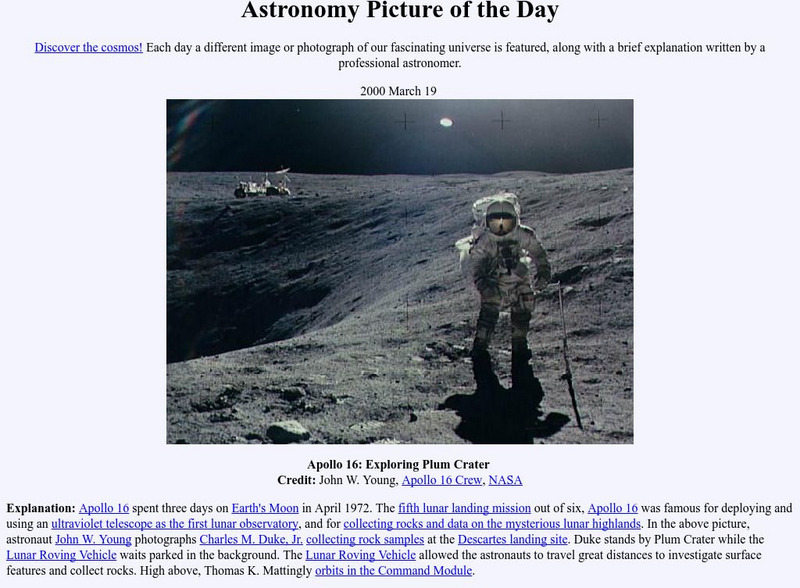
NASA
Nasa: Astronomy Picture of the Day: Apollo 16: Exploring Plum Crater
This is a photograph of Charles M. Duke, Jr. collecting rock samples at the Descartes landing site. Duke stands by Plum Crater while the Lunar Roving Vehicle waits parked in the background. The Lunar Roving Vehicle allowed the astronauts...