Hi, what do you want to do?





Science and Mathematics Initiative for Learning Enhancement (SMILE)
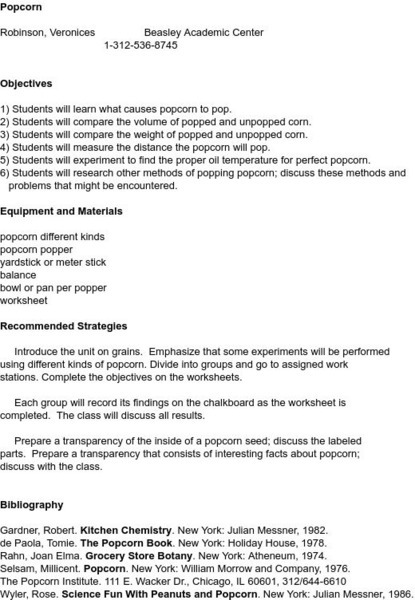
Smile: Popcorn Is a Gas
From the Science and Mathematics Initiative for Learning Enhancement (SMILE) program. A lesson plan in which students explore the pressure-temperature-volume relationships by performing a popcorn lab investigation. Intriguing. Great...

Other
Aquaholic: Introduction to Boyle's Law
Provides a great introduction to Boyle's Law as well as a link to a more detailed explanation if that's what you're looking for. Gives a real life example that is very helpful in comprehending the law.

Khan Academy
Khan Academy: What Is the Maxwell Boltzmann Distribution?
In a gas, there are lots of molecules traveling at lots of different speeds. Here's a framework for thinking about that.
Simon Fraser University
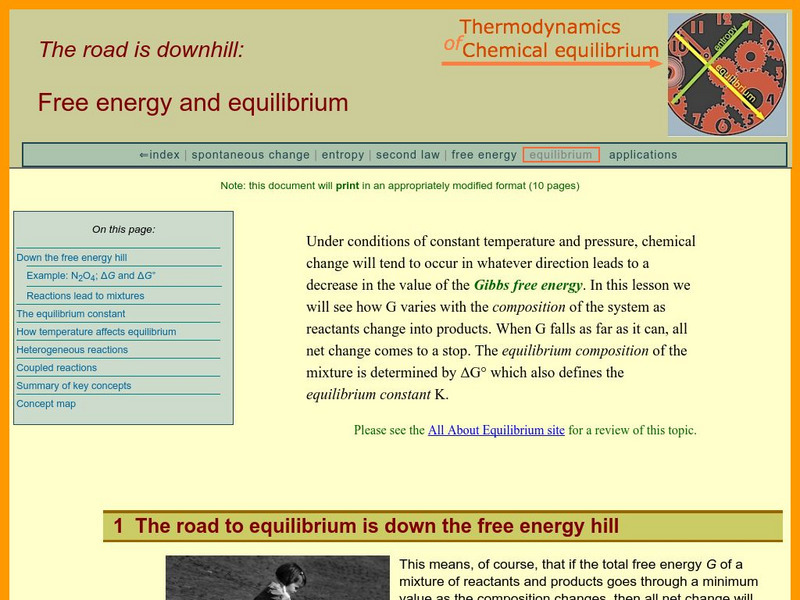
Chem1 Virtual Textbook: The Equilibrium Constant
With an overview of topics related to chemical equilibrium, this site provides a foundation to a study of thermodynamics and equilibrium. Included in the discussion with the equilibrium constant are topics such as equilibrium and...
Other
The Science House: Floating Candles
In this experiment students observe a combustion reaction and deduce the components necessary for the reaction to occur. They also see the relationship between pressure, volume, and number of molecules for gases.
Other
Universe Today; What Is John Dalton's Atomic Model?
Article explaining the legacy of John Dalton. His research into gases led to his gas laws and then his proposed atomic model. The flaws in his atomic theory are discussed also. (Jan. 20, 2016)
Science Education Resource Center at Carleton College
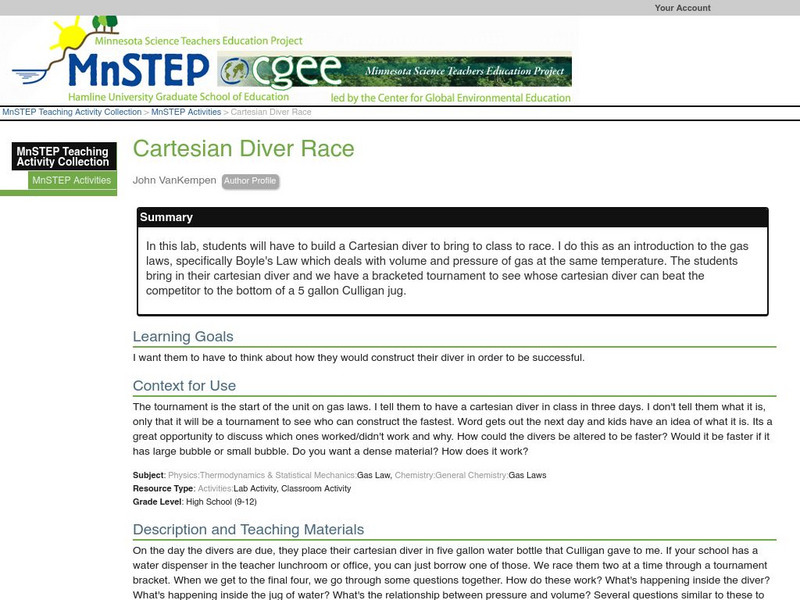
Serc: Cartesian Diver Race
In this lab, students will have to build a Cartesian diver to bring to class to race. I do this as an introduction to the gas laws, specifically Boyle's Law which deals with volume and pressure of gas at the same temperature. The...
Simon Fraser University
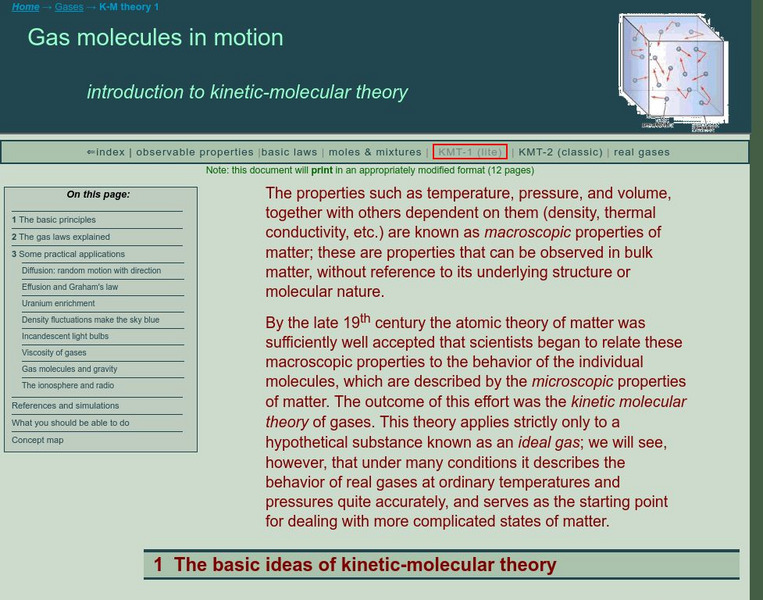
Chem1 Virtual Textbook: Kinetic Molecular Model
The General Chemistry Virtual Textbook, or Chem 1, is broken into several sections covering various aspects of topics related to chemistry. This section deals with the basic components of the Kinetic-Molecular Theory in addition to...
University of Sydney (Australia)
Thermal Physics Module: Ideal Gases [Pdf]
A molecular model of a gas is introduced and explained. Assumptions behind the ideal gas law are presented. The ideal gas law is stated. Charles' law and Boyle's law are derived from the ideal gas law.
OpenStax
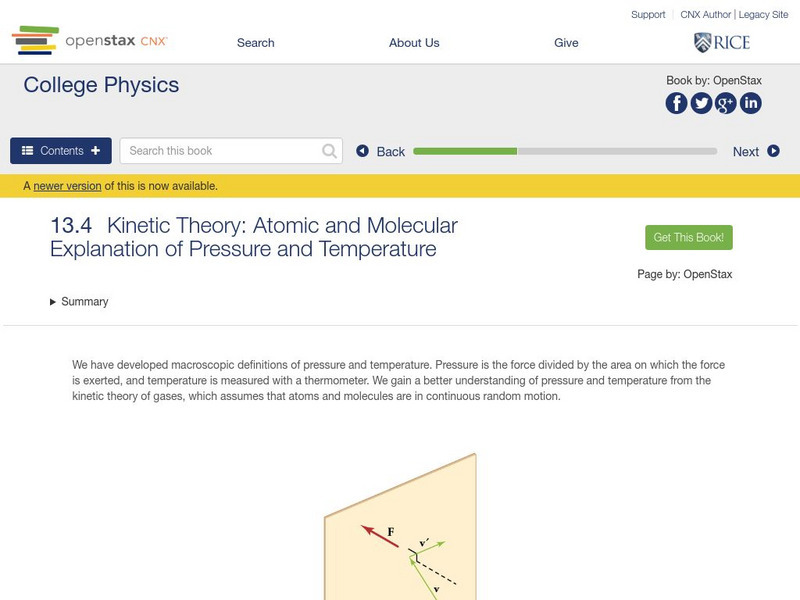
Open Stax: Atomic and Molecular Explanation of Pressure and Temperature
A college textbook section that explores the kinetic theory. Learn how the kinetic theory relates to ideal gas law and thermal energy. Section includes problems and questions for the students to answer to ensure understanding. Book can...
Other
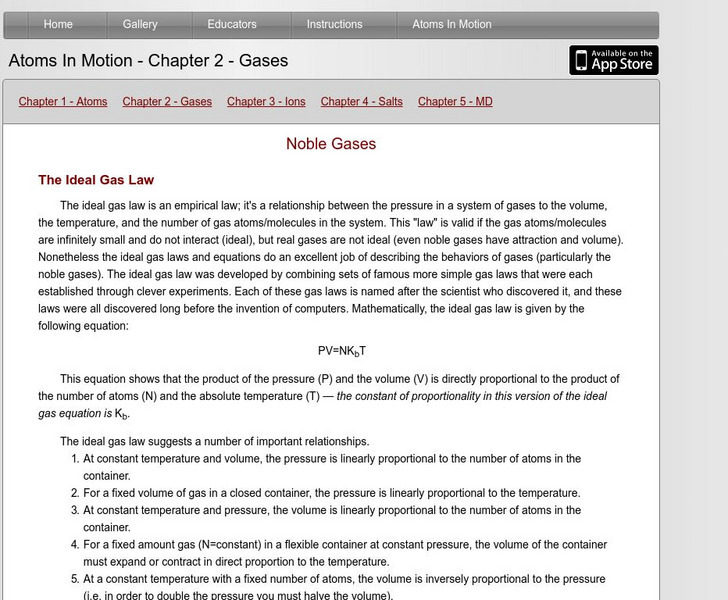
Atoms in Motion: Noble Gases
The ideal gas law is an empirical law; it's a relationship between the pressure in a system of gases to the volume, the temperature, and the number of gas atoms/molecules in the system. This "law" is valid if the gas atoms/molecules are...
Curated OER
Hyper Physics: Ideal Gas Law With Constraints
Boyle's law is derived from the ideal gas law. An equation is given and the derivation is explained.
Curated OER
Hyper Physics: Ideal Gas Law With Constraints
Boyle's law is derived from the ideal gas law. An equation is given and the derivation is explained.
University of Maryland
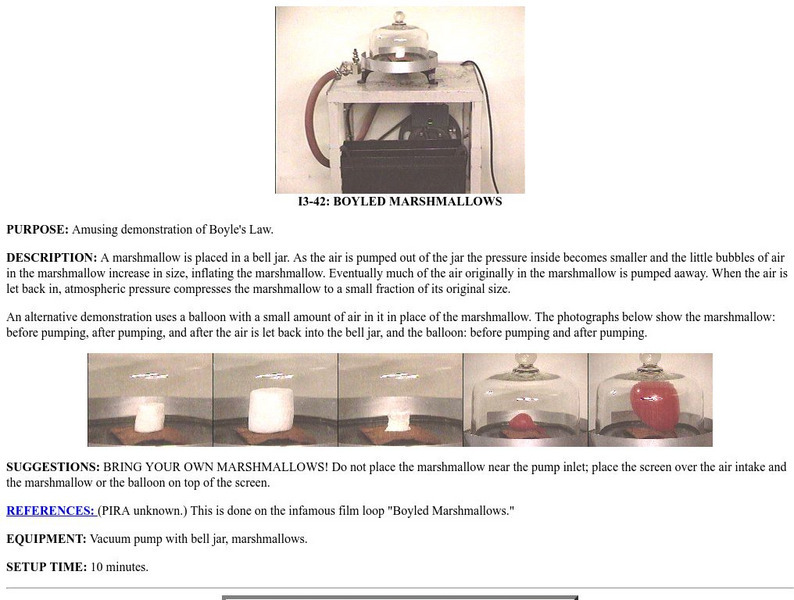
University of Maryland: Boyled Marshmallows
A page from the University of Maryland Physics Lecture Demonstration Facility. Provides directions for a teacher demonstration of Boyle's law. Shows apparatus and set-up; provides suggestions. Easily adaptable as a student project or lab...
Chiral Publishing
Chiral Publishing: An Introduction to Chemistry: Gas Stoichiometry Shortcut
This section of the online book "An Introduction to Chemistry", describes a shortcut that can be used for equation stoichiometry problems that include two gases. An example calculation which shows the shortcut being used is helpful. Also...
Science Education Resource Center at Carleton College
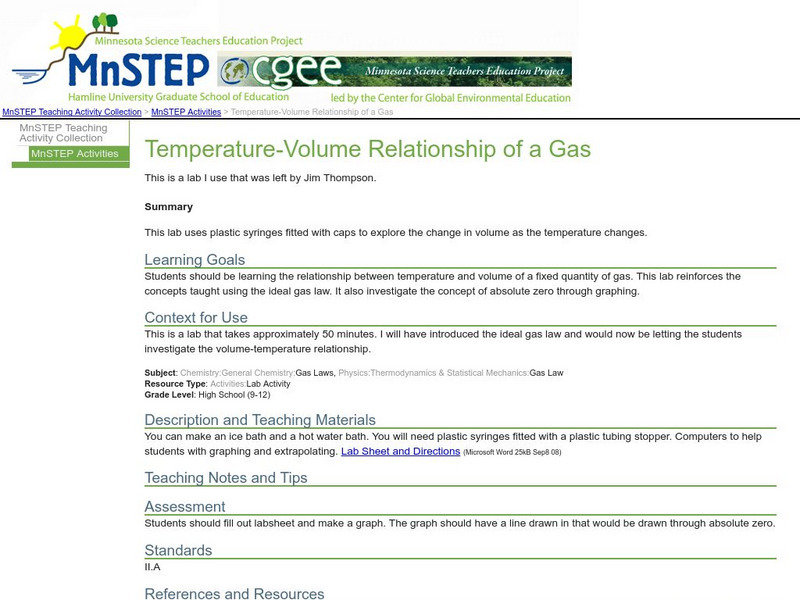
Serc: Mn Step: Temperature Volume Relationship of a Gas
A lab activity where students investigate the relationship between temperature and volume using a plastic syringe with a stopper. The syringe, filled with trapped air, is placed in a hot and a cold water bath, and temperature and volume...
University Corporation for Atmospheric Research
Ucar: What Do Soda and the Oceans Have in Common?
Students will use soda to explore how carbon dioxide is able to dissolve into liquid. They will learn about Henry's law, which describes how the solubility of gas into liquids is dependent on temperature and develop hypotheses about how...

CK-12 Foundation
Ck 12: Plix Series: Gay Lussac's Law
[Free Registration/Login Required] Increase the heat in the virtual container, and observe what happens to the internal pressure.
University of Wisconsin
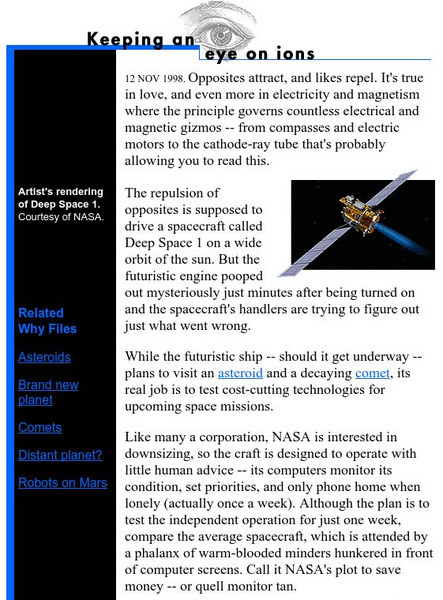
The Why Files: Keeping an Eye on Ions
Discusses the development of a new rocket engine that operates by the ion propulsion as opposed to gas propulsion. Well written and great graphics!
McGraw Hill
Mc Graw Hill Companies: Origins of the Quantum Theory
An indexing page for Chapter 27 (Origins of the Quantum Theory) of the companion web site for McGraw Hill's Contemporary College Physics textbook. Includes several worthy pages with chapter notes, simple definitions, online computer...
University of North Carolina
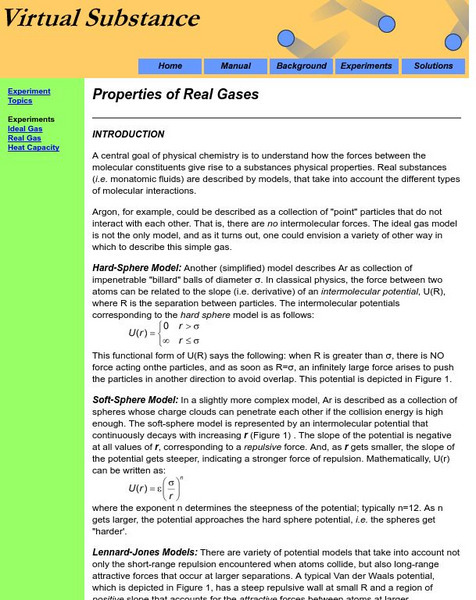
University of North Carolina: Properties of Real Gases
The University of North Carolina at Charlotte Chemistry Department provides slides 36-40 of this a 40-slide PowerPoint presentation. The site discuss real gases and the van der Waals equation of state. The explanation for why gas samples...
Massachusetts Institute of Technology
Mit: Open Course Ware: Courses: Physics: Classical Mechanics
College-level online course highlighting the study of classical mechanics. This course focuses on Newtonian mechanics, fluid mechanics, and kinetic gas theory. Course features include a 35 video lecture series by Walter Lewin. Also link...
University of Oregon
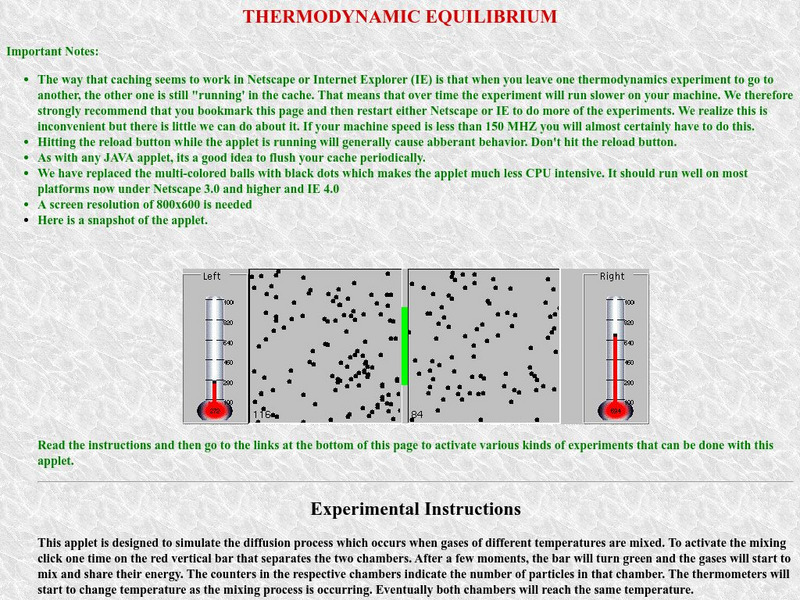
Virtual Laboratory: Thermodynamic Equilibrium
An interactive Java applet which depicts gas diffusion and emphasizes the importance of thermal equilibrium. Directions and challenges available.
TeachEngineering
Teach Engineering: Fluid Power Basics
Students learn about the basic fundamental concepts regarding fluid power, which includes both pneumatic, which utilize gas, and hydraulic, which utilize liquid, systems. Both systems contain four basic components: a reservoir, a pump or...