Hi, what do you want to do?






Utah Education Network
Uen: The Earth Is Flat
Activity helps students understand that the shape of the earth and the moon are spherical.
Harvard University
Chandra X Ray Observatory: Video Podcasts: The Incredible Two Inch Universe
A set of podcasts outlining a four-step process for understanding the vastness of our universe, from the vicinity of the Earth and Moon, out into distant galaxies. Downloadable instructions and a handout are included, as well as...
Utah Education Network
Uen: A Moon With a View
Understand the rotation of the earth and the appearance of movement of other bodies in the sky.
TeachEngineering
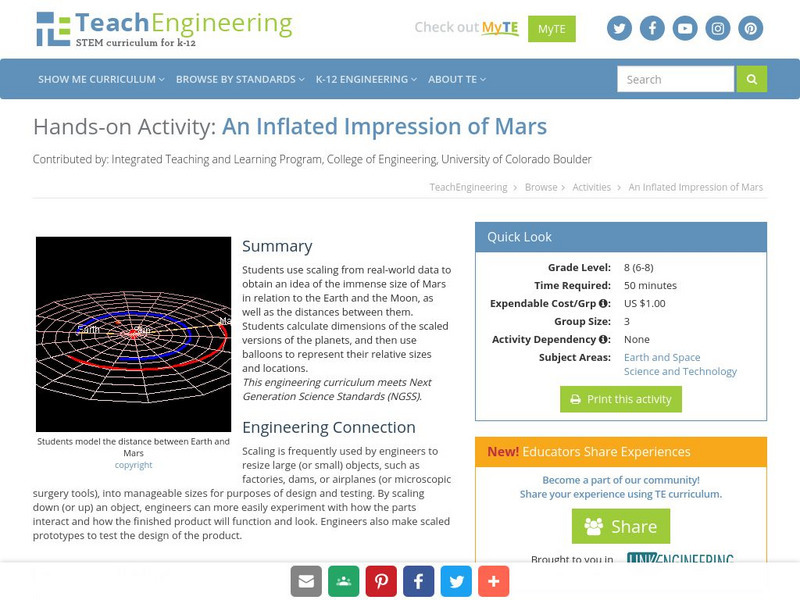
Teach Engineering: An Inflated Impression of Mars
The purpose of this activity is to use scaling in order to give students an idea of the size of Mars in relation to the Earth and the Moon as well as the distance between them. The students will have to calculate dimensions of the scaled...
Other
Buzzle.com: Univer Savvy: Which Is Bigger the Earth or Sun?
Find out what the diameter and volume of the Earth and the Sun are and learn just how much bigger the Sun is. Also explains how the Sun compares to the Moon.
Utah Education Network
Uen: The Night Sky
Learn about the rotation of the earth, the movement of the moon, and the position of the sun.

Alabama Learning Exchange
Alex: Sun, Earth, and Moon: Calendar of Events
During this lesson students are going to take a look at moon phases and sunrise-sunset times in order to learn about daylight hours. Students discover that we do not always have the same amount of daylight each day. This lesson is best...

CK-12 Foundation
Ck 12: Earth Science: Tides
[Free Registration/Login may be required to access all resource tools.] Reveals tidal patterns and that tides are caused by the gravitational attraction of the Sun and Moon to Earth.
Nine Planets
The Nine Planets: An Overview of the Solar System
A detailed overview of the history, mythology, and current scientific knowledge of each of the planets and moons in the solar system.
TeachEngineering
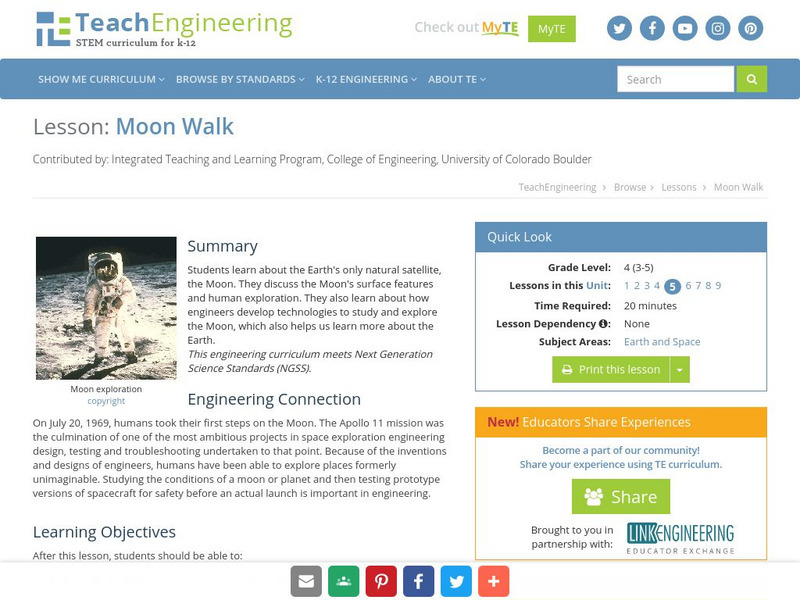
Teach Engineering: Moon Walk
Students learn about the Earth's only natural satellite, the Moon. They discuss the Moon's surface features and human exploration. They also learn about how engineers develop technologies to study and explore the Moon, which also helps...
Annenberg Foundation
Annenberg Learner: Moon Journal Activity
Students use the process of journaling to make discoveries about the moon. This activity involves having students write observations about the moon in a journal. Using their observations they go to an online resource and choose...
Annenberg Foundation
Annenberg Learner: Earth and Space Science: Our Nearest Neighbor: The Moon
Material to begin an exploration of the Moon, theories about its origin, and its history's relationship to our Earth's history. An hour-long video is accompanied by learning goals, an outline and overview, details on the Moon's movement,...
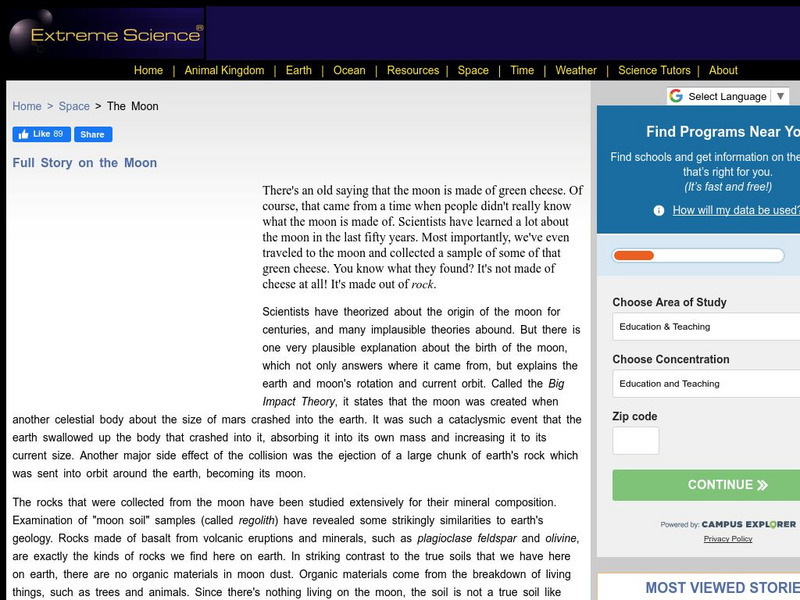
Extreme Science
Extreme Science: The Moon
Read about the birth of Earth's moon, its composition, orbit, visible phases, and other interesting facts. Link to a virtual moon phase interactive which shows the current lunar phase and the phase on any date in the past or future.
NASA
Nasa Space Place: All About the Moon
Learn all about the moon, what makes it glow, and its phases. Includes some exciting images.
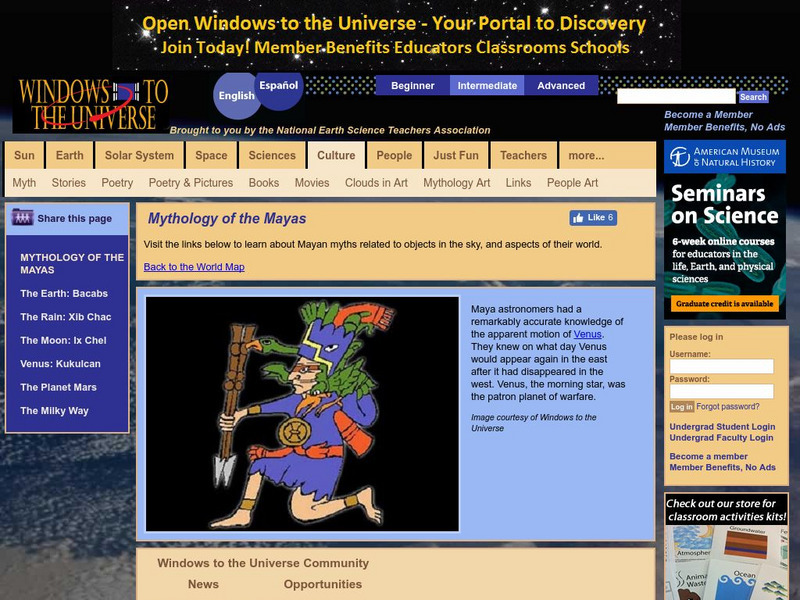
National Earth Science Teachers Association
Windows to the Universe: Mythology of the Mayas
This article from the Windows to the Universe gives information on Mayan myths related to the Earth, rain, the Moon, Venus, Mars, and the Milky Way. There are illustrations and explanations of vocabulary. Choose from beginner to advanced...
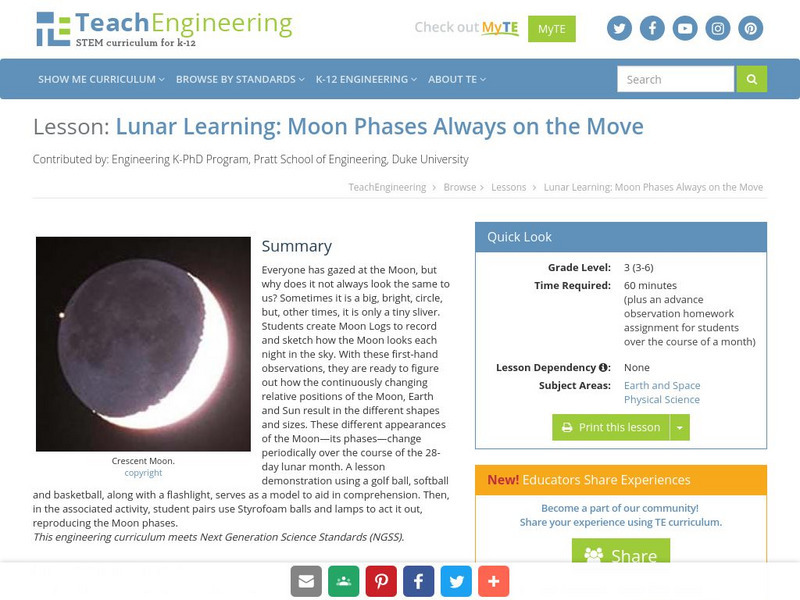
TeachEngineering
Teach Engineering: Lunar Learning
Why does the Moon not always look the same to us? Sometimes it is a big, bright, circle, but, other times, it is only a tiny sliver, if we can see it at all. The different shapes and sizes of the slivers of the Moon are referred to as...
Other
Bad Astronomy/phil Plait: Tides and Why Our Days Are Getting Longer
Why does the Moon always shows the same face to the Earth? Why is the Moon's rotation period the same as the length of time it takes to orbit the Earth? Why are there two tides a day? These questions and more are answered here.

Ducksters
Ducksters: Earth Science for Kids: Ocean Tides
Did you know the rising and falling of the sea level is caused by the gravity of the Moon and the Sun? Kids learn about ocean tides including tidal currents and types of tides on this site.
NASA
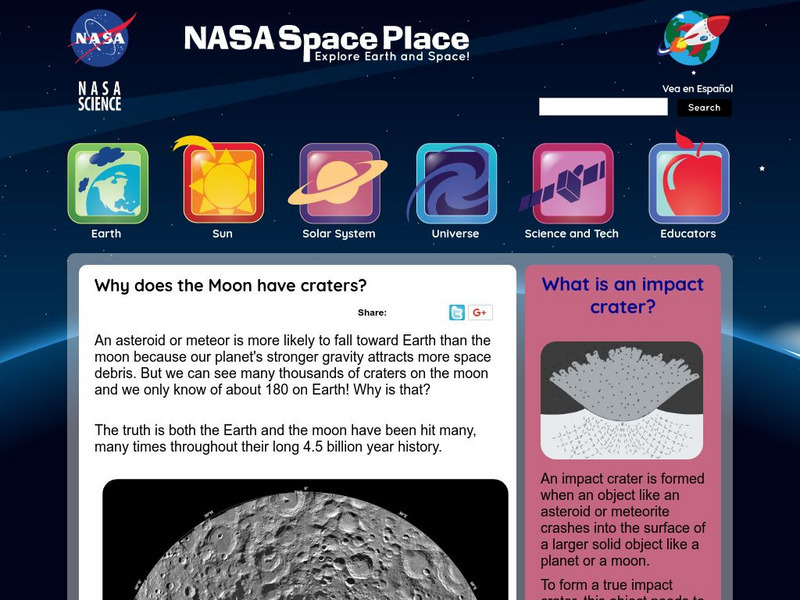
Nasa: Space Place: Why Is the Moon So Scarred With Craters?
Find out about why Earth's moon is full of craters, and what happens to asteroids and meteors when they come into contact with Earth.
Annenberg Foundation
Annenberg Learner: Teachers' Lab: A Private Universe
This section is dedicated to educators to become expert instructors on topics like: distance between Earth, the Sun, and the moon, the phases of the moon, and reason for the seasons. Site includes information about how to address...

Enchanted Learning
Enchanted Learning: Earth's Oceans Tides
This site explains what tides are and the difference between Proxigean Spring Tides, spring tides, and neap tides, and how these are formed. Graphic illustrations are provided.
Cornell University
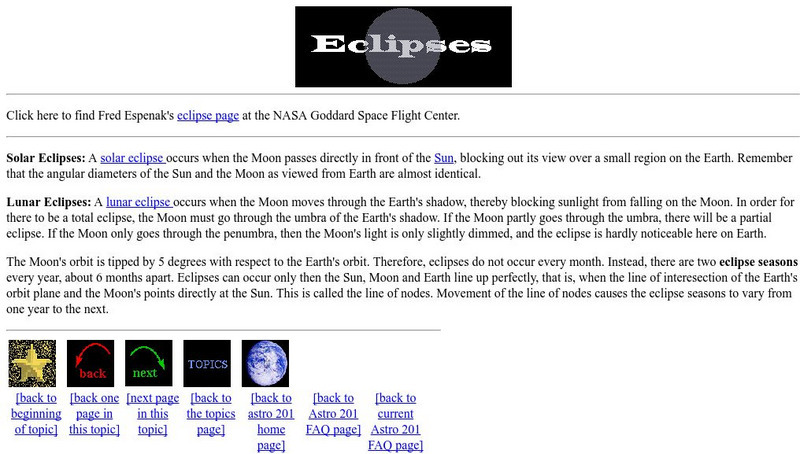
Cornell University: Astronomy: Eclipses
This site from the Astronomy Department of Cornell University provides brief introduction to both solar and lunar eclipses. Links are provided for pictures and charts of the eclipses, and this is a good site to check out on the subject.
NASA
Nasa: Solar System Exploration
Enter our solar system to interact with the planets, moons, asteroids, meteors, and more. Investigate with NASA scientists and explore missions related to space exploration. Read facts, compare statistics, look through resources, and...
Better Lesson
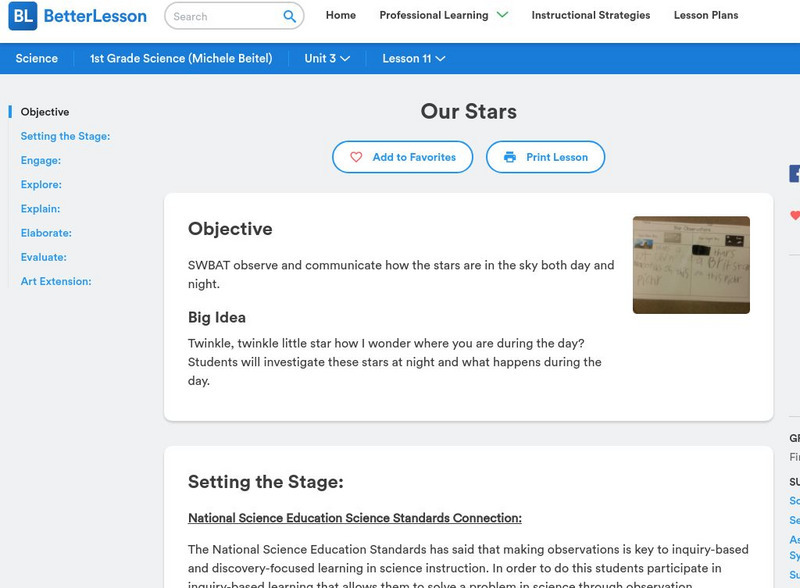
Better Lesson: Our Stars
In this lesson, students will observe and communicate how the stars are in the sky both day and night. The extremely detailed lesson includes photos and videos of the lesson in actions, examples of student's work, materials, parent...