Hi, what do you want to do?






Utah Education Network
Uen: The Earth Is Flat
Activity helps students understand that the shape of the earth and the moon are spherical.
Harvard University
Chandra X Ray Observatory: Video Podcasts: The Incredible Two Inch Universe
A set of podcasts outlining a four-step process for understanding the vastness of our universe, from the vicinity of the Earth and Moon, out into distant galaxies. Downloadable instructions and a handout are included, as well as...
Utah Education Network
Uen: A Moon With a View
Understand the rotation of the earth and the appearance of movement of other bodies in the sky.
TeachEngineering
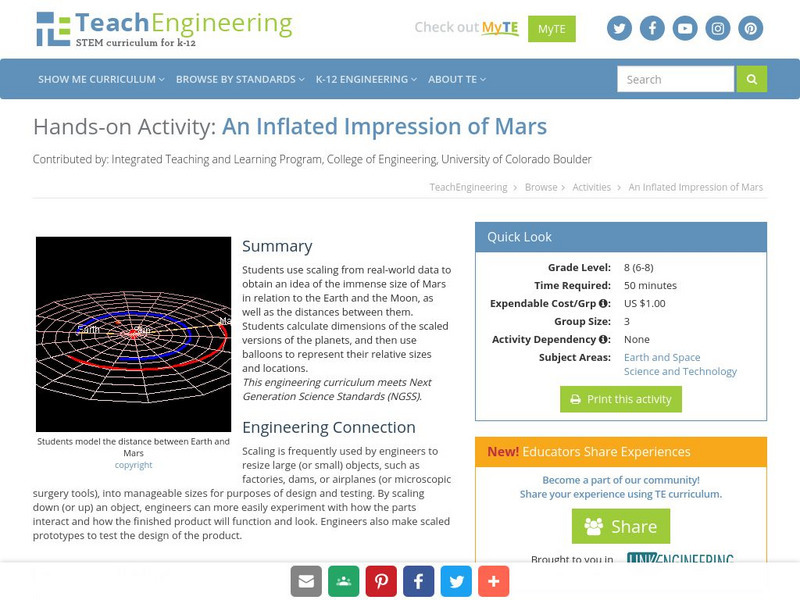
Teach Engineering: An Inflated Impression of Mars
The purpose of this activity is to use scaling in order to give students an idea of the size of Mars in relation to the Earth and the Moon as well as the distance between them. The students will have to calculate dimensions of the scaled...
PBS
Pbs Learning Media: Epic Earth
This mesmerizing video shows seven views of the earth taken by NASA's camera. Watch the moon cross over the earth, storms in the ocean, and smoke from a wildfire. Included are teaching tips for teachers and background information.

Nine Planets
The Nine Planets: Earth Facts
Find lots of information about our planet Earth here. Covers basic facts, Earth's history, layers of the Earth, plate tectonics, composition of the atmosphere, Earth's magnetic field, and some facts about our moon.
Nine Planets
The Eight Planets: Earth
Excellent Eight Planets site that provides a vast amount of information about planet Earth. Very comprehensive and complete site.
Nine Planets
The Nine Planets: The Moon
Explore the mythology, structure, observational history, gravitational force, and orbit of Earth's Moon.
PBS
Pbs Learning Media: Why Doesn't the Moon Fall Down?
In this animated video segment adapted from NASA, astronomer Doris Daou explains how the forces of speed and gravity keep the moon in a constant orbit around Earth. [1:36]
Harvard University
Harvard University: Eye on the Sky, Feet on the Ground
An ebook filled with information and classroom activities covering several astrological topics such as the Earth's rotation and the solar system. Many tips and teaching tools are available to aid in discovering what the sky has to offer.
Annenberg Foundation
Annenberg Learner: Moon Journal Activity
Students use the process of journaling to make discoveries about the moon. This activity involves having students write observations about the moon in a journal. Using their observations they go to an online resource and choose...
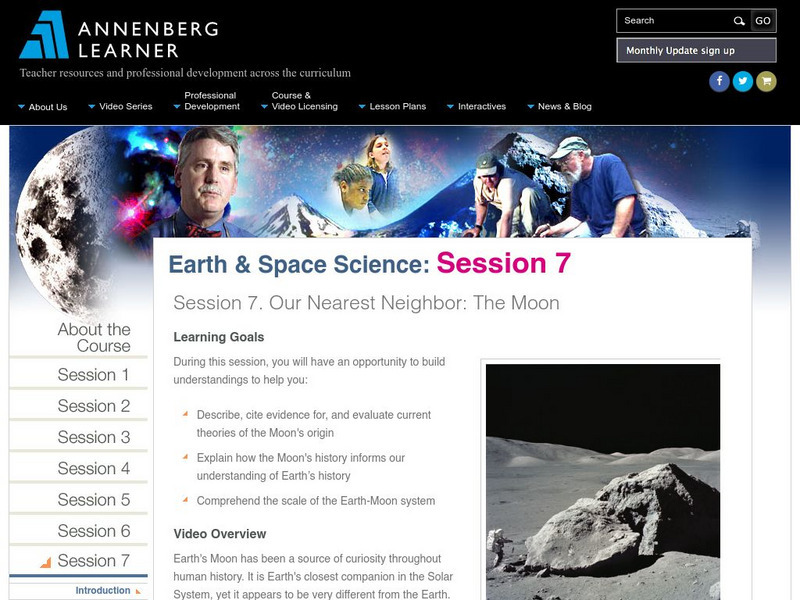
Annenberg Foundation
Annenberg Learner: Earth and Space Science: Our Nearest Neighbor: The Moon
Material to begin an exploration of the Moon, theories about its origin, and its history's relationship to our Earth's history. An hour-long video is accompanied by learning goals, an outline and overview, details on the Moon's movement,...

Blackdog Media
Classic Reader: Author: Jules Verne
This site focuses on the author Jules Verne. It includes a link to his biography and links to the full text of eleven novels: 20,000 Leagues Under the Sea, Around the World in 80 Days, Eight Hundred Leagues on the Amazon, Five Weeks in a...
University of Texas at Austin
The University of Texas Mc Donald Observatory: Earth's Moon
Discover interesting facts about Earth's partner, the moon, which is more like a double planet than a planet and a moon.
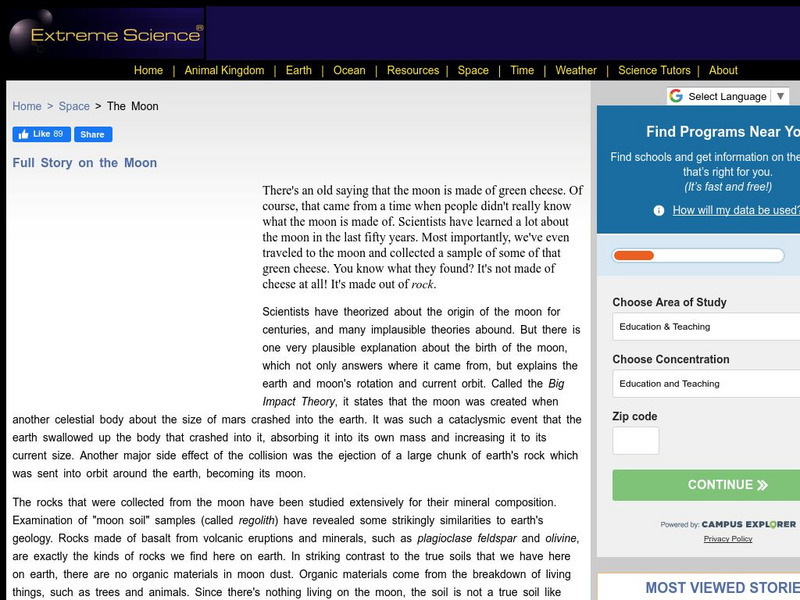
Extreme Science
Extreme Science: The Moon
Read about the birth of Earth's moon, its composition, orbit, visible phases, and other interesting facts. Link to a virtual moon phase interactive which shows the current lunar phase and the phase on any date in the past or future.
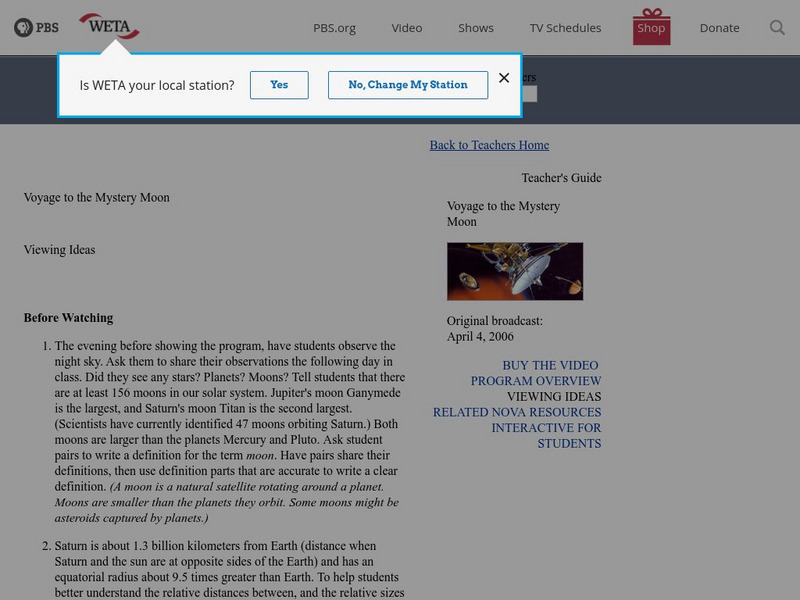
PBS
Pbs Teachers: Voyage to the Mystery Moon
Observe the night sky and speculate the distance between the Earth and its moon and Saturn and its moon. Explore how scientists have used robots to learn about celestial bodies, and conduct research about one of Saturn's moons.
Other
Lunar and Planetary Institute: Explore! Marvel Moon
A variety of hands-on activities designed to engage children in learning about the moon.
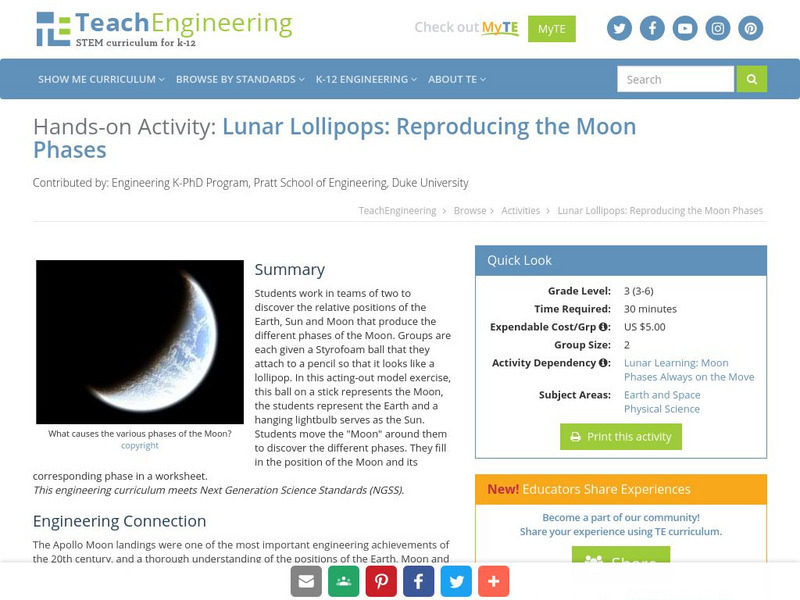
TeachEngineering
Teach Engineering: Lunar Lollipops
The students work in teams of two to discover the relative positions of the Earth, Sun and Moon that produce the different phases of the Moon. The students will be given a Styrofoam ball that they will attach to a pencil so that it looks...
Other
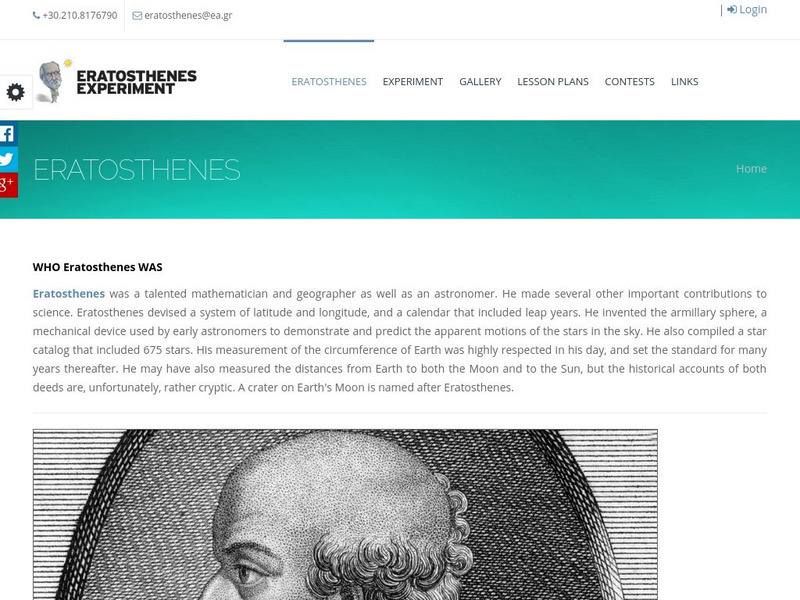
Ellinogermaniki Agogi: Eratosthenes Experiment
A profile of the ancient Greek mathematician, geographer, and astronomer, Eratosthenes. Looks at his many accomplishments, including measuring the circumference of the Earth and the distance to the Moon and the Sun. Includes links to...
NASA
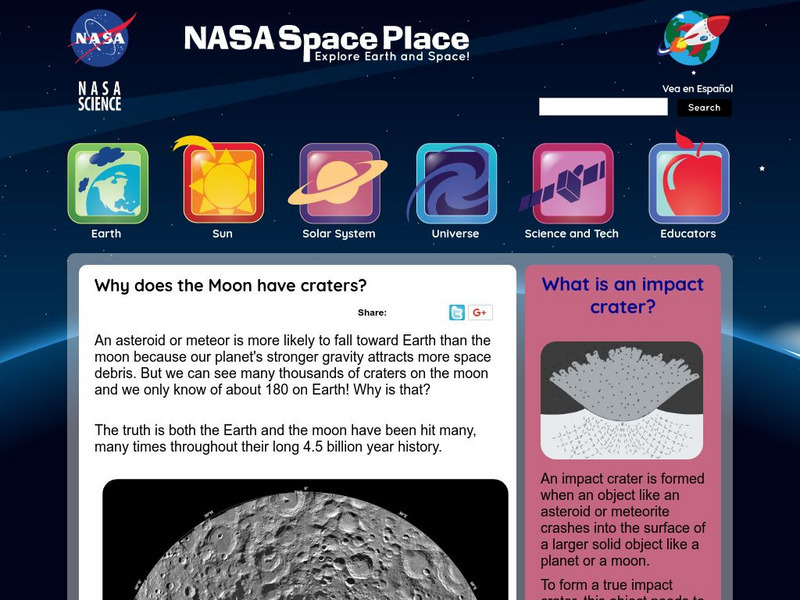
Nasa: Space Place: Why Is the Moon So Scarred With Craters?
Find out about why Earth's moon is full of craters, and what happens to asteroids and meteors when they come into contact with Earth.

TED Talks
Ted: Ted Ed: A Rare, Spectacular Total Eclipse of the Sun
Andy Cohen details the extraordinary celestial phenomenon of a total solar eclipse, and when it will next occur. [3:47]
Cornell University
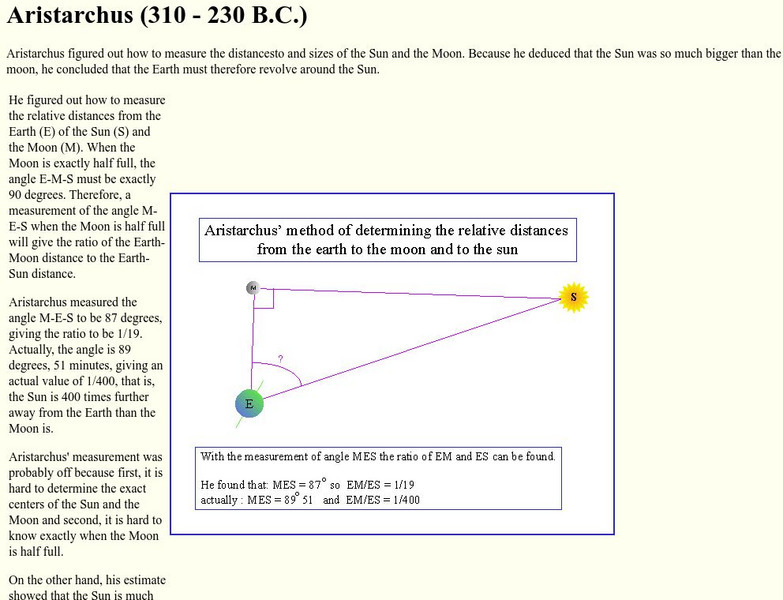
Cornell University: Astronomy: Aristarchus
This site from Cornell University provides a discussion of how Aristarchus arrived at his conclusions of the distance from the Earth to the Sun and Moon. Also has his methods for determining the size of the Moon and the Sun.
NASA
Nasa: Solar System Exploration
Enter our solar system to interact with the planets, moons, asteroids, meteors, and more. Investigate with NASA scientists and explore missions related to space exploration. Read facts, compare statistics, look through resources, and...
Other
Elementary Science Program: Astronomy, Gr. 5 8
"Astronomy is the science that studies the Earth, the Moon and other objects in space. It has helped us discover our place in the physical universe. It is still making discoveries." This landing page gives options for students and...