Hi, what do you want to do?






Khan Academy
Khan Academy: Dalton's Atomic Theory
An article describing Dalton's atomic theory. Learn how this theory was the first attempt to describe a fundamental part of matter, atoms. Article also discusses where the theory is incorrect based on the knowledge we have today.

Khan Academy
Khan Academy: Dalton's Atomic Theory
Article explores the key points of Dalton's atomic theory and the laws of conservation of mass and constant composition. Which points do we still use today?
Khan Academy
Khan Academy: Dalton's Atomic Theory
Resource investigates the beliefs of Dalton's atomic theory which consists of four parts. Which points do we still use today, and what have we learned since Dalton?

Utah Education Network
Uen: Timeline for the Atom
Students will examine how significant scientific theories are developed, explore the work of scientists who contributed ideas to the atomic theory, and develop a timeline of key scientists to show how the work of each one built on the...
Science Struck
Science Struck: Explanation of John Dalton's Atomic Theory
Explains the basic tenets of Dalton's atomic theory.
PBS
Pbs Learning Media: That's My Theory!
Become a game show contestant in this online activity from A Science Odyssey and ask a series of questions to a panel of mystery scientists, using the answers to determine which scientist is Einstein.
BBC
Bbc: Gcse Bitesize: Atomic Structure
This lesson focuses on the structure of atoms. All substances are made from atoms. Each atom is made of a nucleus - containing protons and neutrons - surrounded by electrons. It provides a link to an assessment.
PBS
Pbs: Planck Discovers the Quantum Nature of Energy
PBS offers a short summary of the discovery of the quantum nature of the atom by Max Planck. Easy to follow.
Lawrence Berkeley National Laboratory
Berkeley Lab: The Atom
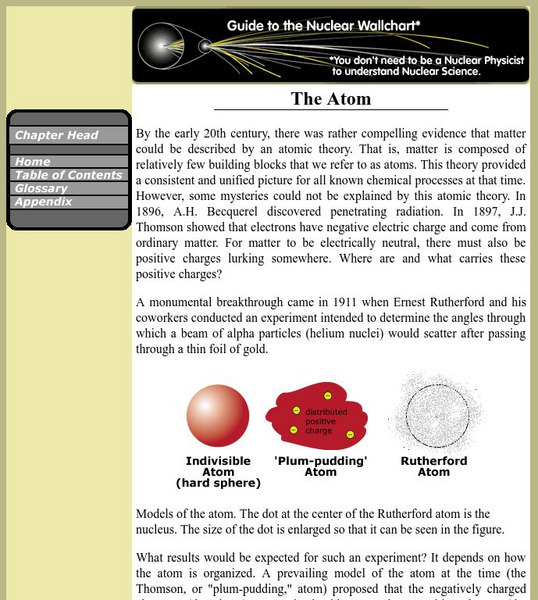
Presented is an overview of atomic theory concentrating on the experiments of Ernest Rutherford.
Boise State University
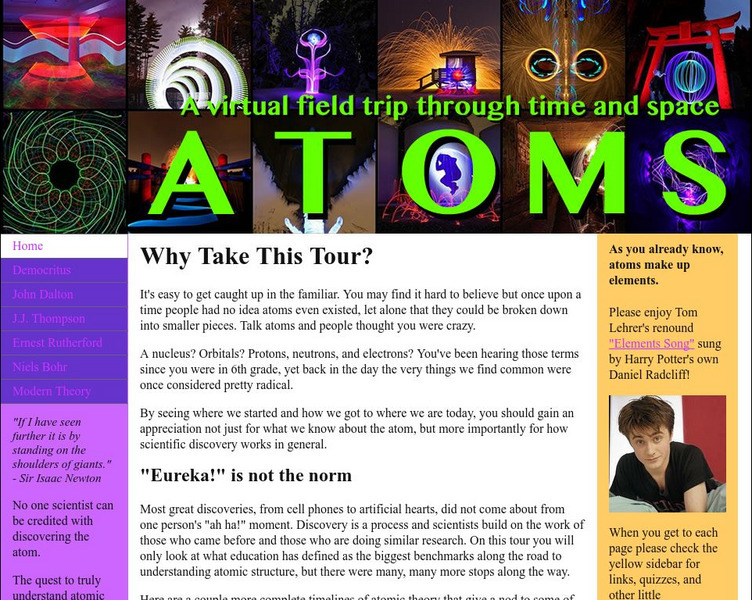
Boise State University: Atoms: A Virtual Field Trip Through Time and Space
Learn about the models of the atom that have been proposed throughout history. Presents Democritus, John Dalton, J.J. Thomson, Ernest Rutherford, Niels Bohr, and the modern theory of the atom. Sections are accompanied by journal...
Other
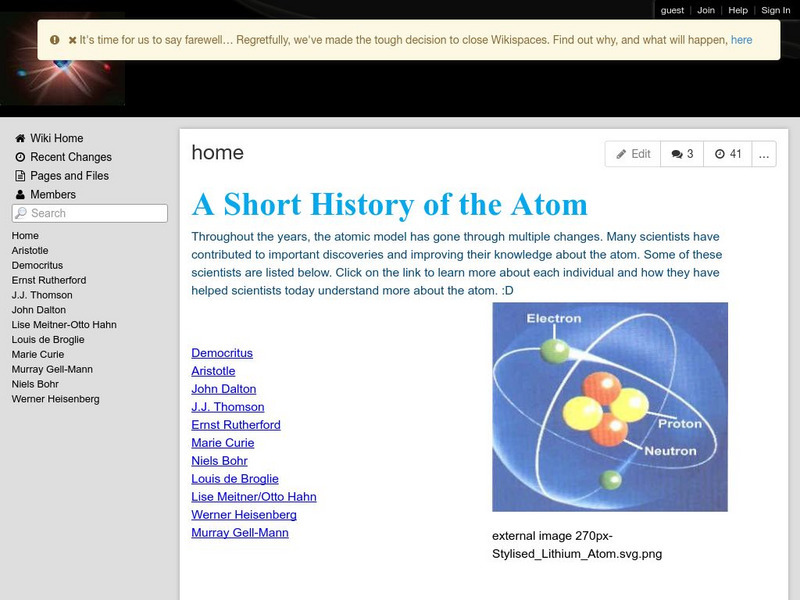
A Short History of the Atom
A classroom wiki where students present profiles of scientists who developed models of the atom or who contributed to the understanding of atomic theory. Covers Democritus, Aristotle, John Dalton, J.J. Thomson, Ernest Rutherford, Marie...
Other
Crocodile Clips: Absorb Chemistry: History of the Atom
A tutorial that presents models of the atom proposed by John Dalton, J.J. Thomson, Ernest Rutherford, and Niels Bohr. Each is supported by an animated illustration. Includes comprehension questions and a quiz at the end.
Exploratorium
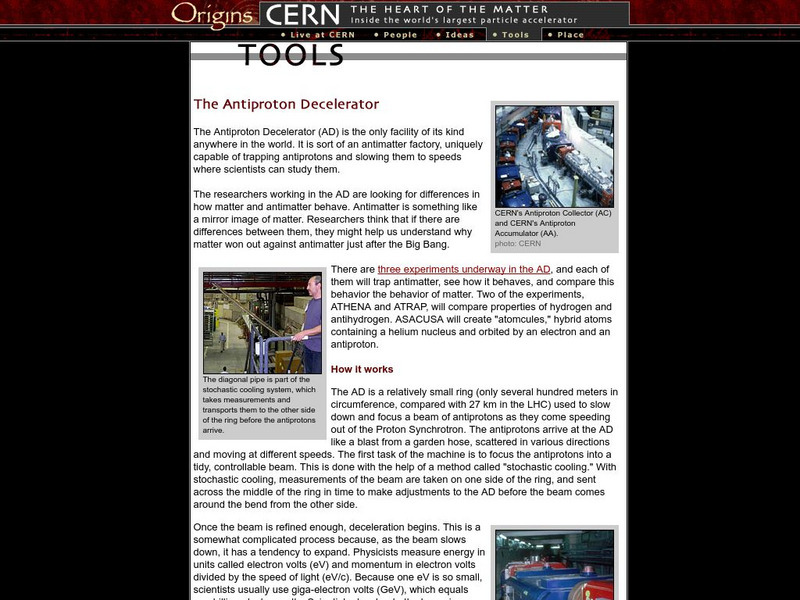
Exploratorium: Cern: The Antiproton Decelerator
Explains the function of the Antiproton Decelerator, a device at the European Center for Nuclear Research used to "slow down" bunches of antiprotons for use in experiments.
University of Wisconsin
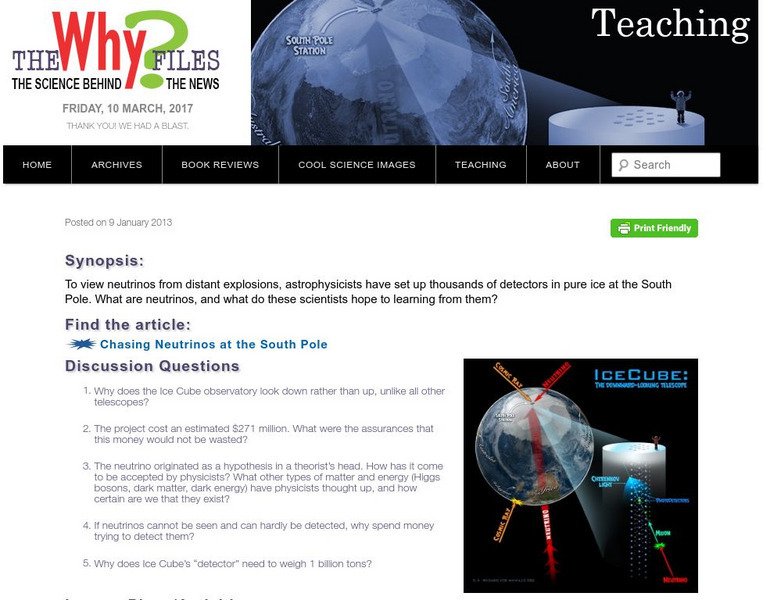
The Why Files: Learning About Neutrinos
A learning resource to understand what neutrinos are and their importance to science.

National High Magnetic Field Laboratory
Magnet Academy: Enrico Fermi
Enrico Fermi was a titan of twentieth-century physics. He outlined the statistical laws that govern the behavior of particles that abide by the Pauli exclusion principle and developed a theoretical model of the atom in his mid-twenties....
Science Struck
Science Struck: Plum Pudding Model
Describes J.J. Thomson's theory of atomic structure, called the 'Plum Pudding Model,' and how it was disproved by Ernest Rutherford.
Cosmo Learning
Cosmo Learning: Ap Chemistry With Chemguy
Need to review a topic for AP Chemistry? This site features a collection of video lectures covering the curriculum of AP Chemistry. The lectures are broken up by topics and vary in length. Lectures cover thermodynamics, bonding,...
Exploratorium
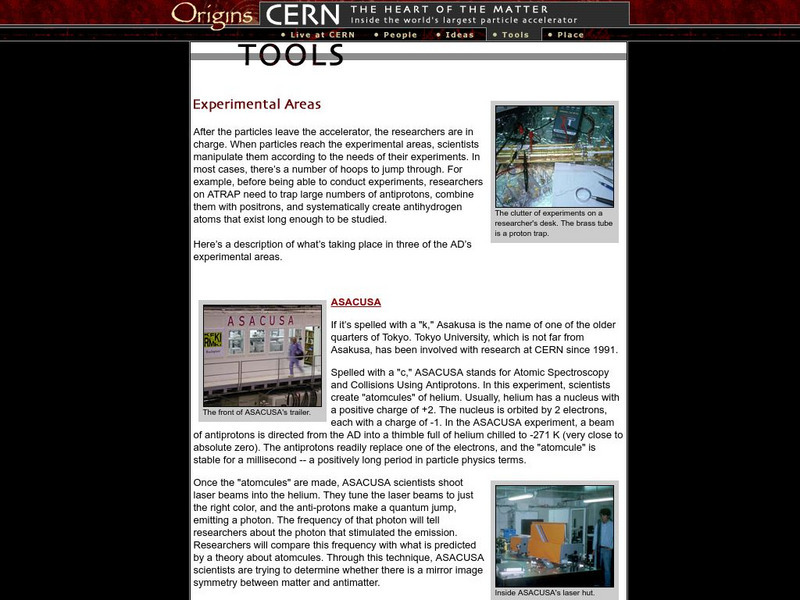
Exploratorium: Cern: Experiments With Antimatter
A description of the two primary experiments conducted at CERN on antimatter: ASACUSA, an attempt to form "Atomcules," using antiprotons; and ATHENA, an experiment to compare the properties of hydrogen and antihydrogen.
Chem Tutor
Chem Tutor: States of Matter
A very descriptive site that allows students to understand the different states of matter at the atomic level. Also discusses the process of phase changes and displays phase change graphs. Thermochemistry is also touched upon for high...
University of St. Andrews (UK)
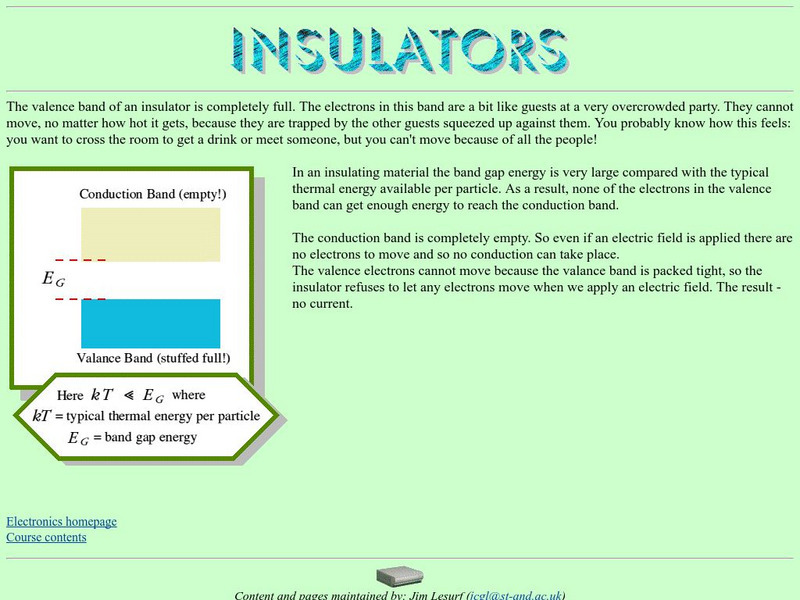
University of St. Andrews: Insulators
The nature of insulators is described at the atomic level. Band gap theory is used to explain what distinguishes insulators from conductors.
PBS
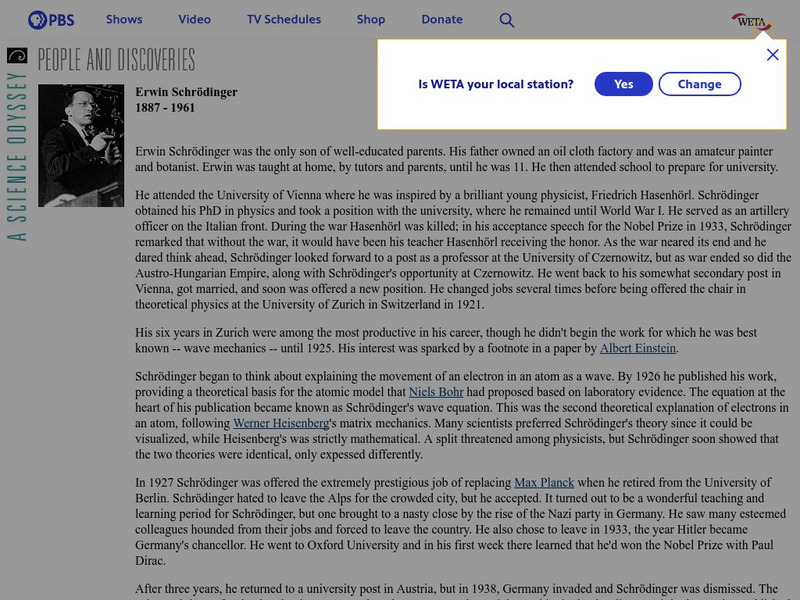
Pbs: People and Discoveries
At this PBS site there is a biography of the Austrian physicist Erwin Schrodinger who lived from 1887 until 1961.
Chem4kids
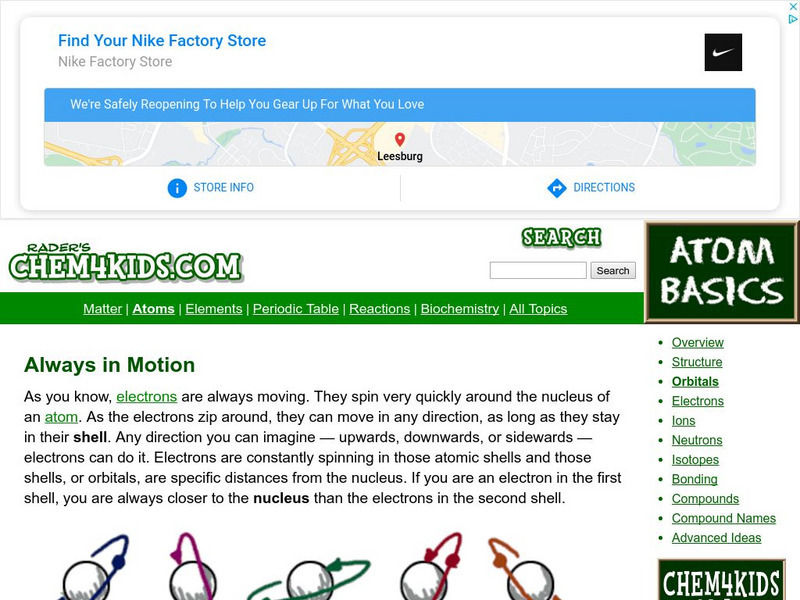
Chem4 Kids: Atoms: Orbitals
The website provides an explanation of the electrons' position in their orbitals as they spin around the nucleus. Quantum theory is also explored by explaining that the exact location of a specific electron is a not exact but a guess.
Towson University
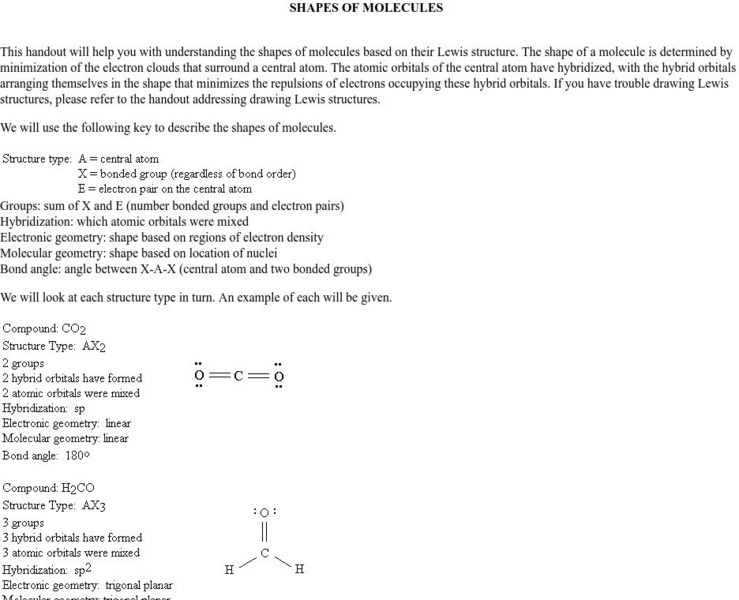
Towson University: Shapes of Molecules
This chemistry class printout details the main points of molecular geometry and explains bond hybridization and bond angles.