Hi, what do you want to do?






SciShow
The Asteroid Belt: Not What You Think!
Buckle up for a trip to the asteroid belt -- though it's not nearly as dangerous out there as you might think. But there's a LOT waiting to be discovered, including some crucial clues about the formation of the solar system itself.
Ancient Lights Media
The Inner Planets of the Solar System - Volume Two: Earth, Mars and the Asteroid Belt- Solar System Series
This video examines details relating to the planets Earth, Mars and their moons, as well as the Asteroid Belt.
Visual Learning Systems
The Outer Planets: the Asteroid Belt
Students are taken on an exciting animated trip to the outer reaches of our solar system. Images from NASA and the Hubble space Telescope illustrate the Giant Red Spot on Jupiter, Saturns' beautiful rings, the tilted rings of Uranus, and...
Professor Dave Explains
Pluto, Comets, Asteroids, and the Kuiper Belt
We've just wrapped up a survey of all the planets and moons in the solar system. But is that all there is? Not even close! There are tons of objects that make up the asteroid belt, the Kuiper belt, the Oort cloud, you can't even believe...
Crash Course
Asteroids
Now that we’ve finished our tour of the planets, we’re headed back to the asteroid belt. Asteroids are chunks of rock, metal, or both that were once part of smallish planets but were destroyed after collisions. Most orbit the Sun between...
SciShow
The Two Asteroids That Shouldn’t Be There
Space Clue: 203 Pompeja and 269 Justitia in the asteroid belt with evidence of being formed outside of it. But the real mystery is how they got there! And we again return to Ganymede with new evidence suggesting even more kinds of water...
SciShow
We Just Took the First Image of a Baby Planet!
SPHERE took a photo of a baby planet and the origin of the asteroid belt may be less mysterious than we thought.
SciShow
The Disappointing Reality of the Asteroid Belt | SciShow Tangents: Asteroids
Welcome to SciShow Tangents, the lightly competitive game show podcast brought to you by the team behind SciShow! For too long, you've only been able to hear SciShow Tangents. Well, no more! SciShow Tangents has officially come to...
Curated Video
Exploring the Kuiper Belt: Home of Dwarf Planets and Frozen Debris
In this video, the topic of discussion is the Kuiper Belt, a region in our solar system that extends from the orbit of Neptune. It is similar to the asteroid belt but much larger, and is home to three recognized dwarf planets, including...
NASA
Gravity Assist: The Bright Spot of the Asteroid Belt, with Britney Schmidt
Between the orbits of Mars and Jupiter is a mysterious dwarf planet called Ceres. Its surface is dark and muddy, but has hundreds of patches of bright material.
Next Animation Studio
The Sun will someday destroy the asteroid belt before it dies
Billions of years from now, the Sun will exhaust its hydrogen fuel and enter what astronomers call the ‘giant branch’ phase.
<br/>
American Museum of Natural History
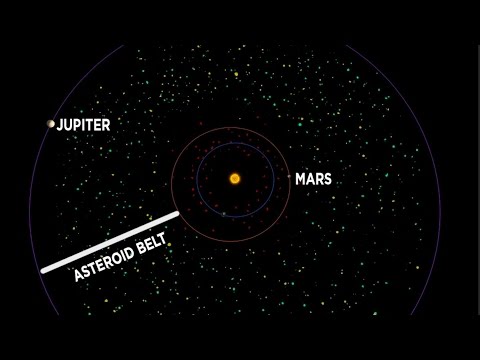
Why Are There No Planets in the Asteroid Belt?
The asteroid belt provides important clues into the history of our solar system. Meteorite specialist Denton Ebel, curator in the Division of Physical Sciences, explains different theories of solar system formation and how the asteroid...
SciShow
The Solar System Might Have a New Dwarf Planet! SciShow News
After observing what we thought was just a big asteroid in the asteroid belt, a team of astronomers now thinks this might qualify as a dwarf planet. And scientists had the chance to directly observe the collision of two neutron stars for...
SciShow
What We've Learned from the Dawn Mission So Far
The Dawn spacecraft has been exploring the two largest objects in the asteroid belt since 2007, and here's what we've learned so far!
SciShow
Move Over, Mars We Could Farm on Asteroids!
When people live throughout the solar system, we'll need some way to feed them that doesn't involve constant shipments of Earth-grown food. Will the asteroid belt be our new cosmic food court?
Curated Video
What Are Asteroids And Where Do They Come From?
Asteroids are small, rocky objects that orbit the sun, just like the rest of the planets and celestial bodies in our solar system. Although asteroids are present throughout the solar system, most of them live in the asteroid belt—a...
Science ABC
What Are Asteroids And Where Do They Come From?
Asteroids are small, rocky objects that orbit the sun, just like the rest of the planets and celestial bodies in our solar system. Although asteroids are present throughout the solar system, most of them live in the asteroid belt—a...
Visual Learning Systems
Our Distant Neighbors: the Most Massive Planet
Upon viewing the Our Distant Neighbors video series, students will be able to do the following: Create a simple diagram of the sun and the orbital paths of each planet around the sun. Label each of the eight planets. Explain that the sun...
Curated Video
Asteroid - Rocky Objects in Space
Objects composed of rocky or metallic materials, mainly found orbiting the Sun in a region called the asteroid belt between Mars and Jupiter. A Twig Science Glossary Film. Key scientific terms defined in just 60 seconds using stunning...
Curated Video
Discovering a Massive Asteroid Belt: Insights into Planetary Formation
NASA's Jet Propulsion Laboratory has discovered a massive asteroid belt, 25 times larger than our solar system's, orbiting a star 41 light years away. Using the Spitzer telescope, scientists observed excess radiation from the belt,...
TMW Media
Threatening Asteroids From Space: Learn how asteroids affected the Earth in the past
Where are the impacts on Earth? What is the asteroid belt? Are there collisions in the asteroid belt? How do we find old craters?<br/>
Threatening Asteroids From Space, Part 1
Threatening Asteroids From Space, Part 1
FuseSchool
PHYSICS - Astrophysics - The Solar System (Part 1)
In this video we will begin to look at some of the key features that describe the parts our Solar System. Quite simply it is the name given to the collection of planets and other bodies that orbit a star. It is only recently by using...
FuseSchool
The Solar System Part 1| Astrophysics
"""CREDITS
Animation
& Design:
/>Joshua T
homas
r/>Narr
ation:
Dale
Bennett
Script:
Alistair Haynes
In this video we will begin to look at some of the
key features...
Animation
& Design:
/>Joshua T
homas
r/>Narr
ation:
Dale
Bennett
Script:
Alistair Haynes
In this video we will begin to look at some of the
key features...
NASA
Gravity Assist: This Asteroid Is Metal, With Lindy Elkins-Tanton
Scientists will soon have the opportunity to visit a unique object in the asteroid belt called Psyche, which may be the exposed metallic core of a planetary body that stopped growing before it became a big planet like Earth. Dr. Lindy...