Hi, what do you want to do?






Core Knowledge Foundation
Volume 1 - A History of the United States: Precolonial to the 1800s
Volume One of the 299-page Core Knowledge History of the United States covers events from the Precolonial Period to the 1800s.

Rice University
American Government 2e
An informative resource provides a textbook on American government that covers topics such as the definition of government and how democracy works. Each section provides brief questions at the end to assess scholars' understanding.
Henry J. Sage
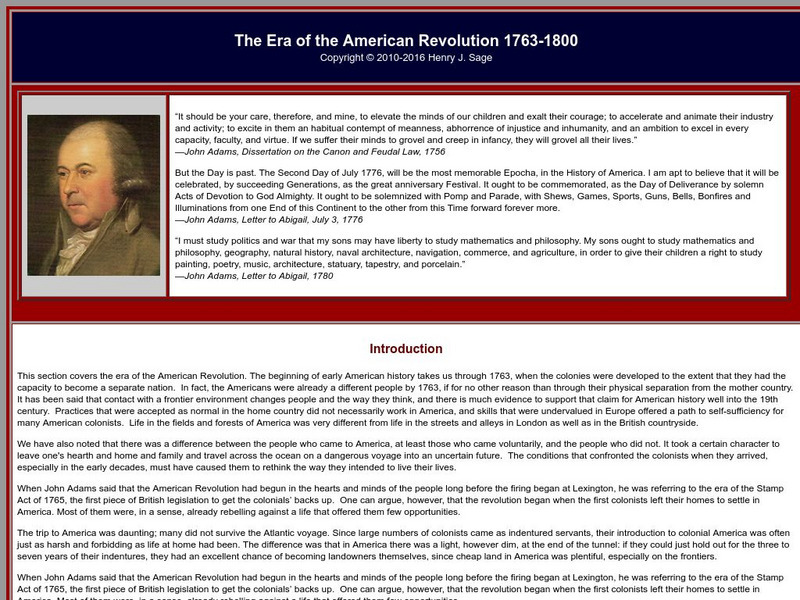
Sage American History: The Era of the American Revolution 1763 1783
Introductioon to the Era of the American Revolution, 1763-1783. The author discusses how the Revolution unfolded by weaving together events with new ways of thinking on the part of colonists.
Henry J. Sage
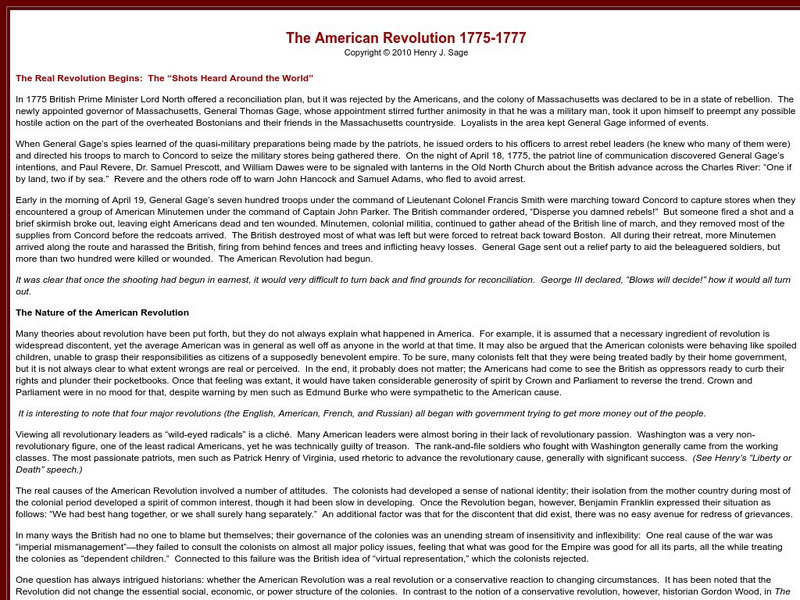
Sage American History: The American Revolution 1775 1777
Article on the American Revolution between 1775-1777, beginning with a discussion summarizing events preceding the point of war to the move for independence. Link to primary source documents.
Henry J. Sage
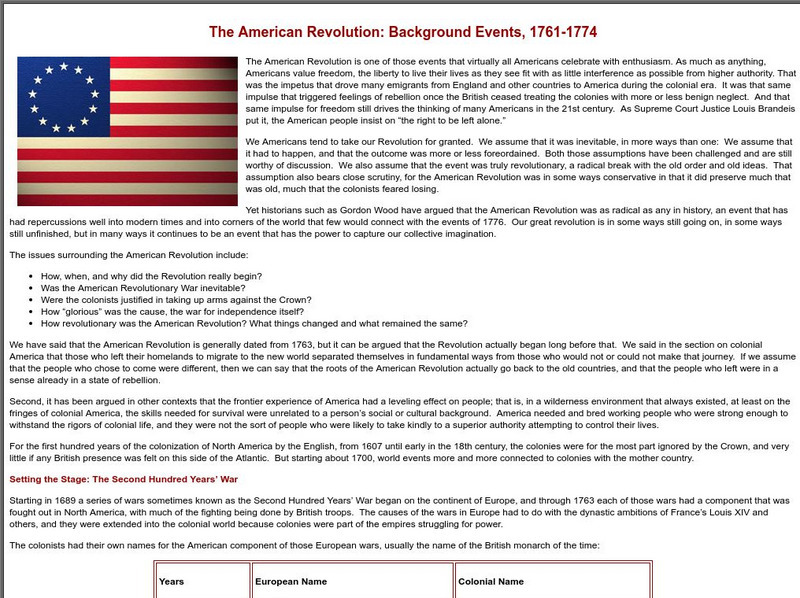
Sage American History: The American Revolution: Background Events, 1761 1774
Article on the background events of the American Revolution in which the author raises pertinent questions such as about the inevitablility and justification of the Revolution.
University of Michigan
American Verse Project: Poems Relating to the American Revolution
Although he was not, strictly speaking, a combatant in the American Revolution, Philip Freneau (1752-1832 CE) nevertheless spent time on a prison ship in New York Harbor. Some of the poems in this volume speak to that experience.

OpenStax
Open Stax: Identity During the American Revolution
From a chapter on "America's War for Independence," this section of the chapter explains Loyalist and Patriot sentiments and identifies different groups that participated in the Revolutionary War.

Other
American Revolution: A Naval History of the American Revolution
This online reproduction of the original 1913 text by Gardner W. Allen is organized chronologically beginning in 1775 and ending with 1783. An appendix includes source citations, a list of vessels, officers, privateers and other...
Henry J. Sage
Sage American History: The American Revolution 1778 1783
Summary of ongoing events of the Revolutionary War from 1778 to the war ending with the Treaty of Paris in 1783. Includes a brief discussion on diplomacy, government and women of the Revolution.
OpenStax
Open Stax: On the Move: The Transportation Revolution
By reading this section of a chapter on "Industrial Transformation in the North", students will learn about the development of improved methods of nineteenth-century domestic transportation and identify the ways in which roads, canals,...
![America Dept. Of State: Outline of American Literature [Pdf] eBook](http://lessonplanet.com/content/resources/thumbnails/410155/large/bwluav9tywdpy2symdiwmduymc0yotc0ny0xzhf5cgiwlmpwzw.jpg?1589985629 "America Dept. Of State: Outline of American Literature [Pdf] eBook")
Other
America Dept. Of State: Outline of American Literature [Pdf]
This online book presents an overview of American literature chronologically. Eras and movements are explained and biographies of significant authors are provided. This is a good way to understand the background and influences of...

OpenStax
Open Stax: The Early Years of the Revolution
Section from a textbook style book explains the British and American strategies of 1776 through 1778 and identifies the key battles of the early years of the Revolution.
OpenStax
Open Stax: War in the South
By reading this section of a chapter on "America's War for Independence," students will be able to outline the British southern strategy and its results, describe key American victories in the war, and also identify the main terms of the...
University of Groningen
American History: Essays: Revolution
Essay on the Dutch alliance with pro-Revolution American colonists. Outlines reasons for the sentiment to support American independence as well as strategy involved.
US Army Center
U.s. Army Center of Military History: Robert Morris
A good biography of Robert Morris who, besides being involved in the American Revolution, also served as a delegate from Pennsylvania to the Constitutional Convention.
US Army Center
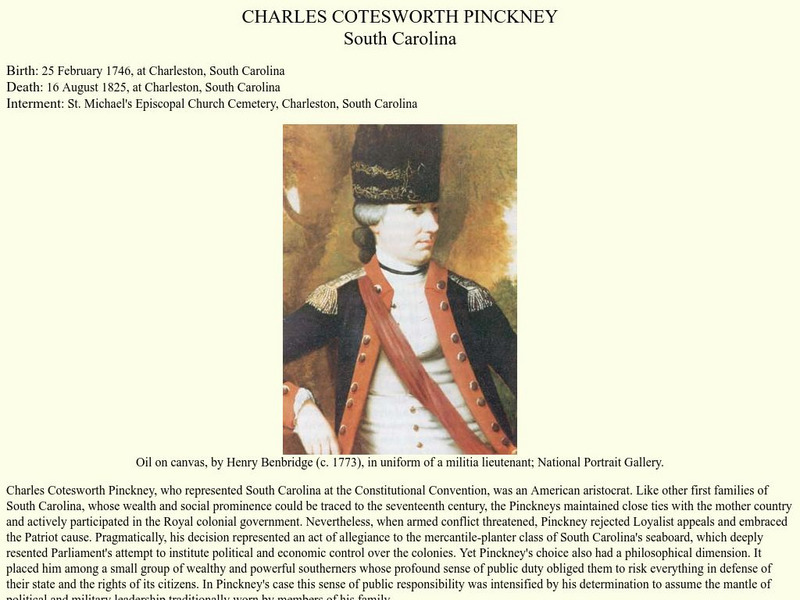
U.s. Army Center of Military History: Charles Cotesworth Pinckney
A good biography of the life of a famous general in the American Revolution, and later a delegate to the Constitutional Convention from South Carolina.
University of Groningen
American History: Outlines: The Presidency of George Bush
Outline of the presidency of George H.W. Bush as part of a section on Conservatism and a New World Order, offers a brief discussion of President Bush's election and administrative policy.

OpenStax
Open Stax: How Much Revolutionary Change?
This section of a chapter on "Creating Republican Governments" describes the status of women and nonwhites in the new republic.

Henry J. Sage
Sage American History: George Washington: The Indispensable Man
Brief article on George Washington articulates why he is considered the "father of our country". With list of books for further reading.
OpenStax
Open Stax: The New American Republic
From a chapter on the New American Republic. After reading this section, students will be able to identify the major foreign and domestic uprisings of the early 1790s and explain the effect of these uprisings on the political system of...
University of Groningen
American History: Essays: What Do the Netherlands and the Us Have in Common?
Essay on the commonalities between the Dutch and U.S. The author points to political ideology and humanistic beliefs that unite the two countries.
Independence Hall Association
U.s. History: The Impact of Slavery
See how the ideals of freedom and equality garnered from the American Revolution were reflected in the early abolitionist movement and the banning of slavery in many Northern state constitutions as the new country was forming.
University of Groningen
American History: Essays: Communitarian Way of Life
Discussion on the decentralized nature of the indigenous populations and their desire, as opposed to Europeans, to live in self-sustaining communities without surplus of wealth.
Teaching American History
Teaching American History: From Bullets to Ballots: Chapter 9
Zvesper's ninth chapter of "From Bullets to Ballots" concludes by addressing the revolution of 1800 and the establishment of party government.