George Mason University
Roy Rosenzweig Center: Declaration of the Rights of Man and Citizen
After a long debate about what should be included in their Bill of Rights, French leaders eventually came to a "Declaration of the Rights of Man and Citizen," seventeen articles that laid out a government that protected natural rights....
![Digital History: The Stamp Act and Virtual Representation [Pdf] Website](https://static.lp.lexp.cloud/images/attachment_defaults/resource/large/FPO-knovation.png "Digital History: The Stamp Act and Virtual Representation [Pdf] Website")
Digital History
Digital History: The Stamp Act and Virtual Representation [Pdf]
This lesson plan is from a unit on events leading to the American revolution. It highlights the Stamp Act, and the British concept of 'virtual representation' where a member of government was believed to represent every citizen, not just...
Other
Business Education Resource Consortium: Accounting and Finance Online Manual
This online manual will provide examples of integrated performance activities developed to coordinate with the Accounting and Finance Career Path in the Business Education Career Path and Model Curriculum Standards. Included with the...
PBS
Wnet: Thirteen: Independence: Boston Tea Party and Other Acts of Rebellion [Pdf]
A lesson plan from the producers of the 16-episode PBS series "Freedom: A History of US" that helps learners understand why the American colonists objected to taxation without representation. Includes activities that investigate the acts...
Bill of Rights Institute
Bill of Rights Institute: James Otis
James Otis was called the most important American of the 1760s by John Adams. A trained lawyer and master of argument, James Otis was a leader of the Patriot movement in Boston in those years. Initially a prosecutor for the British...

Texas State Library and Archives Commission
Texas State Library and Archives Commission: Forever Free: The 1870s: Matthew Gaines
Read about Matthew Gaines, an African American state senator from Texas during Reconstruction. Learn about where he stood on issues such as integrated education and taxation of specific groups, and why he was removed from office.
Massachusetts Historical Society
Mhs: Coming of the American Revolution: Stamp Act
Provides details surrounding the passage of another attempt by the British to tax the American colonies, the Stamp Act. Includes original supporting documents and great teacher resources.
Massachusetts Historical Society
Mhs: Coming of the American Revolution: Townshend Acts
Discover interesting details surrounding the passage of another attempt to tax the American colonies, the Townshend Acts. Includes supporting original documents and many teacher resources.
Massachusetts Historical Society
Mhs: Coming of the American Revolution: Sugar Act
Summary of the controversy surrounding Parliament's passage of the Sugar Act in 1764 to raise revenue and the American colonies reaction to it. Supported by original documents.
Independence Hall Association
U.s. History: Account of the Declaration: Jefferson's Story
Thomas Jefferson's account of events leading up to and the actions of the First Continental Congress, including information about the Committees of Correspondence which communicated through Circular Letters.
CPALMS
Florida State University Cpalms: Florida Students: What Led to the Declaration of Independence
This tutorial examines the events that created conflict between the American colonies and Britain and led to war and the Declaration of Independence. A PDF file of the tutorial is available.

Khan Academy
Khan Academy: The Intolerable Acts and the First Continental Congress
An overview of the American colonists response to the Intolerable Acts and how it began to unify the colonists.
University of Groningen
American History: Essays: The Intolerable Acts
This resource gives a comprehensive account of the Intolerable Acts, why they were passed, colonists' reactions, and particulars surrounding the Massachusetts Government Act and other Coercive Acts with text links and references.
The History Cat
The History Cat: Countdown to Revolution
Begins with a description of the British system of mercantilism that was imposed on the American colonies along with the taxes levied through the Stamp Act and the Sugar Act. The Americans complained that it was taxation without...
Yale University
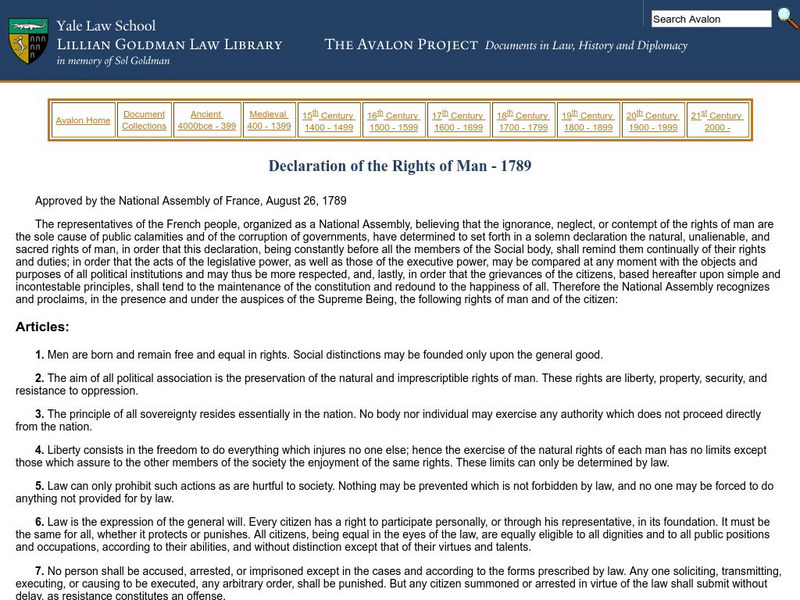
The Avalon Project: Declaration of the Rights of Man
After a long debate about what should be included in their Bill of Rights, French leaders eventually came to a "Declaration of the Rights of Man and Citizen," seventeen articles that laid out a government that protected natural rights....
PublicBookshelf Corporation
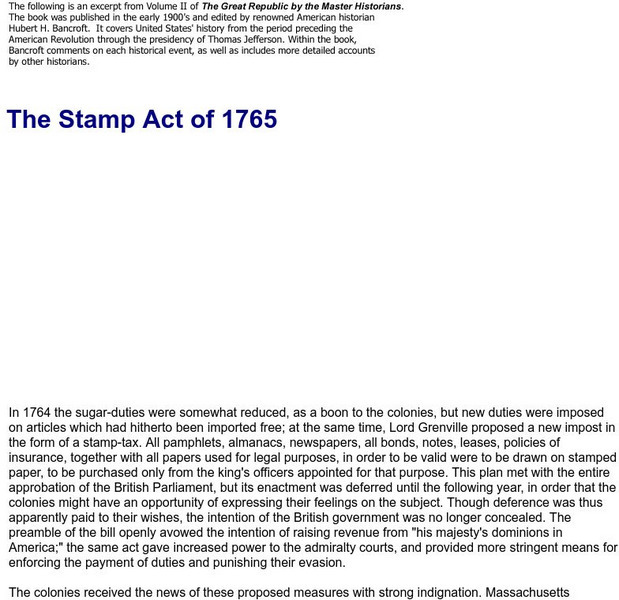
Public Bookshelf: The Stamp Act of 1765
A discussion of the causes and effects of the Stamp Act of 1765 in the British Colonies of North America.
Bartleby
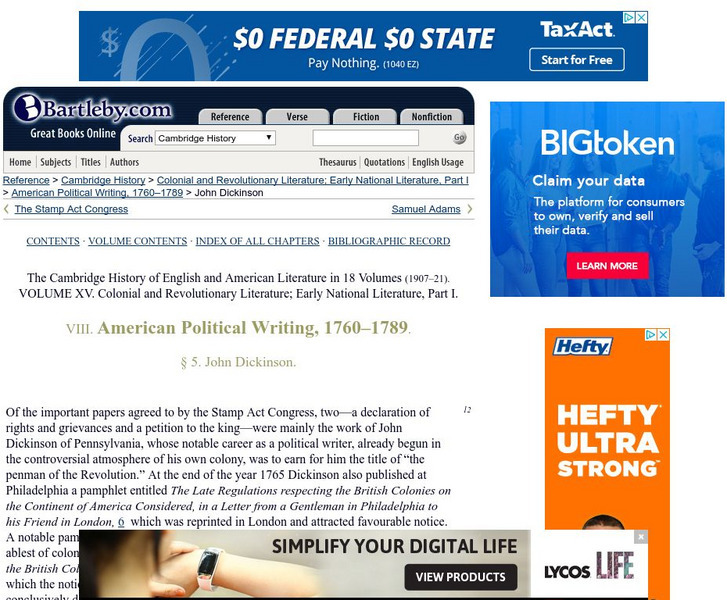
Bartleby.com: John Dickinson's Writings
The site discusses political writings by John Dickinson concerning the British Parliament's right to tax the colonies without representation and against the Stamp Act. Dated 1907-21.

TED Talks
Ted: Ted Ed: The Story Behind the Boston Tea Party
This short TED talk given by Ben Labaree gives the background of the Boston Tea Party and its eventual ramifications. [3:48]
Independence Hall Association
U.s. History: The Townshend Acts
It seems like the British Parliament was just throwing laws at the American colonists just to see what might stick. Read about the Townshend Acts that were passed after the Declaratory Act which was passed after the repeal of the Stamp...
A&E Television
History.com: Continental Congress
From 1774 to 1789, the Continental Congress served as the government of the 13 American colonies and later the United States. The First Continental Congress, which was comprised of delegates from the colonies, met in 1774 in reaction to...

Khan Academy
Khan Academy: Us History: 1754 1800: Unit Test
Take this eleven question unit test over US history during the period of 1754 and 1800.
Independence Hall Association
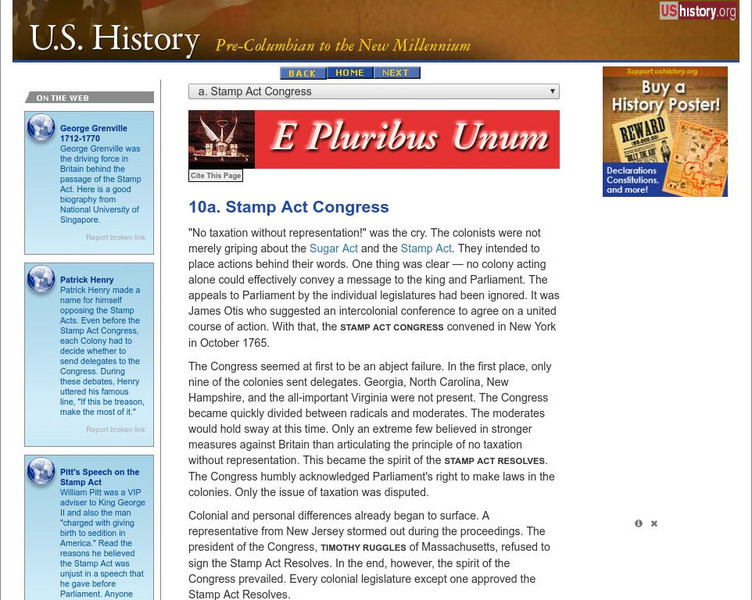
U.s. History: The Stamp Act Congress
Read about how the colonies were discovering that they had more clout by acting together than acting as individual colonies. The Stamp Act Congress and the resulting Stamp Act Resolves helped them band together to resist the acts passed...
Varsity Tutors
Varsity Tutors: Archiving Early America: Letters From a Pennsylvania Farmer
A voice of dissent prior to the American Revolution, John Dickenson, a Philadelphia lawyer, was active in protesting British policies. His writings, entitled Letters from a Pennsylvania Farmer, were published in newspapers in 1767 and 1768.
University of Groningen
American History: Biographies: Daniel Dulany Jr. (1722 1797)
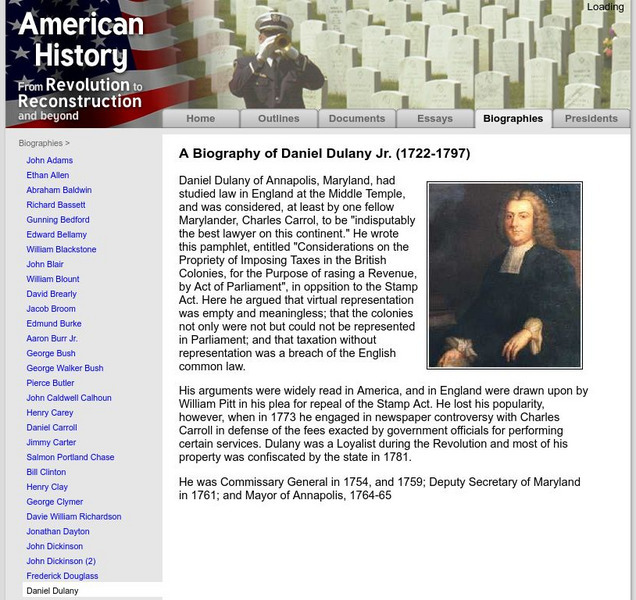
Daniel Dulany of Annapolis, Maryland, had studied law in England at the Middle Temple, and was considered, at least by one fellow Marylander, Charles Carrol, to be "indisputably the best lawyer on this continent." He wrote this pamphlet,...