Hi, what do you want to do?






California Academy of Science
Which Way is North?
Who needs a compass to find cardinal directions? Just place a stick in the ground and record the movement of its shadow over the course of a day. Then, measure the shadow lengths in order to determine a north-south line. A simple...
TeachEngineering
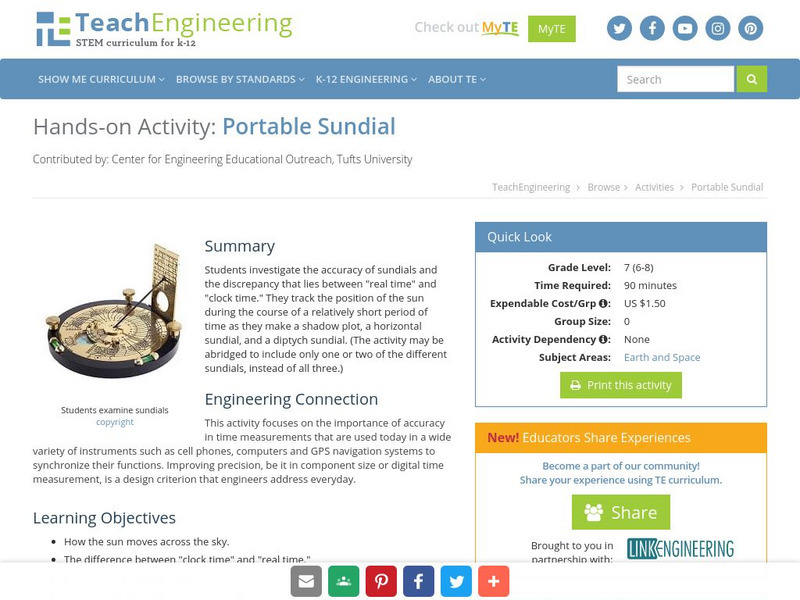
Teach Engineering: Portable Sundial
In this activity students will investigate the accuracy of sundials and the discrepancy that lies between "real time" and "clock time". They will track the position of the sun over the course of a relatively short period of time as they...
Other
Center for Science Education: Eye on the Sky: Observing and Using Shadows
This resource provides all the directions and worksheets necessary to make a sundial and record data with it.
Exploratorium
Exploratorium:seasons/shadows: Investigate How Shadows Shift Throughout the Year
Ancient Chacoans used shadows to tell daily time and seasons. Build a model that demonstrates the changes in Earth's tilt that affect the length of shadows relative to the sun that determines the seasons. The lesson plan uses everyday...
Harvard University
Eyes on the Sky, Feet on the Ground: The Earth's Rotation
Plenty of cool activities about the Earth's rotation can be found here, such as tracing shadows, observing shadows during different times of the day, and tracking the sun's path in the sky to understand the rotation of the earth.
Exploratorium
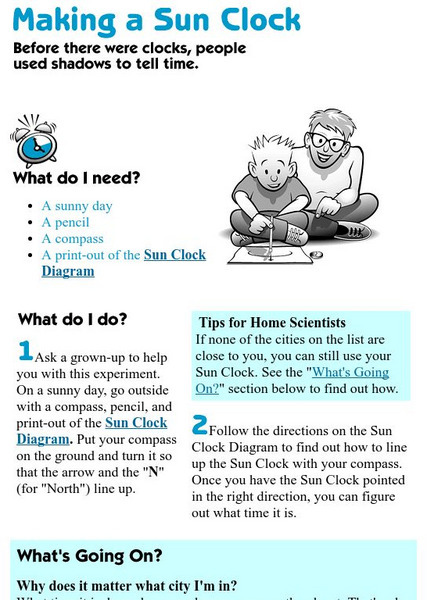
Exploratorium: Making a Sun Clock
Learn how to use the sun to tell time. This simple activity reinforces the concepts of light and shadow, night and day, time, and geographical north vs. magnetic north.