Hi, what do you want to do?






NASA
Blinded by the Light!
Pupils learn of multiple ways astronomers look for planets outside of the solar system. By completing a hands-on activity, scholars discover that trying to see the planets directly because of the glare from the nearby star is nearly...

NASA
Packing for a L-o-o-o-ng Trip to Mars
Pack just enough to fit. Crews determine what personal items to take with them on a trip to Mars. Each team must decide what to take with them on a two-and-a-half year trip to Mars and whether their items will fit within the allotted...

NASA
Taking Apart the Light
Break down light into spectra. Scholars learn how atoms emit and absorb photons and come to understand how this process allows scientists to identify different atoms based on either absorption lines or emission lines. Learners then...

American Institute of Biological Sciences
Action Bioscience: Looking for Life on Mars and Beyond
Learn some of the characteristics of Mars. These characteristics lead some people to believe that life forms may be found on the fourth planet from the Sun.

Society for Science and the Public
Science News for Students: So Many 'Earths'
Article reports on the recent discovery that many suns in the universe host "Earth-like" planets. Includes a vocabularly list.
US Environmental Protection Agency
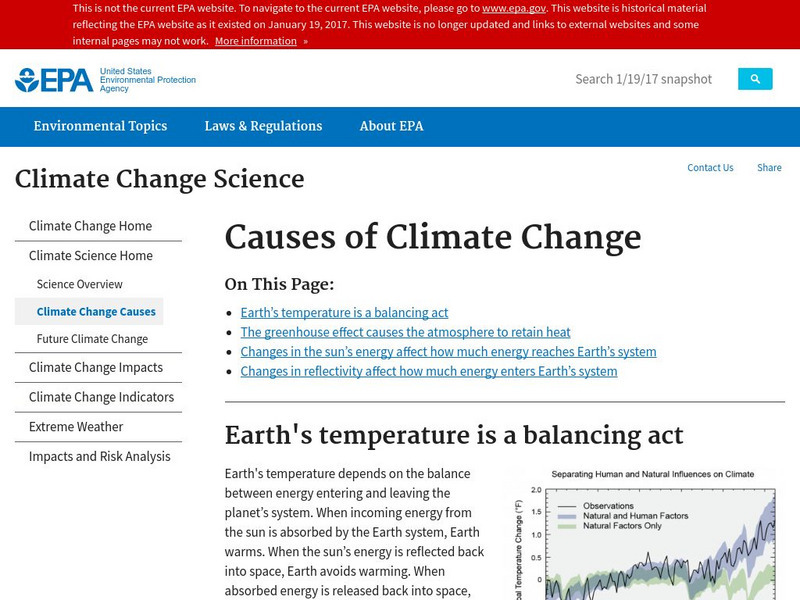
Epa: Causes of Climate Change
Earth's temperature depends on the balance between energy entering and leaving the planet's system . When incoming energy from the sun is absorbed by the Earth system, Earth warms. When the sun's energy is reflected back into space,...

University of Texas at Austin
The University of Texas Mc Donald Observatory: Venus
Discover interesting facts about Venus, the hottest planet and the second planet from the Sun.

Other
Christopher Crockett: The Astronomy Word of the Week Is "Barycenter"
While astronomers and philosophers have long mused on the possibility of other solar systems, the first planets confirmed to orbit a star other than our Sun weren't found until 1992. The reason it took so long is that it's really hard!...
National Earth Science Teachers Association
Windows to the Universe: What Controls the Climate?
Learn what aspects of our planet have an impact on climate. Links to related materials.
Enchanted Learning
Enchanted Learning: The Earth's Atmosphere
The Earth's atmosphere is a thin layer of gases that surrounds the Earth. It composed of 78% nitrogen, 21% oxygen, 0.9% argon, 0.03% carbon dioxide, and trace amounts of other gases. This thin gaseous layer insulates the Earth from...
University Corporation for Atmospheric Research
Ucar: A Global Look at Moving Air: Atmospheric Circulation
Even with disruptions like weather fronts and storms, there is a consistent pattern to how air moves around our planet's atmosphere. This pattern, called atmospheric circulation, is caused because the Sun heats the Earth more at the...
Other popular searches
- Sun and Planets Wordsearch
- Sun and Planets Word Search
- The Sun and Its Planets
- Sun and Planets Pictures