Hi, what do you want to do?






PBS
Pbs Learning Media: All Planet Sizes
This illustration from the Lunar and Planetary Laboratory shows the approximate sizes of the planets relative to each other. Note that the planets are not shown at appropriate distances from the Sun.

American Institute of Biological Sciences
Action Bioscience: Looking for Life on Mars and Beyond
Learn some of the characteristics of Mars. These characteristics lead some people to believe that life forms may be found on the fourth planet from the Sun.
PBS
Pbs Learning Media: Scaled Images of the Solar System
Use the following lithographs to envision the scale of our solar system. View different models of planets at different scales, an infographic about the relative sizes of the planets and distance from the sun, and images of the largest...
Nine Planets
The Eight Planets: The Sun Solar Wind
This Eight Planets site briefly describes solar wind, a low density stream of charged particles emitted by the Sun. It also provides the basics on the sun's composition and additional sun links.

Nine Planets
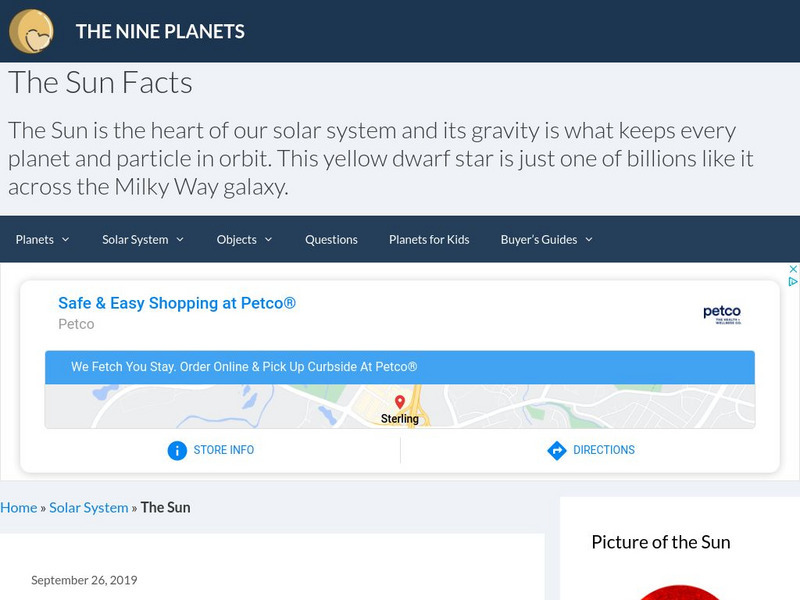
The Nine Planets: The Sun Facts
Statistical data, general features, key terms, characteristics, and influences of the sun.
Harvard University
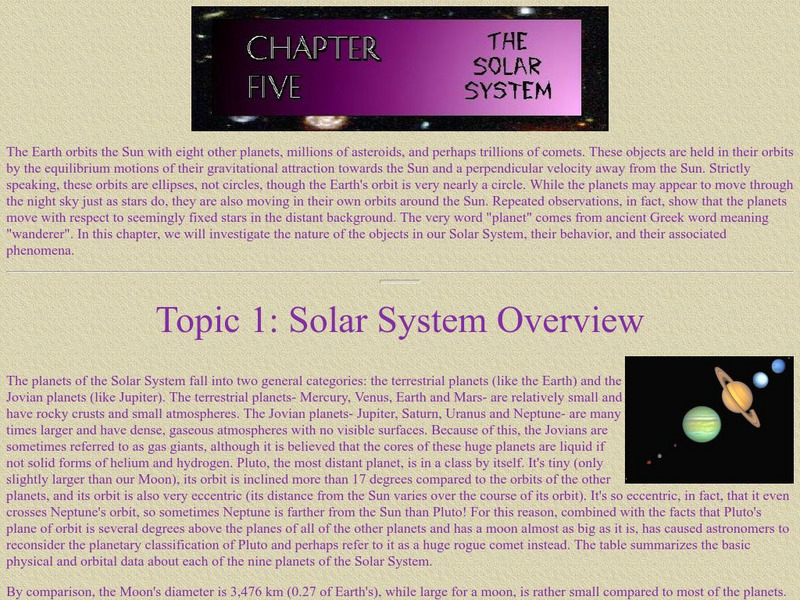
Harvard University: The Solar System
These hands-on activities are a great way for students to gain perspective on the relative sizes and distances of each planet, the relationship between the sun and Earth, and much more.
TeachEngineering
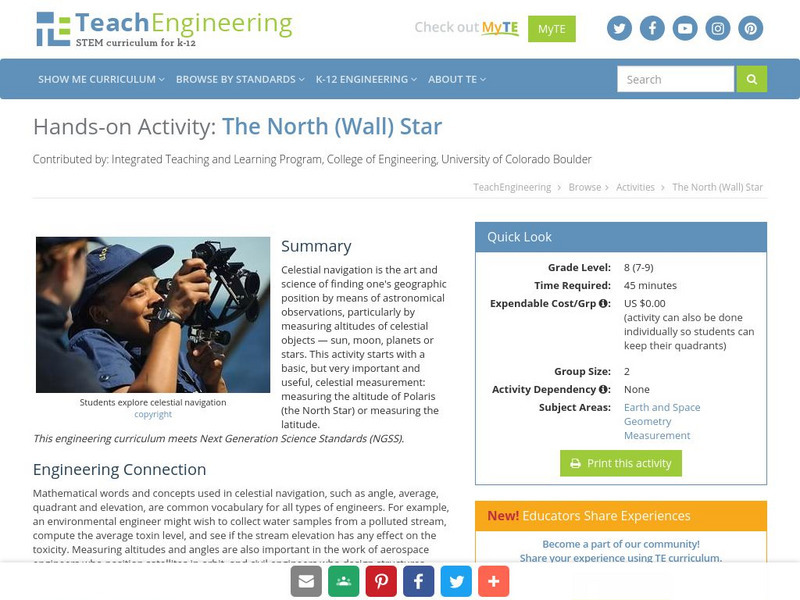
Teach Engineering: The North (Wall) Star
Celestial navigation is the art and science of finding one's geographic position by means of astronomical observations, particularly by measuring altitudes of celestial objects - sun, moon, planets or stars. This activity starts with a...
TeachEngineering
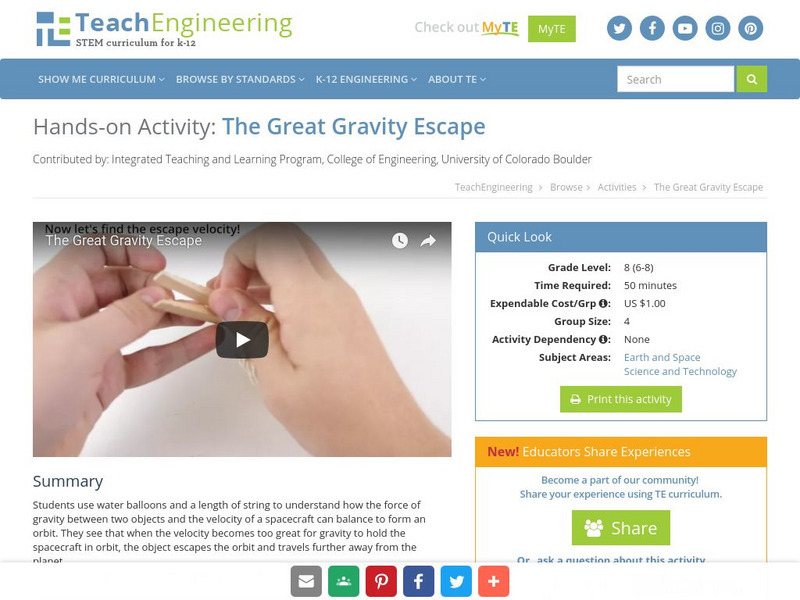
Teach Engineering: The Great Gravity Escape
Students use water balloons and a length of string to understand how gravity and the velocity of a spacecraft balance to form an orbit. They see that when the velocity becomes too great for gravity to hold onto an object, the object...
Science4Fun
Science4 Fun: Earth
Learn fun facts and details about the geography and composition of Earth, the third closest planet to the sun and the only planet that contains life.

Ducksters
Ducksters: Astronomy for Kids: The Planet Earth
This site is astronomy for kids and teachers! Here students can learn about the planet Earth of the Solar System including fun facts, mass, day, year, and distance from the Sun.

Society for Science and the Public
Science News for Students: So Many 'Earths'
Article reports on the recent discovery that many suns in the universe host "Earth-like" planets. Includes a vocabularly list.
Science4Fun
Science4 Fun: Mars
Learn fun facts and details about the weather, geography, composition, and discovery of Mars, the fourth closest planet to the Sun.
Science4Fun
Science4 Fun: Venus
Learn fun facts and details about the atmosphere, geography, composition, and discovery of Venus, the second closest planet to the sun.

Other
Christopher Crockett: The Astronomy Word of the Week Is "Barycenter"
While astronomers and philosophers have long mused on the possibility of other solar systems, the first planets confirmed to orbit a star other than our Sun weren't found until 1992. The reason it took so long is that it's really hard!...
Science4Fun
Science4 Fun: Mercury
Learn fun facts and details about the atmosphere, geography, composition, and discovery of Mercury, the closest planet to the sun.
Science4Fun
Science4 Fun: Uranus
Learn fun facts and details about the atmosphere, composition, and discovery of Uranus, the seventh closest planet to the sun.
Other popular searches
- Sun and Planets Wordsearch
- Sun and Planets Word Search
- The Sun and Its Planets
- Sun and Planets Pictures