Hi, what do you want to do?






Concord Consortium
Concord Consortium: Protein Folding
Generate all polar, all nonpolar, or random proteins and observe how the protein folds in response to these molecular properties. Explore how the potential energy of the system changes over time to draw conclusions about how proteins...
CK-12 Foundation
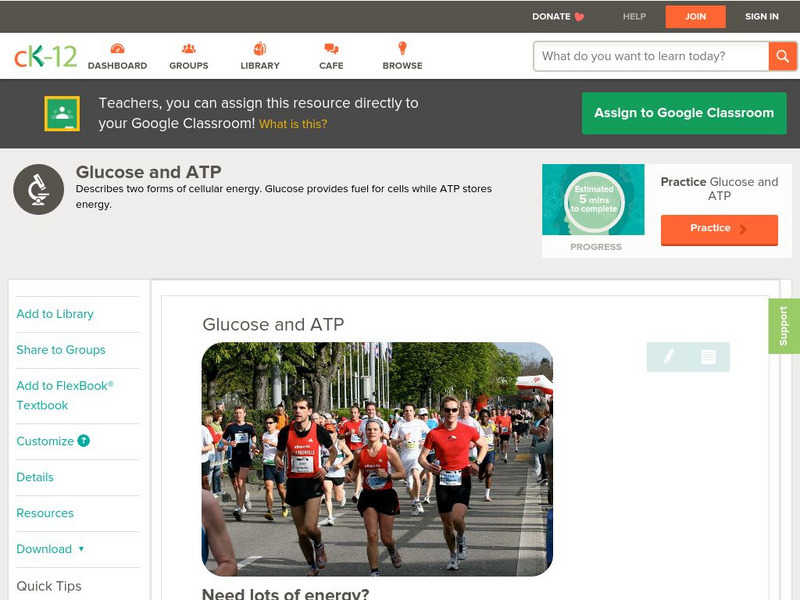
Ck 12: Biology: Glucose and Atp
[Free Registration/Login may be required to access all resource tools.] Overview of glucose and ATP.
Science Struck
Science Struck: Ribose vs. Deoxyribose
Explains what ribose and deoxyribose are, their chemical structure and properties, similarities and differences, their functions, and their biological importance.

Khan Academy
Khan Academy: Biological Macromolecules Review
A review of the structure and function of biological macromolecules.
Other
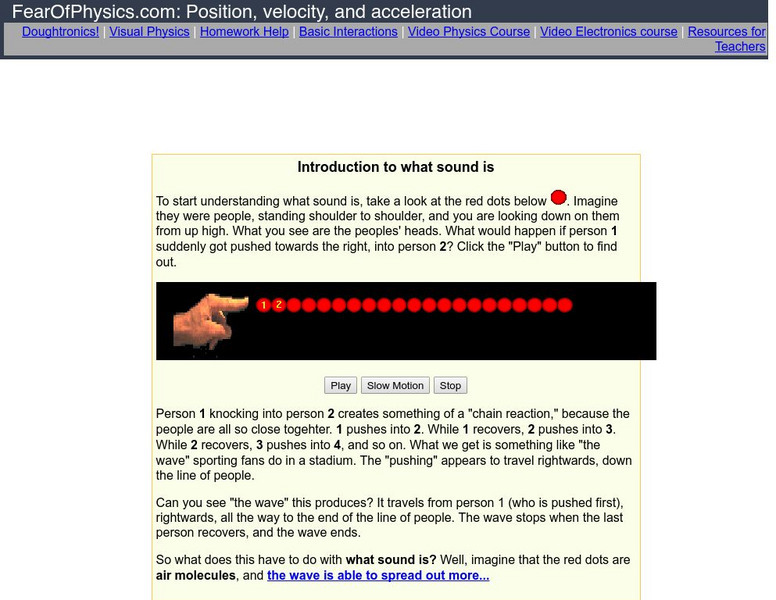
Science Alive: Synthetic vs. Natural: What's the Difference?
Through this reading, students will learn that a substance's properties arise from its molecular structure, not from how it's made (i.e., synthesized by people or found in nature). There is no fundamental difference between natural and...
McREL International
Mc Rel: Glue Polymer (Whelmer #15 Learning Activity)
An easy to do activity that investigates the basic principles behind chemical bonding. The activity is written in lesson plan format that meets NSES standards.
Concord Consortium
Concord Consortium: Molecular Workbench: Molecular Crystals
A collection of interactive simulations relating to molecular crystals.
Cosmo Learning
Cosmo Learning: General Chemistry
A collection of video lectures from a general chemistry course taught at the University of California, Berkeley. The course teaches periodic table, chemical bonds, molecular shape, phase changes, chemical reactions, stoichiometry,...
BiologyWise
Biology Wise: Start Codon
A start codon is a nucleotide triplet in a genetic sequence that occurs at the start of a protein's synthesis. Read about how this works and how a mutation can sometimes occur.
BiologyWise
Biology Wise: What Is a Stop Codon?
A stop codon is a nucleotide triplet in messenger RNA that signals the end of a protein during the translation process. Read about how this works, the different types of stop codons, and how a mutation can sometimes occur.
Curated OER
Bristol University: Molecule of the Month:atp
A great page for all around biochemistry and background information. Includes the molecular structure and most of the information relevant to its role in living cells.
PBS
Pbs Teachers: Scientific American: Never Say Die: How to Make a Nose
Investigate breakthroughs in stem cell research, and explore the structure and function of a DNA molecule. Create a model of a DNA from tagboard.

PBS
Pbs Teachers: Salt and Pepper Experiment
Demonstrate surface tension by sprinkling pepper on a bowl full of water, then touching a soapy finger to the water.
Sophia Learning
Sophia: Facilitated Diffusion: Lesson 3
This lesson explains the process of facilitated diffusion, explaining that it is a passive form of transport which uses protein channels to move larger molecules down their concentration gradient. It is 3 of 9 in the series titled...
Sophia Learning
Sophia: Facilitated Diffusion: Lesson 4
This lesson explains the process of facilitated diffusion, explaining that it is a passive form of transport which uses protein channels to move larger molecules down their concentration gradient. It is 4 of 9 in the series titled...
Sophia Learning
Sophia: Facilitated Diffusion: Lesson 5
This lesson explains the process of facilitated diffusion, explaining that it is a passive form of transport which uses protein channels to move larger molecules down their concentration gradient. It is 5 of 9 in the series titled...
Sophia Learning
Sophia: Facilitated Diffusion: Lesson 1
This lesson explains the process of facilitated diffusion, explaining that it is a passive form of transport which uses protein channels to move larger molecules down their concentration gradient. It is 1 of 9 in the series titled...
Science Buddies
Science Buddies: Study Chirality With a Homemade Polarimeter
Some molecules can be either left- or right-"handed." The left- and right-handed molecules have the same number and type of atoms, and their chemical structures look identical, but they are actually mirror images of each other. Many...

Concord Consortium
Concord Consortium: Stem Resources: Molecular Self Assembly
A series of science simulations exploring how molecules assemble themselves and how scientists are learning to engineer their structure. Students will discover what patterns molecules form with interactive lessons. At the end there is a...
OpenStax
Open Stax: Andrew R. Barron: Valence Shell Electron Pair Repulsion (Vsepr) Theory
Detailed explanation of Valence Shell Electron Pair Repulsion (VSEPR) Theory with examples and questions for the reader to check comprehension. Also includes step-by-step instructions for correctly building molecules using VSEPR Theory....
Simon Fraser University
Chem1 Virtual Textbook: What Is Chemistry All About?
Covering a range of eight topics related to chemistry, this resource provides a wealth of information complete with pictures, charts, graphs, and examples. Includes information on elements, compounds, atoms, molecules, structures,...
Science Buddies
Science Buddies: Paper Chromatography: Advanced Version 1
This project will teach you the basics of analytical chemistry, which is a must for students who want to go into chemistry or materials science. The molecules in objects we see all around us are constantly attracting each other....
American Chemical Society
Middle School Chemistry: Represent Bonding With Lewis Dot Diagrams
Students draw and interpret Lewis dot diagrams for individual atoms and both covalent and ionic compounds.