Hi, what do you want to do?





Other
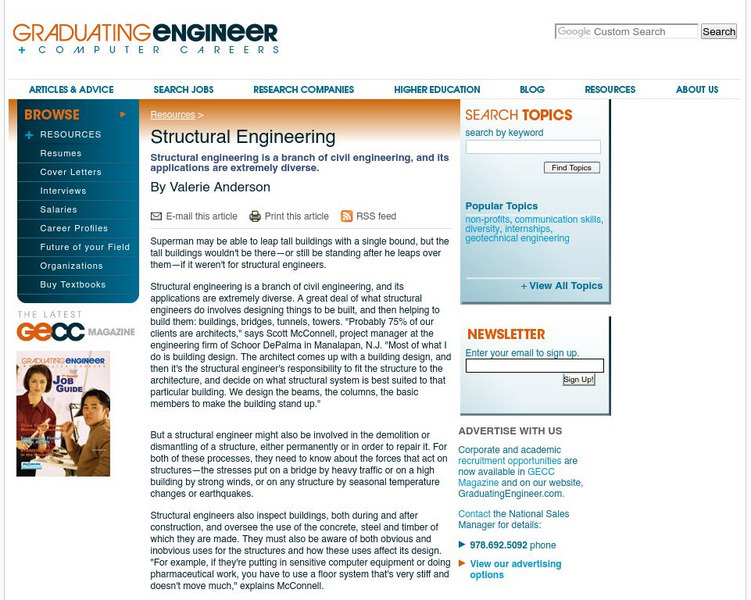
Graduating Engineer and Computer Careers Magazine: Structural Engineering
Structural engineering is a branch of civil engineering, and its applications are extremely diverse. A career as a structural engineer is profiled .. education, salary, job description .. are included.

TryEngineering
Try Engineering: Working With Watermills
Teams of young scholars design, build, test, and evaluate a working watermill made from everyday materials. Lesson explores how watermills generate energy from water, while students gain an understanding of the structural engineering...
TeachEngineering
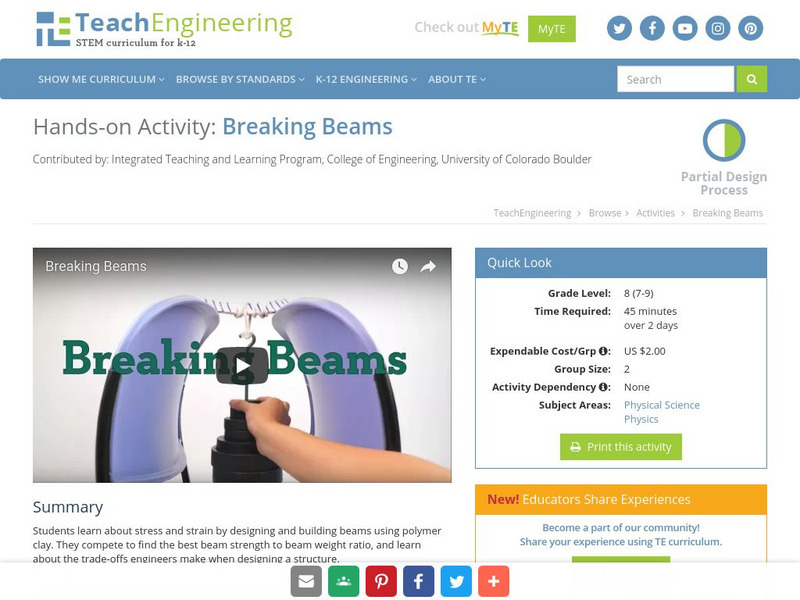
Teach Engineering: Breaking Beams
Students learn about stress and strain by designing and building beams using polymer clay. They compete to find the best beam strength to beam weight ratio, and learn about the trade-offs engineers make when designing a structure.
TeachEngineering
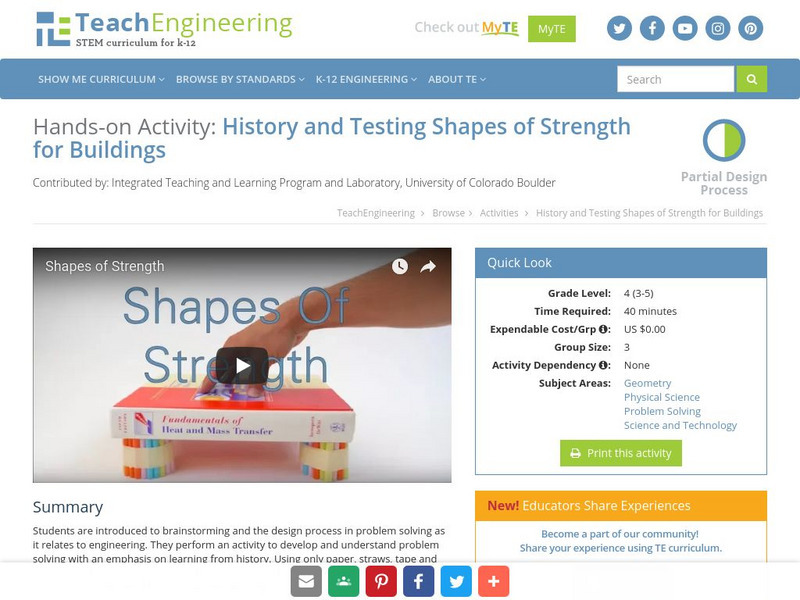
Teach Engineering: Shapes of Strength
Students are introduced to brainstorming and the design process in problem solving as it relates to engineering. They perform an activity to develop and understand problem solving with an emphasis on learning from history. Using only...
TeachEngineering
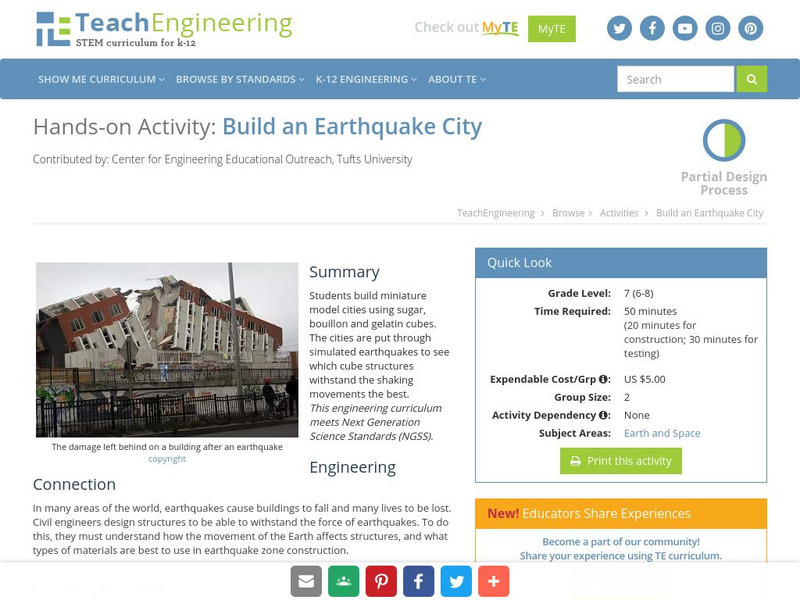
Teach Engineering: Build an Earthquake City
Students learn about earthquakes and how they effect structures. Student then apply their knowledge by trying to build an earthquake resistant city.
TeachEngineering
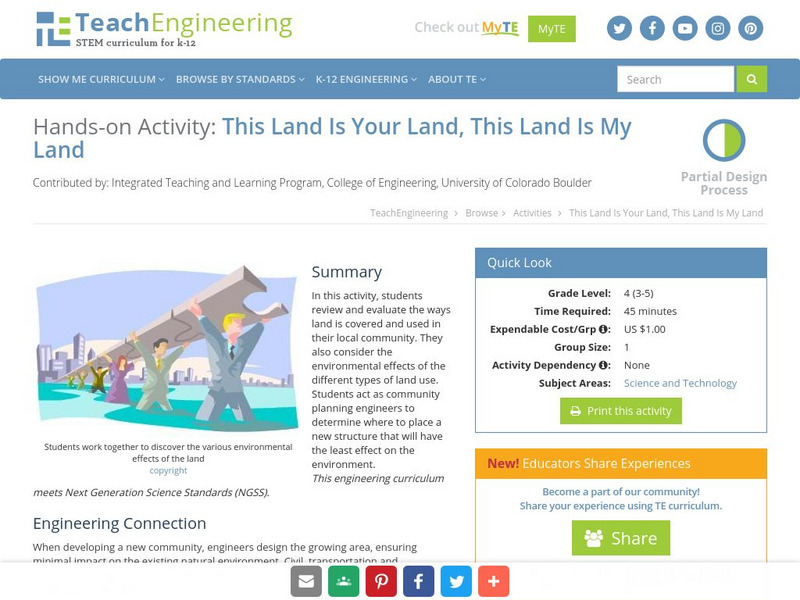
Teach Engineering: This Land Is Your Land, This Land Is My Land
In this activity, students will review and evaluate the ways land is covered and used in their local community. They will also consider the environmental effects of the different types of land use. Students will act as community planning...
Science Buddies
Science Buddies: Building Structures: It's a Slippery Slope
All structures require a foundation to keep them from falling down. This is especially important when a structure is built on a hill or on a slope. In this science project, you will build a tower of Lego Duplos on slopes with different...

Better Lesson
Better Lesson: Goody Goody Gumdrop! Building Structures Are Fun!
In this lesson, the children will be building a physical model to illustrate how the shape of an object, such as triangles, helps it function. At the end, the children will test their gumdrop structures and the class will collectively...
TeachEngineering
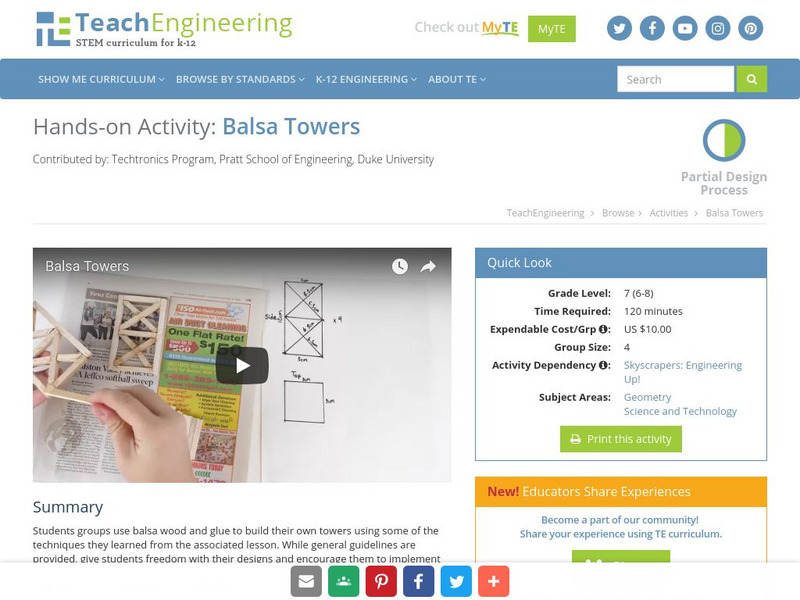
Teach Engineering: Balsa Towers
Students will build their own towers using some of the techniques they have learned. The materials will consist of balsa wood and glue. General guidelines are provided, but the students will have a lot of freedom with their design to...
TeachEngineering
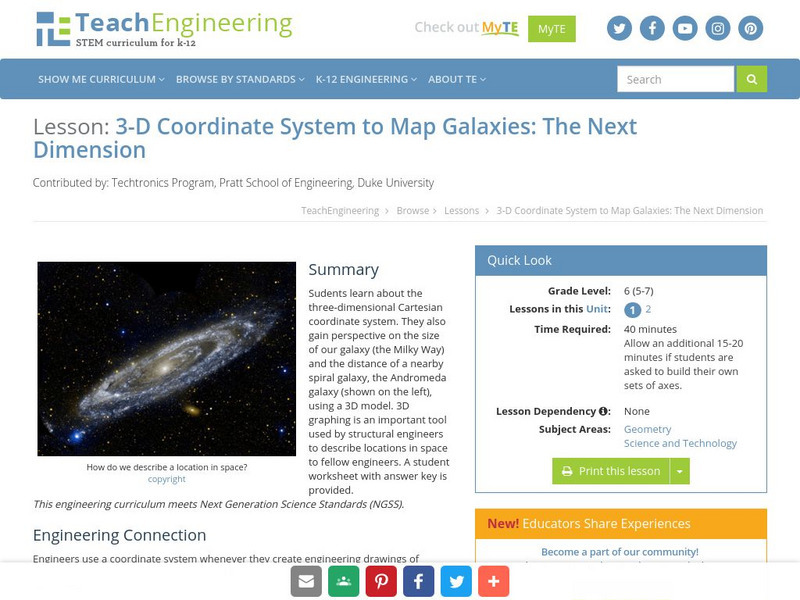
Teach Engineering: The Next Dimension
The purpose of this lesson is to teach young scholars about the three dimensional Cartesian coordinate system. It is important for structural engineers to be confident graphing in 3D in order to be able to describe locations in space to...
TeachEngineering
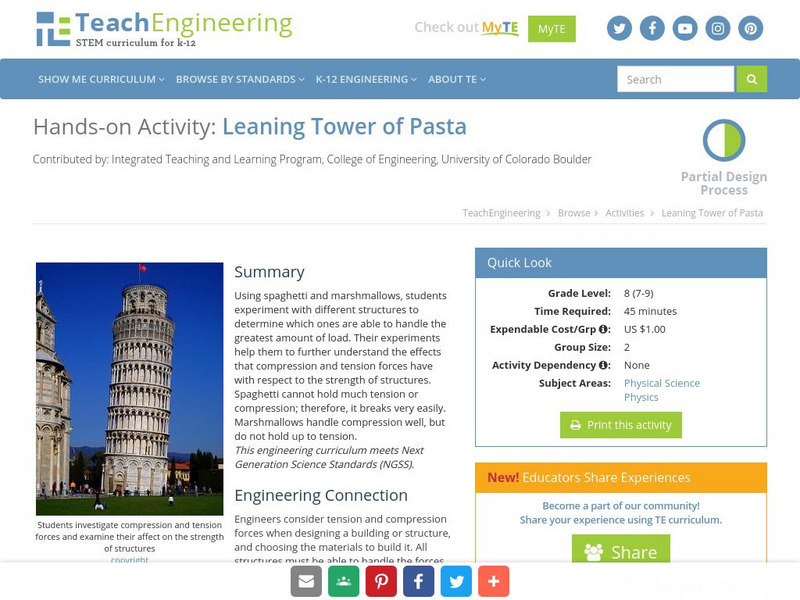
Teach Engineering: Leaning Tower of Pasta
Using spaghetti and marshmallows, students experiment with different structures to determine which ones are able to handle the greatest amount of load. Their experiments help them to further understand the effects that compression and...
TeachEngineering
Teach Engineering: Build It Better!
Students learn about tornados and how engineers design structures to better withstand them. Students then design and draw a house that will better withstand a tornado. Students also learn about the Fujita Tornado Damage Score.
TeachEngineering
Teach Engineering: Muscles, Muscles Everywhere
This activity helps students learn about the three different types of muscles and how outer space affects astronauts' muscles. They will discover how important it is for astronauts to get adequate exercise both on Earth and in outer...
TeachEngineering
Teach Engineering: Designing Bridges
Students learn about the types of possible loads, how to calculate ultimate load combinations, and investigate the different sizes for the beams (girders) and columns (piers) of simple bridge design. Students learn the steps that...
TeachEngineering
Teach Engineering: Can You Catch the Water?
Students construct a three-dimensional model of a water catchment basin using everyday objects to create hills, mountains, valleys and water sources. They experiment to see where rain travels and collects, and survey water pathways to...
TeachEngineering
Teach Engineering: Glaciers, Water and Wind, Oh My!
This hands-on activity explores five different forms of erosion (chemical, water, wind, glacier and temperature). Students rotate through stations and model each type of erosion on rocks, soils and minerals. The students record their...
TeachEngineering
Teach Engineering: Modern Day Pyramids
Students investigate the ways in which ancient technologies - six types of simple machines and combinations - are used to construct modern buildings. As they work together to solve a design problem (designing and building a modern...
TeachEngineering
Teach Engineering: Soapy Stress
To experience the three types of material stress related to rocks - tensional, compressional and shear - students break bars of soap using only their hands. They apply force created by the muscles in their own hands to put pressure on...
TeachEngineering
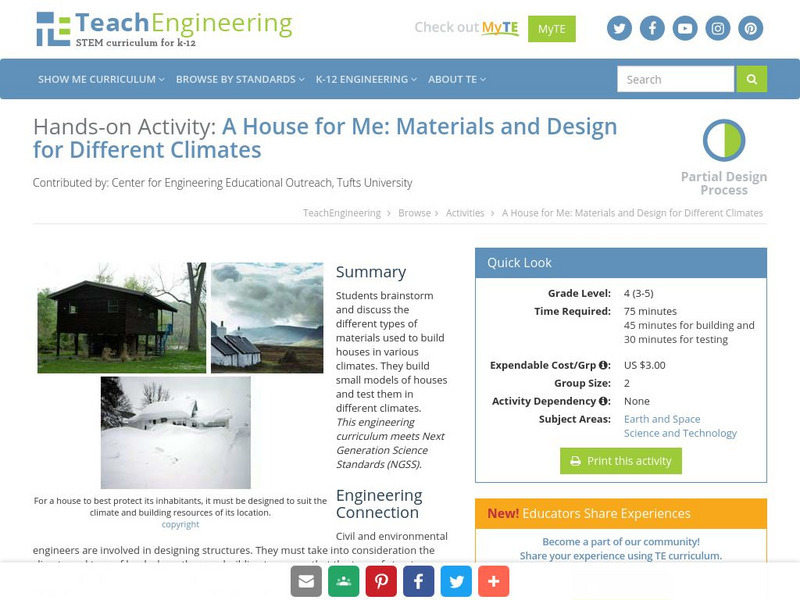
Teach Engineering: A House Is a House for Me
Students brainstorm and discuss the different types of materials used to build houses in various climates. Small models of houses are built and tested against different climates.
TeachEngineering
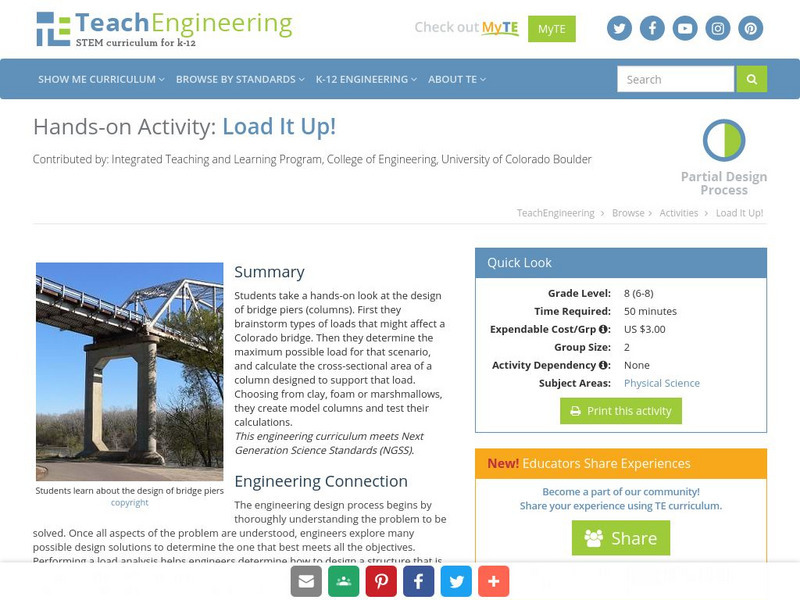
Teach Engineering: Load It Up!
Students take a hands-on look at the design of bridge piers (columns). First they brainstorm types of loads that might affect a Colorado bridge. Then they determine the maximum possible load for that scenario, and calculate the...
Science Buddies
Science Buddies: The Leaning Tower of Pasta
Here's a project for a budding architect or structural engineer. Can you make a strong, lightweight tower using only uncooked spaghetti and white glue? In this project, you'll learn about materials testing and apply what you learn to...
Science Buddies
Science Buddies: Fallen Arches: The Surprising Strength of Eggshells
Arches have been used for structural engineering since ancient times. This experiment tests the strength of a naturally occurring arch shape: the shell of an egg. How much weight do you think an eggshell can support?
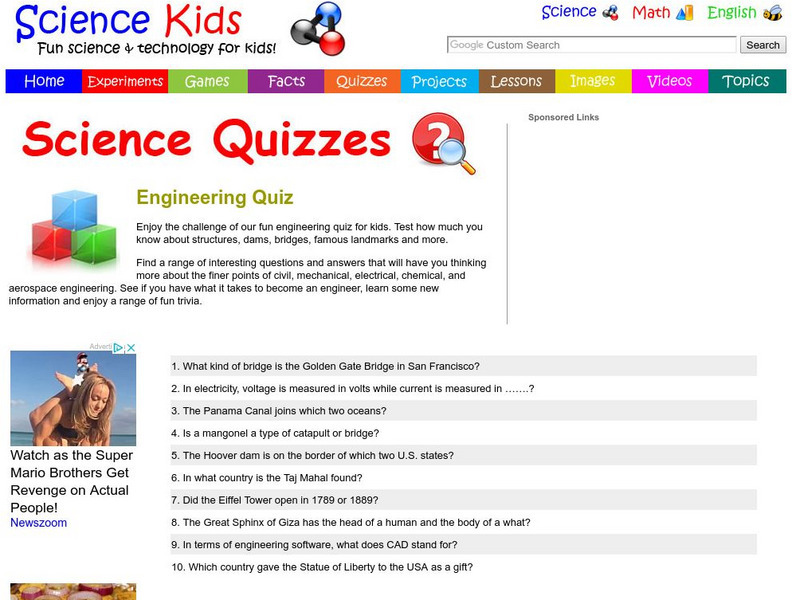
Science for Kids
Science Kids: Science Quizzes: Engineering Quiz
A ten-question trivia quiz on popular topics in engineering, e.g., famous structures.
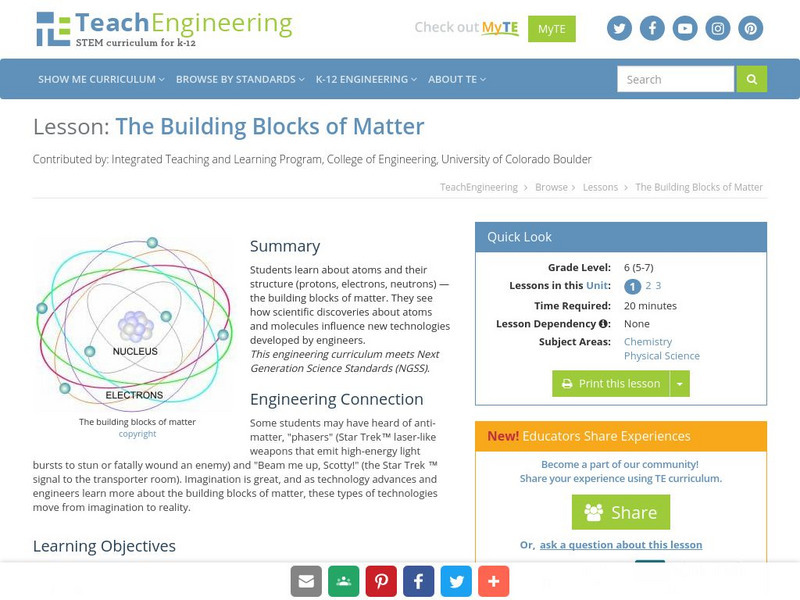
TeachEngineering
Teach Engineering: The Fundamental Building Blocks of Matter
This lesson plan explores the fundamentals of atoms and their structure. The building blocks of matter (protons, electrons, neutrons) are covered in detail. Students think about how atoms and molecules can influence new technologies...