
US National Archives
National Archives: Congress Protects the Right to Vote
Students will draw conclusions regarding actions taken by Congress when passing the Voting Rights Act of 1965. They will weigh the balance of power between the federal and state governments when protecting the right to vote. Materials...
US Department of Justice
U.s. Department of Justice: Webb v. Clyde L. Choate Mental Health Center [Pdf]
Although specifically a case in which the plaintiff is seeking federal support under the ADA against Illinois, there is an excellent discussion of state v. federal powers in the section labeled "Summary of Argument." The connection to...
Digital History
Digital History: Local Control vs. National Authority [Pdf]
One of the debates at the Constitutional Convention centered on whether states or a national government would have greater authority. Read a reconstruction of speeches given by delegates to the convention concerning this important issue....
Other
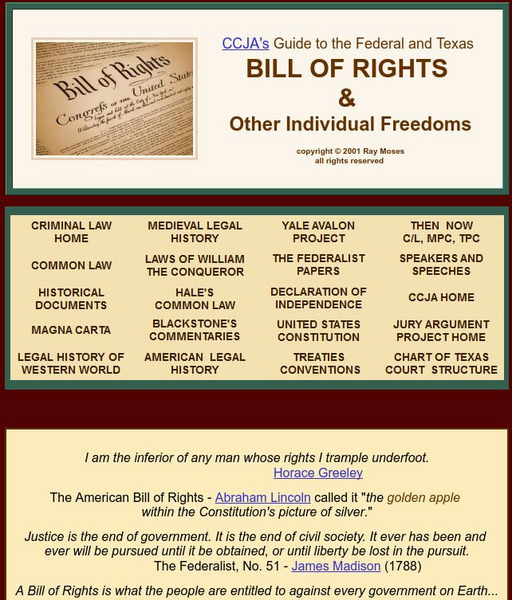
Ccja: Guide to the Federal and Texas Bill of Rights and Individual Freedoms
This guide contains excerpts and annotation for four historical government documents: the Federal Bill of Rights, the United States Constitution, the current United States Supreme Court Justices, and the Bill of Rights from the Texas...
Rock and Roll Hall of Fame
Rock & Roll Hall of Fame: Sti Lesson 42: The Bill of Rights Is a Rockin
Students are aware of most their personal rights and freedoms. However, many have not critically evaluated the significance of the Bill of Rights and are unaware that the Bill of Rights only applied to the federal government from 1791...

Other
Civil Rights Movement 1955 1965: Mississippi & Freedom Summer
Take a look at Mississippi in the early 1960s to understand why the focus of African American voter registration targeted that state. Read about the organization and implementation of the Mississippi Summer Project in 1964. See also the...
Bill of Rights Institute
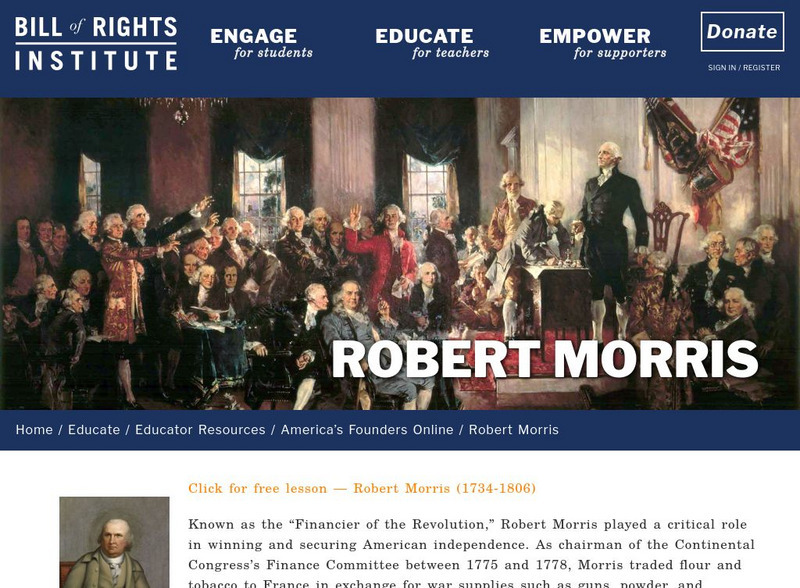
Bill of Rights Institute: Robert Morris
Known as the "Financier of the Revolution," Robert Morris played a critical role in winning and securing American independence. As chairman of the Continental Congress's Finance Committee between 1775 and 1778, Morris traded flour and...
The Newberry Library
Newberry Library: Anti Statism in u.s. History
Newberry Library digital collections presents a lesson using primary sources from which students explore the concept of "anti-state" sentiment and examine the reasons writers and politicians protest the authority of the federal...
Other
D Archives: Alice Stone Blackwell, Objections Answered
Read this 1915 essay by Alice Stone Blackwell, who outlines the basic reasons women should be granted equal voting rights in the U.S.
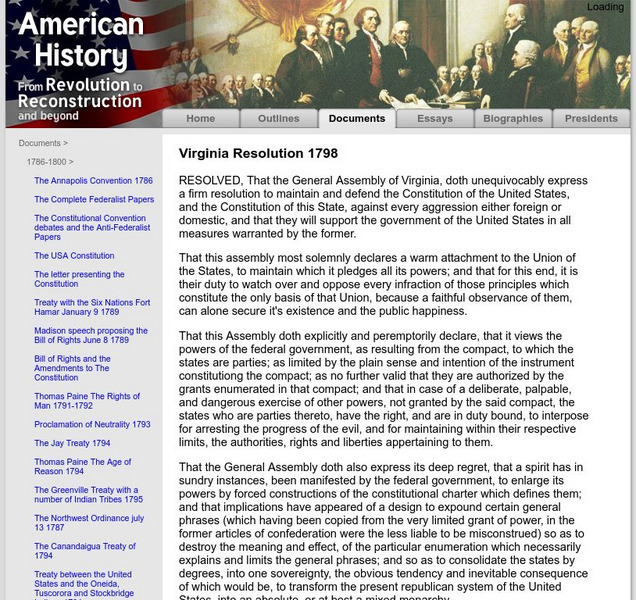
University of Groningen
American History: Documents: The Virginia Resolution of 1798
This resource presents the full text of the Virginia Resolution of 1798, in which the General Assembly of the State of Virginia protests the enactment of the Alien and Sedition Acts of 1798.
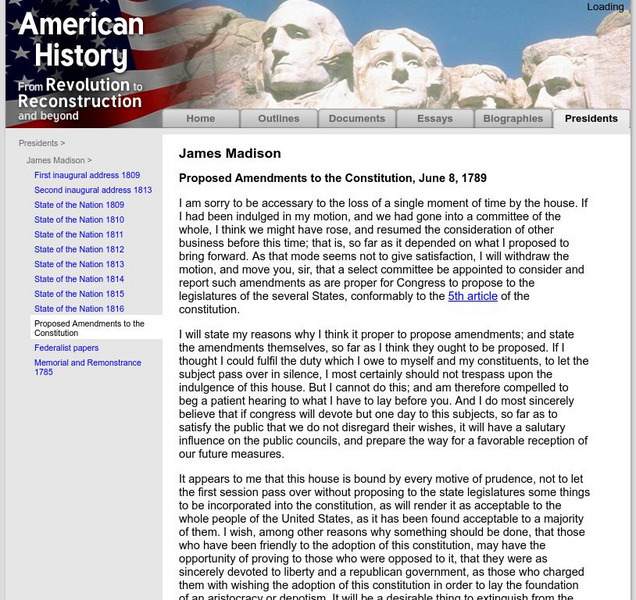
University of Groningen
American History: Presidents: James Madison: Proposed Amendments to Constitution
Text of James Madison's "Proposed Amendments to the Constitution," June 8, 1789. Madison states his reasons for the amendments in view of the anti-federalist feelings in many of the colonies. The proposal explains in Madison's own words...
US Government Publishing Office
U.s. Government Publishing Office: Core Documents of u.s.democracy
Direct online access to the basic Federal Government documents that define our democratic society, a core group of current and historical Government publications.
A&E Television
History.com: How the u.s. Constitution Has Changed and Expanded Since 1787
Through amendments and legal rulings, the Constitution has transformed in some critical ways. The U.S. Constitution, written in 1787 and ratified by nine of the original 13 states a year later, is the world's longest-surviving written...
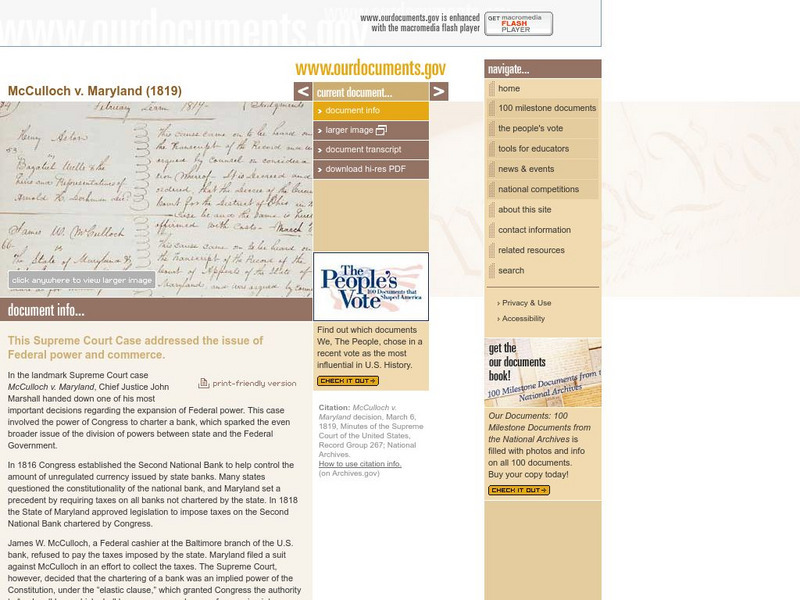
US National Archives
Our Documents: Mc Culloch v. Maryland
Learn about this landmark Supreme Court case on the issues of federal power and commerce. Provides an image of a document from the case files and a transcript of the opinion delivered in 1819 by Chief Justice John Marshall.
Ohio State University
Osu History Teaching Institute: The Alien and Sedition Acts
Objective of this lesson is to understand the provisions of the Alien and Sedition Acts within their political and constitutional contexts.
US Department of Justice
U.s. Department of Justice: Omnibus Crime Control and Safe Streets Act of 1968
A complete government description of Section 3789d of the Omnibus Crime Control and Safe Streets Act of 1968, which explicitly prohibits the federal government from controlling state or local police agencies, and which explicitly...
Cato Institute
James Madison's Vision of Liberty [Pdf]
An article by the CATO institute about James Madison's vision for his writing and contribution for the U.S. Constitutional Convention. Includes information on his views of a limited government for citizens' rights.
Annenberg Foundation
Annenberg Classroom: The Pursuit of Justice
This book analyzes 30 Supreme Court cases chosen by a group of Supreme Court justices and leading civics educators as the most important for American citizens to understand. An additional 100 significant cases included in state history...
iCivics
I Civics: Breaking Barriers: Constance Baker Motley
Meet a woman who broke all the barriers to become a champion for civil rights: Constance Baker Motley lawyer, state senator, and federal judge. [1:52]

Alabama Learning Exchange
Alex: Is a Legal Career Right for You?
This is a 3-part project; however, you may opt to omit 1 part. Students will investigate a career related to the legal profession to determine the various aspects of the career. In addition, students will create a PowerPoint presentation...
Henry J. Sage
Sage American History: Daniel Webster: The Union Address
Primary source material of famous speech made by Daniel Webster in 1830 in which Webster objects to imposing high tariffs and argues in favor of a state's right to refuse federal law.
Other
Uintah Basin Tah Project: American Indians 101: Frequently Asked Questions
Provides answers to commonly asked questions about Native Americans, e.g., how they are defined, the proper terms to use, and what a reservation is, as well as questions about their relationship with the federal and state governments,...

The Dirksen Congressional Center
Dirksen Congressional Center:congress for Kids: Introduction to the Constitution
Explore the history of the United States Constitution: information about the writing the Constitution, the Great Compromise, the Constitution's signers, the Bill of Rights, the Amendments to the Constitution, federal powers, checks and...

Annenberg Foundation
Annenberg Learner: Democracy in America: Legislatures: Laying Down the Law
This ambitious unit examines the various levels of legislature from federal to municipal, the wants of constituents versus what the legislators feel is right, and the need for compromise. Offers video, activities, and related resources.