Hi, what do you want to do?






Exploratorium
Groovy Sounds
Make music. Class members construct a simple record player using a paper cone and a pin. The resource provides a description of what is happening and why listeners can hear the sounds through the cone.

IOP Institute of Physics
Physics in Concert
What do physicists and musicians have in common? A lot more than you might think. After first viewing a slide show presentation and completing a series of skills practice worksheets on the physics of light, sound, and...

Exploratorium
Vocal Visualizer
Make sound visible with an activity that provides directions for how to build a vocal visualizer meant to create light patterns. Making noise into the visualizer causes a mirror to vibrate, reflecting a laser beam, and creating...

DiscoverE
Slinky® Science
Toys are great for learning about physics. Scholars use Slinky® toys to study Newton's laws of motion and types of energy. After a little play, they then model longitudinal and transverse waves with the Slinky® toys.

Washington State University
Defining Bullying
How can you recognize bullying? How is verbal bullying different from physical or social bullying, and when has a joke gone too far? Learners use their own experiences and ideas to inform the discussion.

Curated OER
The Old Man and the Sea: Guided Imagery
What do you imagine when you think of the sea? Put on some ocean sounds, close your eyes, and listen to a guided meditation based on the imagery from The Old Man and the Sea by Ernest Hemingway. After class members listen to...
Science Buddies
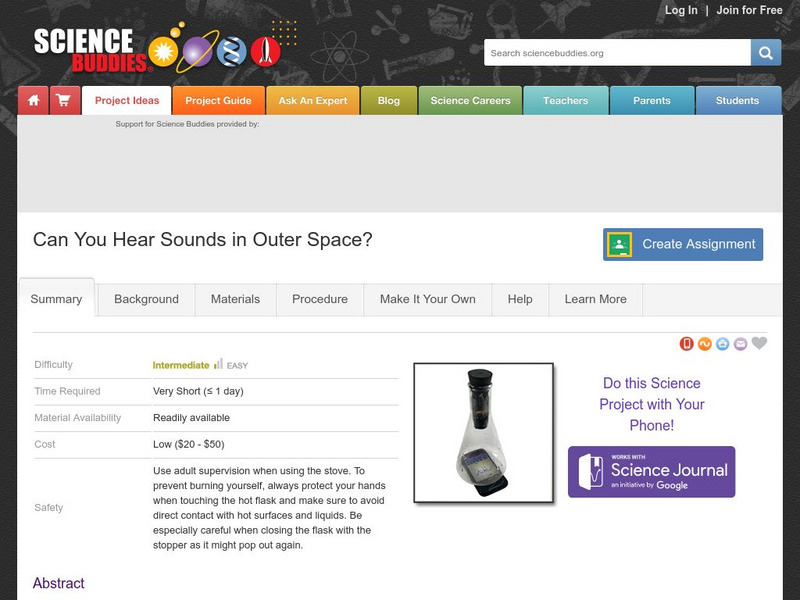
Science Buddies: Outer Space, the Silent Frontier: An Experiment on Sound Waves
In outer space there is utter silence. There are no sounds of traffic jams or thunderstorms or crashing waves. No buzzing bees or babies crying. Just silence. In this experiment, you will discover why empty space is void of sound.
Physics Central
Physics Central: Physics at Your Desk: Drumming Fingers
An easy experiment through which students explore sound waves while tapping their fingers on a desk or table in a quiet room.
Science Buddies
Science Buddies: Extreme Sounds: Lessons in a Noisy World
Just how loud does a sound have to be for us to hear it? And how loud is too loud for our ears? Learn to measure levels of sound in this project, and discover the amazing auditory range your ears can detect in the noisy world around you.
Science Buddies
Science Buddies: Frequency Dependent Sound Absorption
Want to start a garage band, but Mom or Dad won't let you because it will make too much noise? This is a good project for someone who is interested in acoustics and likes to build things. The objective of this project is to determine if...
Read Works
Read Works: How to See Sound
[Free Registration/Login Required] An informational text showing how to see sound waves. A question sheet is available to help students build skills in reading comprehension.
Read Works
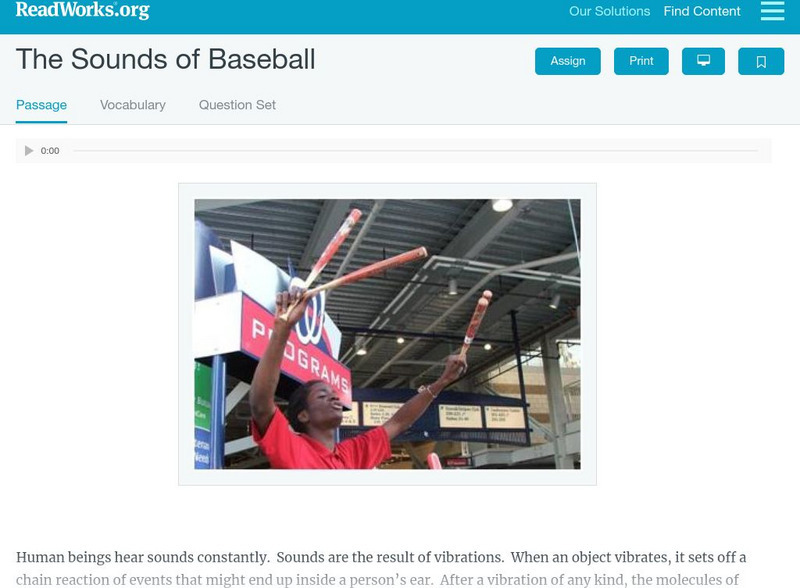
Read Works: The Sounds of Baseball
[Free Registration/Login Required] An descriptive text about the sounds a person would hear at a baseball game. A question sheet is available to help students build skills in reading comprehension.
Science Buddies
Science Buddies: How Does Color Affect Heating by Absorption of Light?
Light is an example of an electromagnetic wave. Electromagnetic waves can travel through the vacuum of interstellar space. They do not depend on an external medium-unlike a mechanical wave such as a sound wave which must travel through...
Physics Central
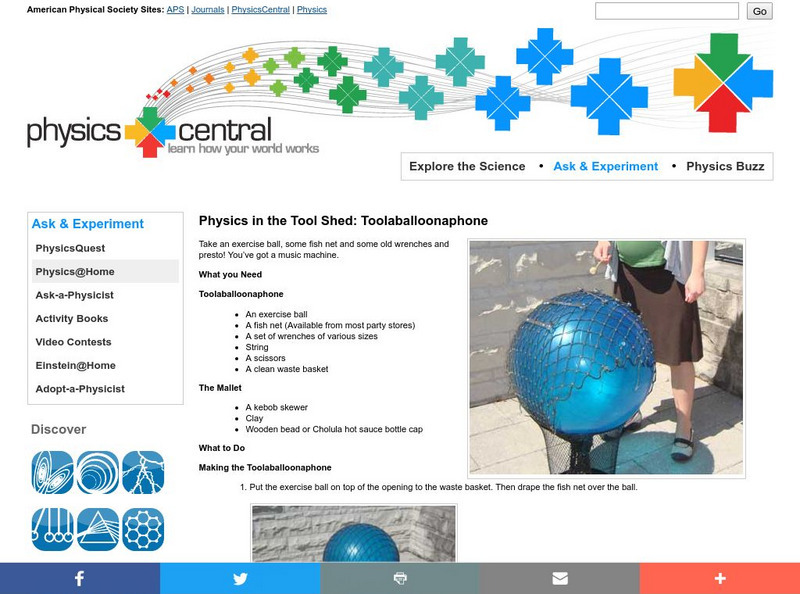
Physics Central: Physics in the Tool Shed: Toolaballoonaphone
Learn about compression waves and amplification through constructing a toolaballoonaphone! The toolaballoonaphone is made out an exercise ball, fish nets, wrenches, strings, scissors, and a clean waste basket that allows students to...
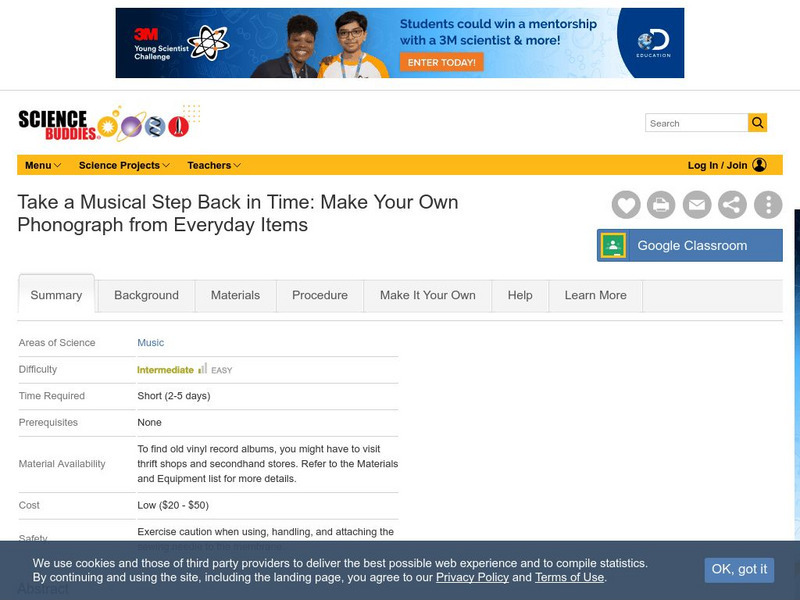
Science Buddies
Science Buddies: Project Ideas: Make a Phonograph From Everyday Items
In this physics science fair project, the student will use common materials to play back sound from a vinyl record album. The student will investigate what kinds of materials produce the best sound. The Science Buddies project ideas are...
Michigan Reach Out
Sounds Like Science: Guitars
At this site explore the relationship between audibility and frequency of sound, and the difference between frequency and volume.

Michigan Reach Out
Sounds Like Science: Bottle Organ
In this lesson plan students are able to manipulate sound to arrange a musical scale. Can be used by both science and music teachers.

TeachEngineering
Teach Engineering: Wind Chimes
Using their knowledge of physics, students will build a wind chime. Mathematical computations will be done to determine the length of the pipes.

PBS
Pbs Learning Media: Atlanta Symphony Orchestra: Live Exploration
Take a special trip to the Atlanta Symphony Orchestra with GPB Education! This interactive virtual exploration offers students a behind-the-scenes experience as they learn about the science of sound and the preparation it takes to put on...
Michigan Reach Out
Michigan Reach Out!: Drums (Sounds Like Science)
This site is provided for by Michigan Reach Out. Students experiment with the variables of force, pitch and volume after making a drum.

Science Buddies
Science Buddies: Guitar Fundamentals: Wavelength, Frequency, & Speed
This is a rockin' project for guitarists with an interest in the physics behind music. If you have ever wondered why the pitch of the note changes when you fret the string, this project will help you understand by applying basic...
University of Maryland
Thinking Problems in Oscillations and Waves
A series of thought-provoking, multichoice questions from the University of Maryland on the topic of oscillations and waves. Equations for calculating the period of motion for masses on springs, pendulums, sounds, and waves on a string...
Michigan Reach Out
Michigan Reach Out!: Making a Shoe Box Guitar
This site provides an experiment where students create a guitar to discover what variables will change sound.