Hi, what do you want to do?






E-learning for Kids
E Learning for Kids: Science: Antarctica: How Are Sounds Useful to Us?
Paul is a researcher on Antarctica. The topic of his research is sounds. Identify which objects make sounds, and learn to recognize different sounds.
Curated OER
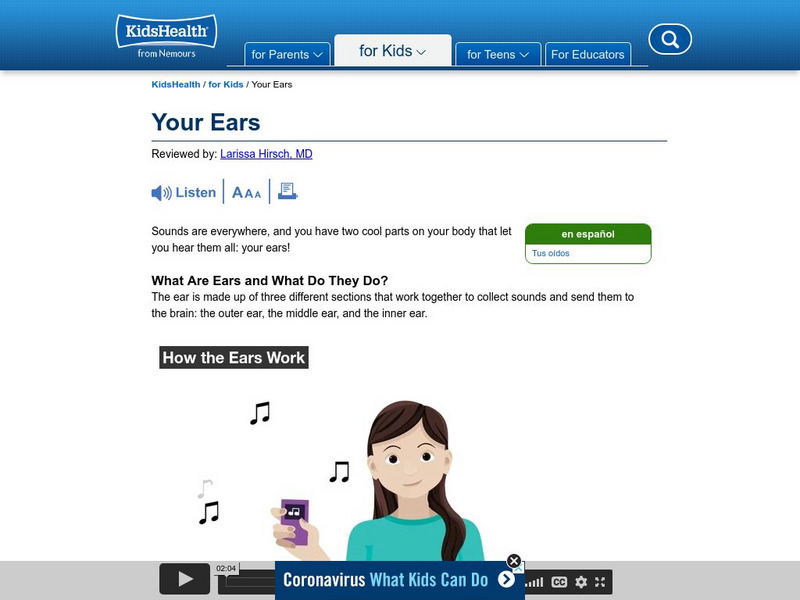
Kids Health: Let's Hear It for the Ear!
Use this site to learn about the body part that is responsible for collecting sounds, processing them and sending them to your brain. See all the inner workings of the ear through great diagrams. Available in Spanish.

Other
Bscs: Sound Lesson 1: Sound Makers
How can you tell if something is making a sound? This lesson will show that to produce sound, an object must vibrate. Included are a minute-by-minute lesson plan, activities, and teacher discussion points and questions.

TeachEngineering
Teach Engineering: Seeing and Feeling Sound Vibrations
Students examine the existence of sound by listening to and seeing sound waves while conducting a set of simple activities as a class or in pairs at stations. Students describe sound in terms of its pitch, volume and frequency. They use...

National Science Foundation
National Science Foundation: Language and Linguistics
The language we use everyday reveals a great deal about who we are and where we come from. However, did you know that language is linked to psychology, biology, and other sciences? Explore the "science" of language: how the brain...

PBS
Pbs Teachers: Scientific American: Growing Up Different: In Tune
Explore the science of sound and the human ear, and explain how this applies to the operation of cochlear implants for the deaf. Observe how structures can be "tuned" to respond to different frequencies.

Alabama Learning Exchange
Alex: Word Families: Ig and Ip
This technology-based lesson will help students develop their phonemic awareness by teaching students to hear the sounds in the -ig and -ip word families. It also leads students to apply what they have learned.

Ducksters
Ducksters: Biology for Kids: Hearing and the Ear
Kids learn about the science of hearing and the ear. A sense that detects sound.
Songs for Teaching
Sciences Songs All Day Long: Nocturnal Animals
By listening to this song your students will learn all of the animals that are awake during the night. They will equate the sounds they hear at night with the animals and their sounds in the song.
Treehut
Suzy's World: Ears
Find out how your ears work and try an experiment involving your hearing.
Cornell Lab of Ornithology
Cornell Lab of Ornithology: Killdeer
The Killdeer is famous for using the broken wing diversion to lure predators away from its nest. Find out more interesting facts and hear the sounds of this interesting bird on this detailed site.
Other
Arizona Sonora Desert Museum: Animal Fact Sheet: Anna's Hummingbird
This fact sheet on Anna's hummingbird provides details on physical characteristics, adaptations, range, habitat, conservation, diet, and other interesting facts. Click the link to hear how Anna's hummingbird sounds.

Music Education
Learn About Instruments: The Winds
This tutorial teaches students about the flute, piccolo, and saxophone. It features sound clips so that you can hear examples of each instrument being played.
Other popular searches
- Science Sound and Hearing
- Hearing and Sound
- Hearing and Sound Experiment
- Sound and Hearing Worksheets