Hi, what do you want to do?





Read Works
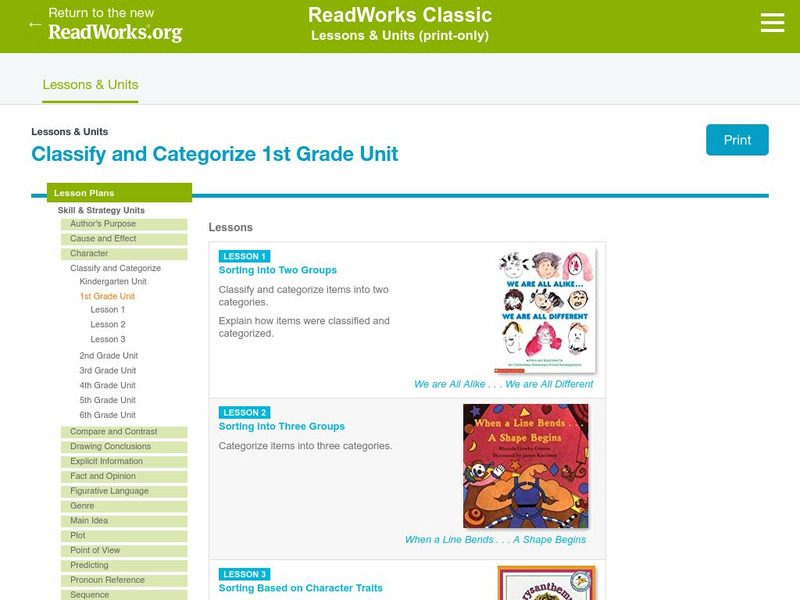
Read Works: Classify and Categorize 1st Grade Unit
[Free Registration/Login Required] A three-lesson unit on classifying and categorizing through which students learn how to sort items into two and three categories and explain how each group is classified. Finally, students categorize...

Alabama Learning Exchange
Alex: What's That Coin?
This Five E's AMSTI lesson prompts students to pay close attention to the details on each of the four U.S. coins as they learn the coin names. Students watch a video clip about the differences in the coins, sort real coins by attributes,...
Illustrative Mathematics
Illustrative Mathematics: Finding Equal Groups
This activity will test how quickly students can count objects. The teacher will assemble a variety of groups of objects in a few different forms (examples included). Students will race against the clock to sort the groups of objects...
Illustrative Mathematics
Illustrative Mathematics: Guess the Marbles in the Bag
Students will make their best guesses as to how many marbles are in a bag. After recording 4-5 guesses, the teacher writes the number representing the total on the board, and the students then help sort their guesses into less than,...

PBS
Pbs Learning Media: Fresh Pick Challenge: Logical Lunch
By using their deductive reasoning skills, children can help Henry and Avril pack a perfect picnic lunch. This activity will provide them with ways to use clues to solve a problem, group objects based on several attributes, and...
National Council of Teachers of Mathematics
Nctm: Illuminations: Shape Sorter
Use this applet to sort shapes according to their properties using Venn diagrams.
Braingle
Braingle: Group Brain Teasers
The brain teasers at this site test "your ability to recognize groups of common attributes" and "to figure out why the words or letters are grouped as they are." Sort brain teasers according to title, popularity, and difficulty, and...
PBS
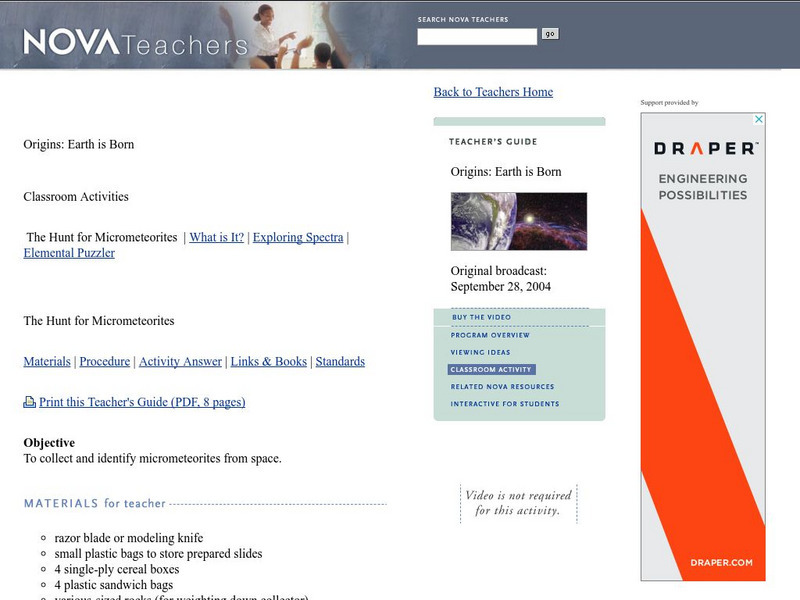
Pbs Teachers: Origins: Earth Is Born
Collect micrometeorites from space -- remnants of the time when the solar system formed about 4.6 billion years ago. Create a sky dust collector, sort particularate matter according to attributes and identify micrometeorites by their...
Better Lesson
Better Lesson: Tree Mapping in 2 D
Identifying 2D shapes in common objects and sorting according to shapes connects the real world to learning shape names and attributes.
PBS
Pbs Learning Media: Measuring With Mixie Bot
Children can measure with a favorite character to understand the value of standardized units of measure, such as inches and feet. This activity will help them practice measuring and understand comparing the measurements of one item to...
Annenberg Foundation
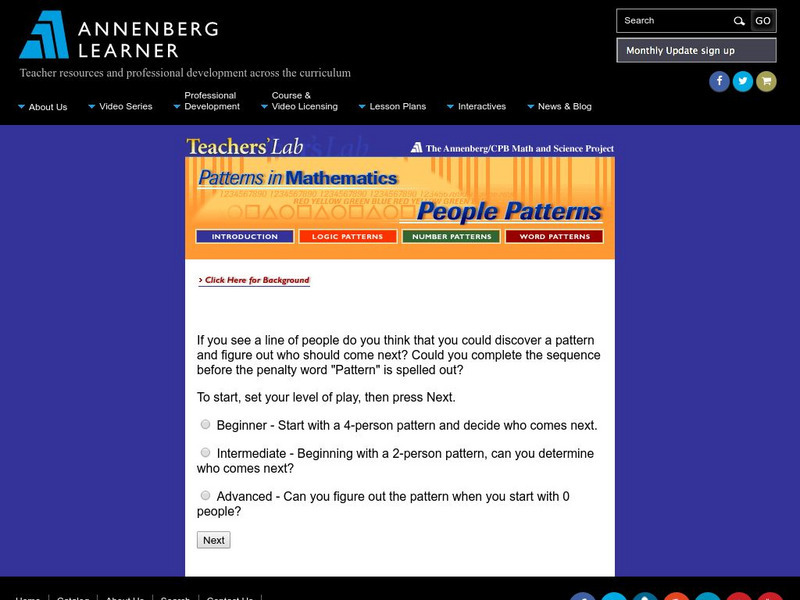
Annenberg Learner: Patterns in Mathematics: People Patterns
This interactive website offers young students an opportunity to discover the pattern and predict who will come next. Feedback and guidance are given for each response. It also offers three increasingly difficult levels that are available.
Illustrative Mathematics
Illustrative Mathematics: Assessing Sequencing Numbers
This lesson plan assesses rather students can correctly order numbers. The teacher will ask the student(s) to put pre-made number cards in order from the smallest number to the biggest number or in the order they would say them if they...
Illustrative Mathematics
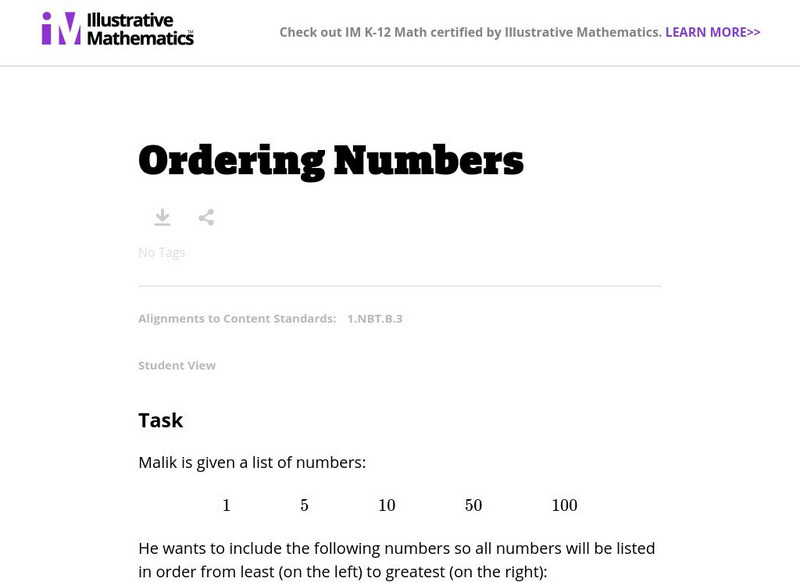
Illustrative Mathematics: Ordering Numbers
Given a set of numbers, young scholars need to decide where to place another set of numbers so they are ordered from least to greatest. This is a good precursor to greater than/less than. A detailed example is included.
Illustrative Mathematics
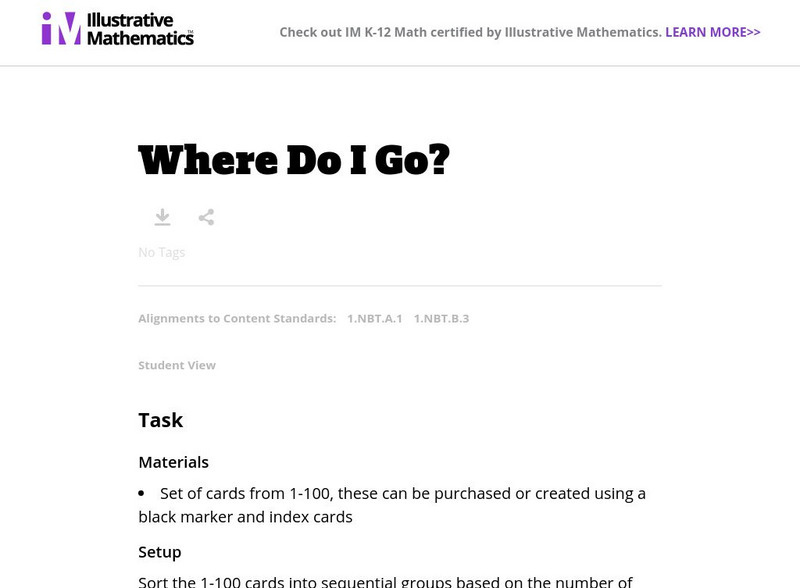
Illustrative Mathematics: Where Do I Go?
Students will get a chance to move around while practicing number sequences. Teachers will pre-make or buy cards numbered to 100. Give each student a card and have them move around and arrange themselves in sequential order. Multiple...
HotChalk
Hot Chalk: Lesson Plans Page: Kick Off Seed Explorations
This simple lesson plan is designed to have young students become more familiar with fruit seeds by identifying fruit that contains seeds/no seeds, gathering seeds from fruit, explaining the importance of seeds, explaining that seeds...
University of Regina (Canada)
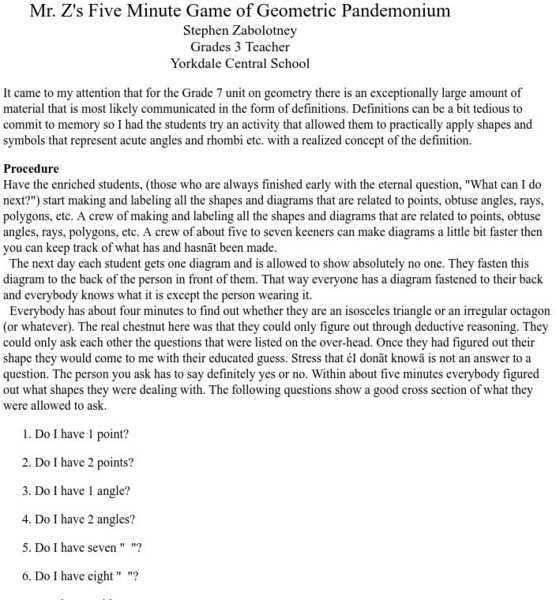
University of Regina: Math Central: Lesson: Mr. Z's 5 Minute Game of Geometric Pandemonium
Students make a series of geometric drawings of points, obtuse angles, rays, polygons, and the like. Each child is given one but not allowed to show anyone else. The drawing is then taped to the back of the child in front of them. The...
The Franklin Institute
The Franklin Institute: Classified
At this site from The Franklin Institute you can practice classifying objects according to physical structure and characteristics.
Quia
Quia: Rags to Riches: Category Ladder Iii
In this interactive, millionaire-style game, students see groups of three items and select the category that fits each group.
Curated OER
Eternal Egypt: Leg of Bull Amulet
An unusual amulet of the leg of a bull of the sort that was called an "assimilation amulet," which confers on its wearer the attributes of the animal. This amulet provides its possessor with the savage strength, the courage and the...
Curated OER
Educational Technology Clearinghouse: Clip Art Etc: Clavis
A key. The key was used in very early times, and was probably introduced into Greece from Egypt; although Eustathius states, that in early times all fastenings were made by chains, and that keys were comparatively of a much later...
Other popular searches
- Sorting Attributes by Color
- Science Sorting Attributes
- Sorting Attributes by Size
- Sorting Attributes by Weight
- Sorting Attributes Pre K
- Sorting Attributes Prue K
- Sorting Attributes Venn