Hi, what do you want to do?





Science and Mathematics Initiative for Learning Enhancement (SMILE)
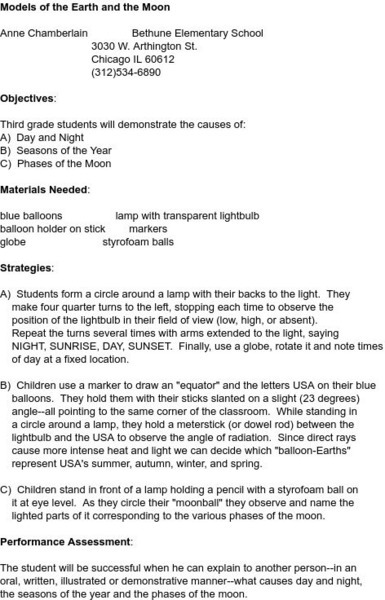
Smile: Models of the Earth and Moon
This lesson plan from the Illinois Institute of Technology demonstrates the causes of; day and night, seasons, and phases of the moon.With a few items, you help the elementary student discover why these phenomena occur.
University of California
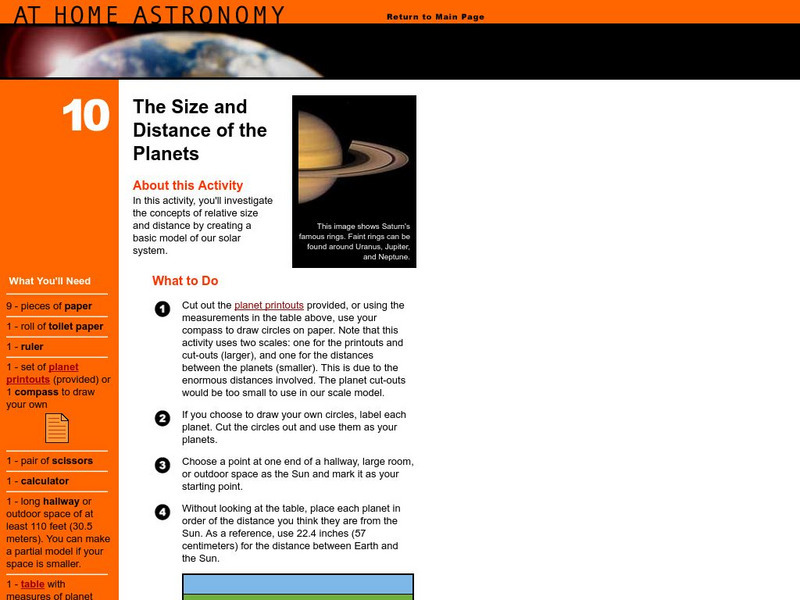
Uc Berkeley: At Home Astronomy: The Size and Distance of Planets
In this activity, "You will investigate the concepts of relative size and distance by creating a basic model of our solar system." Planet printouts are provided and this site contains related links.
TeachEngineering
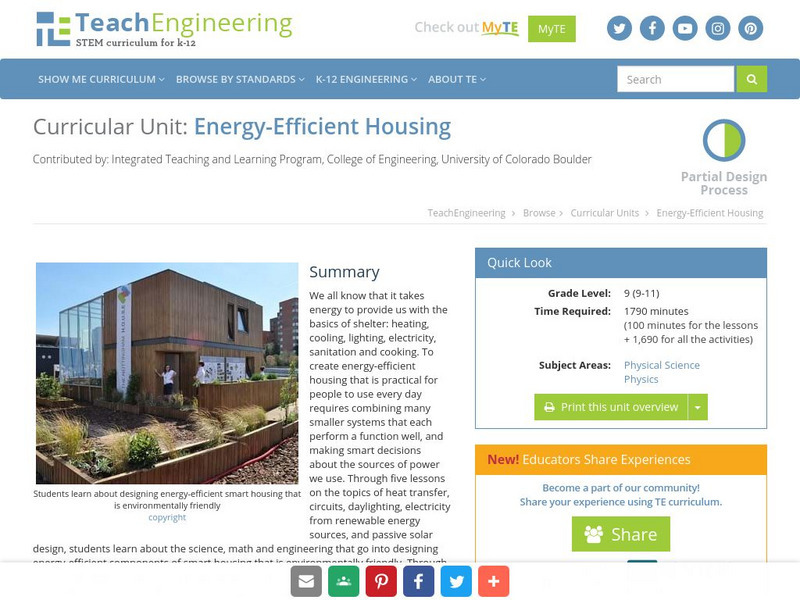
Teach Engineering: Energy Efficient Housing
We all know that it takes energy to provide us with the basics of shelter: heating, cooling, lighting, electricity, sanitation and cooking. To create energy-efficient housing that is practical for people to use every day requires...
![Arts Now Learning: Phases of the Moon [Pdf] Lesson Plan](https://static.lp.lexp.cloud/images/attachment_defaults/resource/large/FPO-knovation.png "Arts Now Learning: Phases of the Moon [Pdf] Lesson Plan")
ArtsNow
Arts Now Learning: Phases of the Moon [Pdf]
In this lesson, 4th graders use their bodies to model the day/night cycles of the Sun and Earth. Next, they discuss the moon's role in the solar system and explore the eight phases of the moon by acting out a story. Finally, a song...

TeachEngineering
Teach Engineering: Photosynthesis Life's Primary Energy Source
This lesson covers the process of photosynthesis and the related plant cell functions of transpiration and cellular respiration. Students will learn how engineers can use the natural process of photosynthesis as an exemplary model of a...

TeachEngineering
Teach Engineering: Life Science
This unit covers the processes of photosynthesis, extinction, biomimicry and bioremediation. In the first lesson on photosynthesis, students learn how engineers use the natural process of photosynthesis as an exemplary model of a complex...