Hi, what do you want to do?






Curated OER
Volumw Measurement, English System
Eighth graders biew each volume container and discuss where they have seen them in their home, and how they have seen them used. They explore the different names of volume sizes and their equivalents towards one another. Students...

Curated OER
Physical Properties Of Coal
Students examine and identify the observable properties of coal. After a lecture/demo, students perform a simple experiment. They observe samples of coal and record data in an organized manner.

Curated OER
Estuarine Currents
Students explore an estuarine system to gather data on density driven currents. This type of current is contrasted with temperature and wind driven currents.

Curated OER
How Do We Breathe?
Students study the structure of the lungs. In this lung structure lesson, students use lung models to study the structure of lungs and experiment to measure the amount of air in the lungs.

Curated OER
#24 Rotating Frames of Reference in Space and on Earth
Young scholars explore rotating frames of reference, focusing on the weightless environment in space and the Coriolis force.

Curated OER
Let's Catch Some Dirt From the Air
Students create "catchers" that collect dirt particles from the air. They observe the particulate matter that is collected from the air and discuss the effects and causes of air pollution.

Curated OER
Mystery Liquids: Linear Function
High schoolers determine the linear equations of the density of water and oil by collecting data on the mass of various volumes of each liquid. They construct scatter plots from the data and use these to write the linear equations for...

Curated OER
The Letter Ww
Students explore letter Ww. In this letter recognition lesson, students participate in country, state, food, literature, physical education, colors, careers, music, and game activities that are linked to the main lesson page. Students...

Teach Engineering
Buoyant Boats
Eureka! Using the clay boats made in the previous lesson, learners investigate the idea of buoyancy and water displacement to finish the last installment of five in a Floaters and Sinkers unit. Their observations during the activity...

Curated OER
Discussing How Plants Grow
Study how plants grow with your English language learners with a cross-curricular lesson plan revolving around pumpkins. These activities provide opportunities to practice new scientific vocabulary while practicing skills such as...

Curated OER
The Impact of Invention
Students explore the impact of invention. In this invention lesson, students examine how inventions are on going and affect all aspects of life in both good and bad ways. Students will research the history of invention, become an...

Curated OER
Inventions 2: The Impact
Students research inventors and inventions and their impacts. In this invention lesson, students research inventions and their affects in good and bad ways.

Better Lesson
Better Lesson: Floating and Sinking Sorting in Science
Students sort objects according to whether they sink or float.
Science Education Resource Center at Carleton College
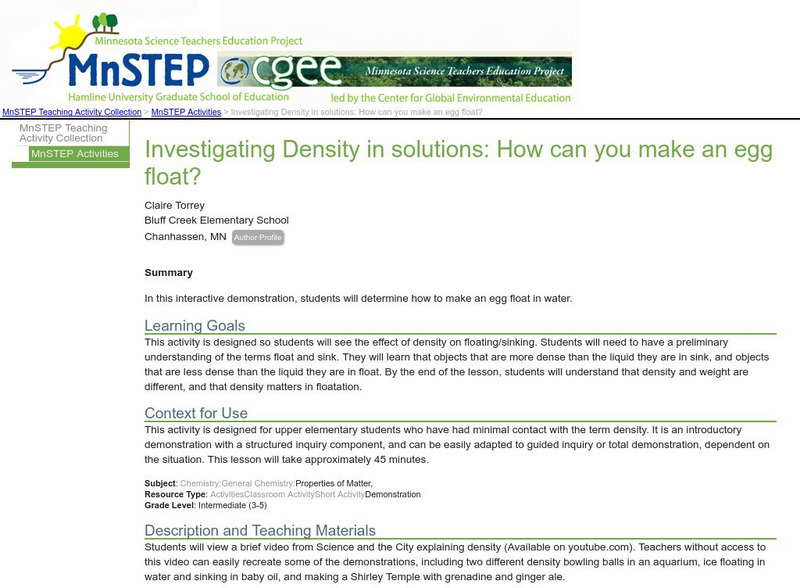
Serc: Investigating Density in Solutions: How Can You Make an Egg Float?
In this activity, students will learn about density by determining how to make an egg float in water. By the end of the instructional activity, students will understand that density and weight are different and that density matters in...
PBS
Pbs: Sesame Street: Science
A collection of interactives, videos, and documents on a variety science concepts.
Science is Fun
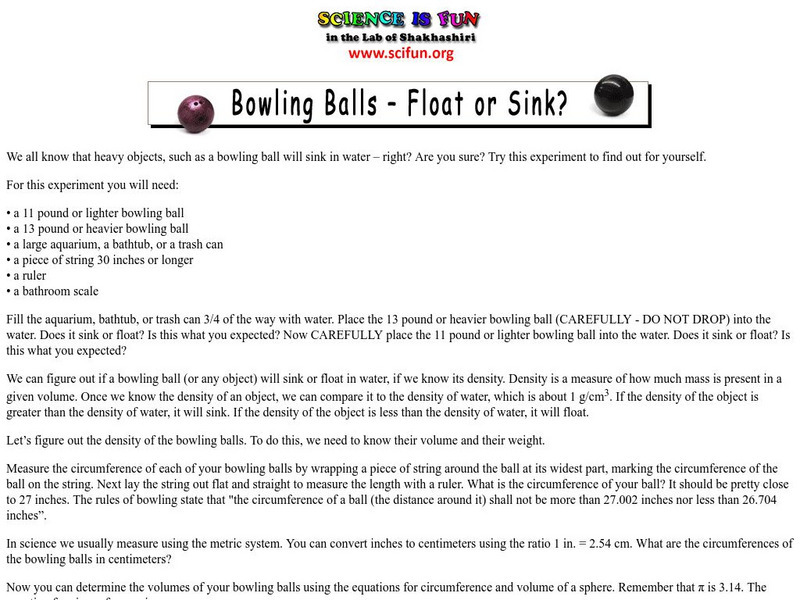
Fun Science: Bowling Balls: Sink or Float?
For a dramatic illustration of density check out this demonstration. It's simple to do, only requiring a bowling ball and some water.
Science is Fun
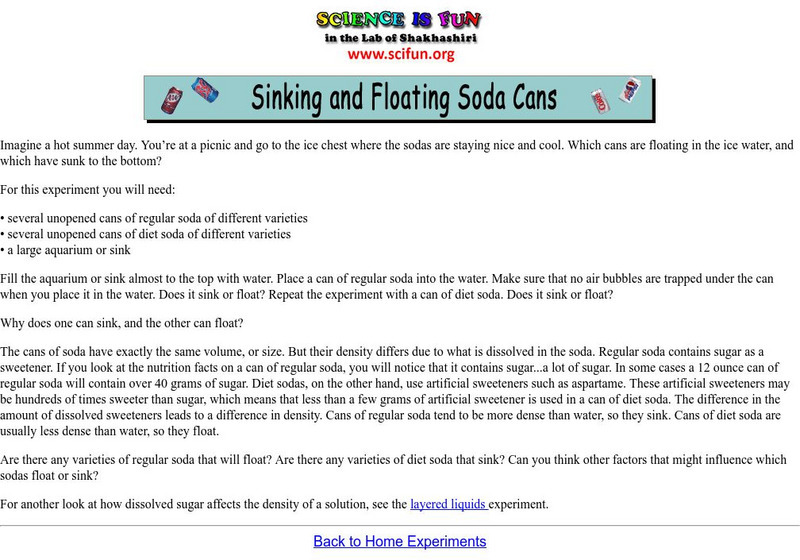
Science Is Fun: Sinking and Floating Soda Cans
An experiment to determine if either a regular or a diet can of soda will float or sink when placed in water, and what causes this.
Science and Mathematics Initiative for Learning Enhancement (SMILE)
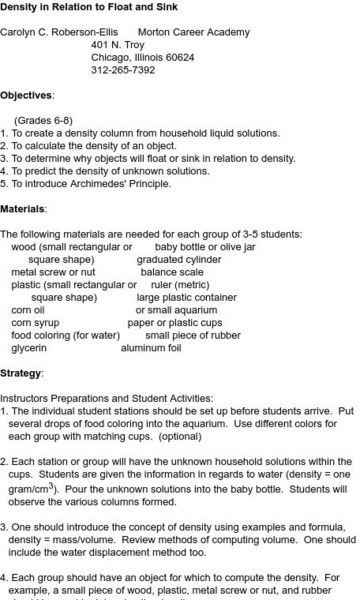
Smile: Density in Relation to Float and Sink
Students find the densities of objects based on sinking or floating in this activity that demonstrates Archimedes Principle.

Alabama Learning Exchange
Alex: What's the Matter: A Sinker or Floater?
Students will explore matter that sinks or floats when submerged in water and that matter is categorized as either a sinker or a floater. Students will work actively in small, cooperative learning groups as well as gather in a whole...
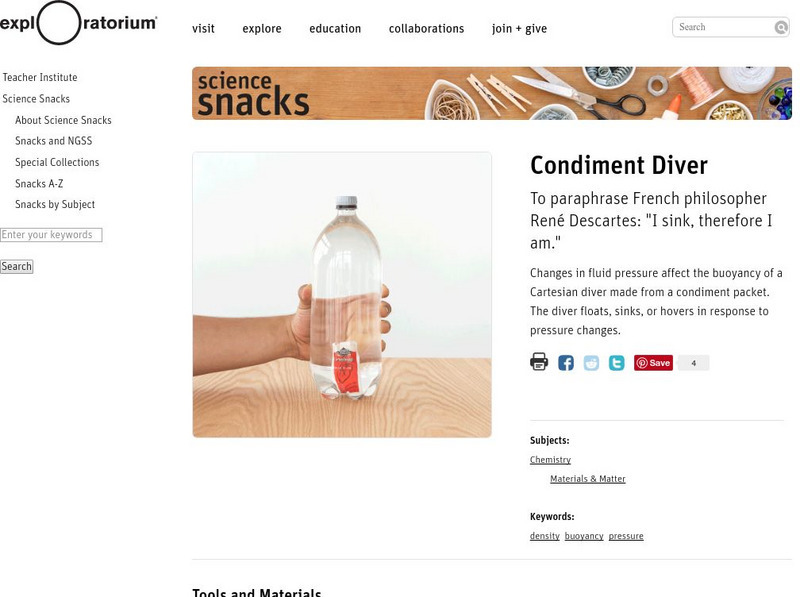
Exploratorium
Exploratorium: Science Snacks: Condiment Diver
Use a condiment packet as a Cartesian diver to show how pressure changes cause the "diver" to float, sink or hover.
Science is Fun
Science Is Fun: Bowling Balls Float or Sink?
In this experiment, you test whether two different bowling balls will float or sink, then determine the density of each of the balls to see if they are less than that of water.
Science is Fun
Science Is Fun: Dancing Raisins
An experiment in buoyancy which involves making raisins float by using carbonated soda pop. Students then try the same test with other materials. Instructions for making one's own carbonated liquid are also provided.
Science Education Resource Center at Carleton College
Serc: Density of Solid Objects
In this science inquiry, learners investigate whether volume or density of objects determine the floating or sinking in water. Using a rock and a block of wood teachers engage students in the discussion of density, mass and volume.
Science is Fun
Science Is Fun: The Cartesian Diver
A simple experiment in buoyancy where you discover how to make a packet of sauce or candy float or sink at will, and why you are able to do this.