Hi, what do you want to do?






Curated OER
Moving Straight Ahead
Pupils analyze the relationship between speed, time and distance. For this math lesson, students plan a school trip. Pupils determine the efficiency and cost effectiveness of a trip.

Curated OER
Exploring Function Graphs
Tenth graders investigate three different sets of data that relate temperature to another variable in the physical world. These illustrate linear, inverse and exponential relationships.

Curated OER
Divide and Conquer
Seventh graders analyze responses to different types of problems. Using pictures and diagrams, they explore and model the division of fractions. Students examine situations that call for division whether with the whole numbers or with...

Curated OER
Triangular Numbers
In this triangular numbers worksheet, students create a table of triangular numbers, write a formula for the nth number, and determine the sum of any two consecutive triangular numbers. This two-page worksheet contains five problems.

Curated OER
Exploring Arrangements of 2, 3, 4, and 5 Cubes
Pupils construct models of various tricubes, tetracubes, and pentacubes that are possible, classify n-cubes into different groupings, and draw these figures on isometric dot paper giving true perspective to what they visualize.

Curated OER
Square and Triangular Numbers
Students use equations to represent practical situations. They solve linear equations and quadratic equations. The use of problem solving strategies is also developed.

Curated OER
Introduction to Plates, Axles, and Gears
Students are introduced to the function and design of the following Lego pieces: beams, bricks, plates, axles, tires, hubs and bushings. They then work with a partner to build something using only these pieces.

Curated OER
Bears
Pupils complete a variety of bear-related activities. They sort and graph teddy bears, distinguish between real and non-real bears and research bear life cycles and habitats.

Curated OER
Fences and Posts
Fifth graders use Geoboards to demonstrate how shapes can be made by looping the rubber bands over the nails. They make a triangle on their Geoboards. At least one side of the triangle should be either horizontal or vertical. The picture...

Curated OER
The Topsy-Turvy Twins
Fourth graders read the problem and brainstorm for ways to solve the problem - list these on the board for the students to refer to as they solve the problem. They work in pairs and focus on the strategy selected.

Curated OER
The Bigger they Are . . .
Young scholars do a variety of data analyses of real-life basketball statistics from the NBA. They chart and graph rebounding, scoring, shot blocking and steals data which are gathered from the newspaper sports section.

Curated OER
Exploding Numbers
Students discuss how numbers increase when exponential growth is occurring. They view a video and compare exponential and linear growth with a graphing calculator.

Curated OER
Reversing Numbers
Second graders solve a math word problem involving the addition of two digit numbers. They discuss the problem as a class, independently explore the problem, and discuss as a class the solution and how they organized their reversed...

Curated OER
The 500 Problem
Students explain face, place and total value of numbers as well as solve three-digit subtraction problems. Before trying answer the problem Students must be able to examine that the same digit is used to represent different amounts.

Mathigon
Mathigon: Algebra: Sequences and Patterns
Explore this course in sequences and patterns including simple sequence, triangle and square numbers, terms, recursive formulas, and explicit formulas. Click on Trailer on the top left to watch an introductory video.
Government of Alberta
Learn Alberta: Math Interactives: Exploring Patterns (Object Interactive)
This interactive Learn Alberta math resource offers a hands-on exploration of number patterns. Students get to control an animated squirrel in order to figure out terms in a sequence and see each pattern represented both in picture form,...
Mathigon
Mathigon: Algebra: Sequences: Pascal's Triangle
This lesson focuses on Pascal's Triangle, a number pyramid in which every cell is the sum of the two cells directly above. It contains all binomial coefficients, as well as many other number sequences and patterns.

ClassFlow
Class Flow: Match Sequences Algebra
[Free Registration/Login Required] In this flipchart, students investigate patterns and sequences used in constructing various shapes using match sticks. Students then develop their introductory algebraic sense by determining the formula...

ClassFlow
Class Flow: Letter Sequences Algebra
[Free Registration/Login Required] In this flipchart, students learn to identify patterns in a sequence of shapes used to create letters. Students then use logic to extend the pattern and extrapolate further shapes.
ClassFlow
Class Flow: Multilink Sequences Algebra
[Free Registration/Login Required] In this flipchart, students are presented with various shapes made up of a sequence of individual blocks. Students apply reason to predict the number of shapes needed to extend the series.

Math Planet
Math Planet: Algebra 2: Geometric Sequences and Series
Gain an understanding of geometric sequences and series by viewing examples and a video lesson. [1:46]

PBS
Wnet: Thirteen: Patterns to the Rescue
Patterns and sequences of numbers are explored through this instructional activity.
Mangahigh
Mangahigh: Algebra: Recognize Number Patterns and Relationships
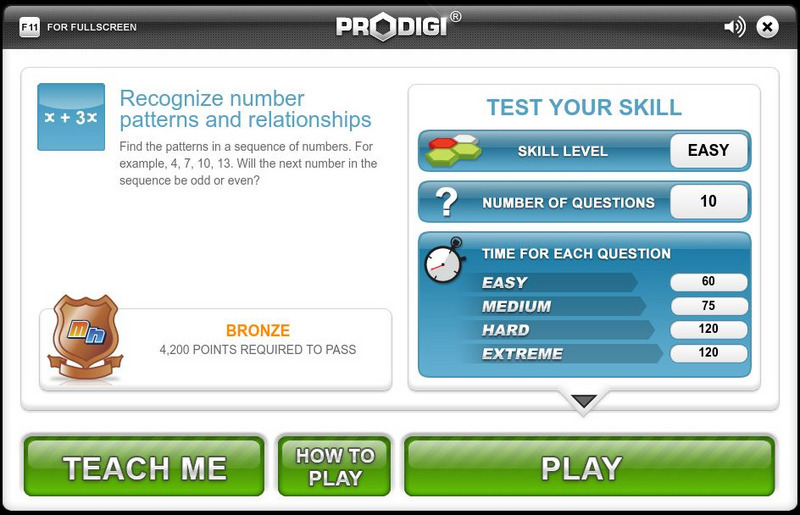
Students work through an online turorial on the topic of number patterns and then take a ten question quiz that increases in difficulty as the problems progress.
Mathigon
Mathigon: Algebra: Special Sequences
In addition to arithmetic and geometric sequences, Fibonacci Numbers, and figurate numbers, there are countless interesting sequences that don't follow a similar, regular pattern. These include prime numbers, perfect numbers, the...