Hi, what do you want to do?






University of Minnesota
Mirroring Emotions
Do you ever give your class the "teacher look"? Without saying a word, they become silent and engaged (hopefully). How do they know what you're thinking? Explore the concept of nonverbal communication and how it relates to our...

Berkshire Museum
Nature Journaling: Experience the Outdoors Through Writing and Drawing
Step into the great outdoors and develop young scientists' skills of observation with a nature journaling lesson. Given a specific focus or goal, children practice making and recording observations of nature through written descriptions...

Curated OER
Five Senses and Four Seasons Quilt
Pupils explore the four seasons and the ways that their five senses give them information about each of the seasons. They work in groups to create a class quilt with one block for each season. Each block should include sensory details...

Alabama Learning Exchange
Systems Every "Body" Needs to Know
Through an informative WebQuest and group work, learners explore the human body and cell structure. They create a cell diagram, research a disease, write a letter explaining the causes of human disease, and work in small groups to create...

Curated OER
SciPod Studies
Have fun preparing a science podcast. After reviewing vocabulary, learners record audio files to create science vocabulary podcasts for particular units of study. A clever way to incorporate technology.

Curated OER
Remember the Egg!
Students investigate how to see, describe and draw faint or subtle features on an object which is thought of by most people as having a smooth, featureless surface. The exercise is important to reinforce skills in making observations...
TeachEngineering
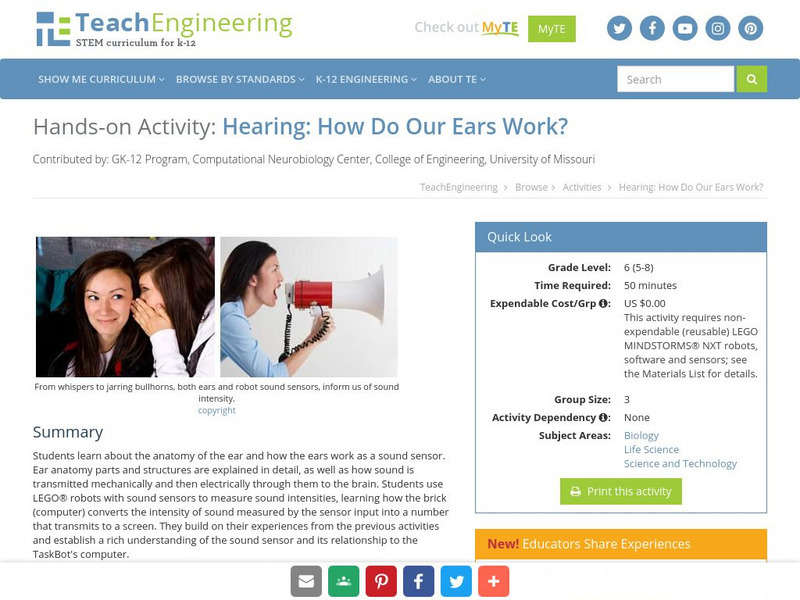
Teach Engineering: Hearing: How Do Our Ears Work?
Students learn about the anatomy of the ear and how the ears work as a sound sensor. Ear anatomy parts and structures are explained in detail, as well as how sound is transmitted mechanically and then electrically through them to the...