Hi, what do you want to do?






University of Florida
Florida Museum of Natural History: My Body My Senses
This teacher's guide introduces children to the human body and the five senses and covers the major body parts and what they do. Children also will use their five senses to learn about the world.
OpenStax
Open Stax: Anatomy & Physiology: Sensory Perception
Learn the different types of sensory receptors, and describe the structures responsible for the special senses of taste, smell, hearing, balance, and vision.

Other
Media Vision Voices: Meet Thomas Paine
Read an extensive biography of 18th century political writer Thomas Paine, click to read about his ideas placed in a contemporary context, and use research links to read more online.
The Franklin Institute
The Franklin Institute Online: Coming to Our Senses
Help students make "Sense," of their senses by using them in the classroom. Site provides discovery activities students can do on themselves, in their classrooms and around campus. A scavenger hunt is also provided.

Ducksters
Ducksters: Biology for Kids: Sight and the Eye
Kids learn about the science of Sight and the Eye. The sense of vision and how it works.
TeachEngineering
Teach Engineering: Haptics: Touch Command
Students experience haptic (the sense of touch) feedback by using LEGO MINDSTORMS NXT robots and touch sensors to emulate touch feedback recognition. With four touch sensors connected to LEGO NXTs, they design sensor attachments that...
TeachEngineering
Teach Engineering: Sound for Sight
Echolocation is the ability to orient by transmitting sound and receiving echoes from objects in the environment. As a result of a Marco-Polo type activity and subsequent activity, students learn basic concepts of echolocation. They use...
The Franklin Institute
Franklin Institute and Science Museum: Seeing
Take a look at this sight and all of the activities it has to offer. Has great activities to use in the classroom as well as world wide web links.
Frontiers Media
Frontiers: Seeing With Your Ears: A Wondrous Journey Across the Senses
For dozens of years it has been believed that the brain is organized into "sensory areas": that is, that there is a "visual area," an "auditory area," and so forth, and that the visual area can only process visual information. It has...
Discovery Education
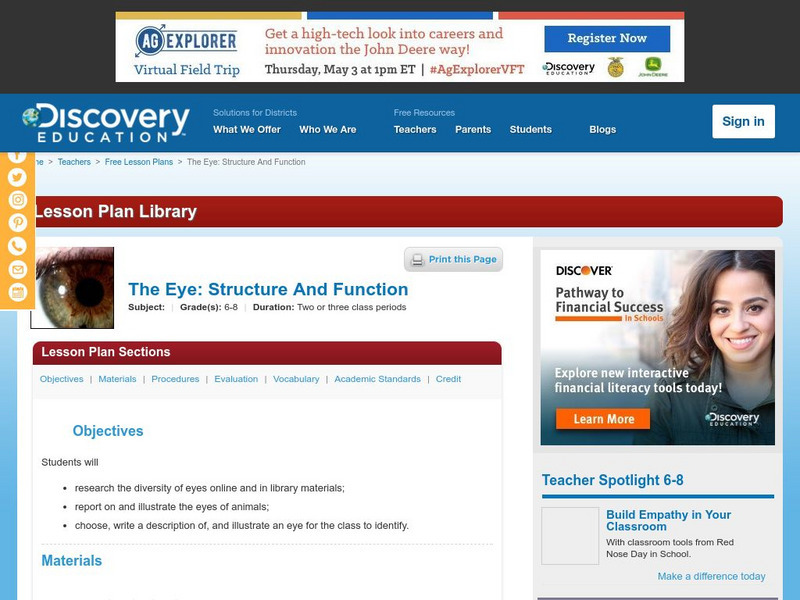
Discovery Education: The Eye: Structure and Function
In this lesson, young scholars learn about the structure and function of the human eye and research how it compares to animal eyes. They will then choose an eye, write a description, and make an illustration of it, which other students...
Georgia Department of Education
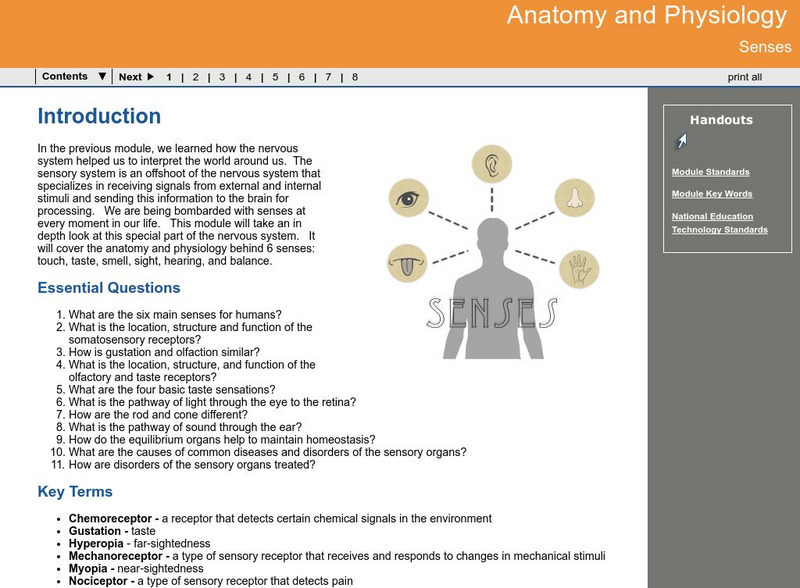
Ga Virtual Learning: Anatomy and Physiology: Senses
Through informational text with printable notes, animations, video clips, and practice problems students discover the function of the sensory structures in the human body.
Exploratorium
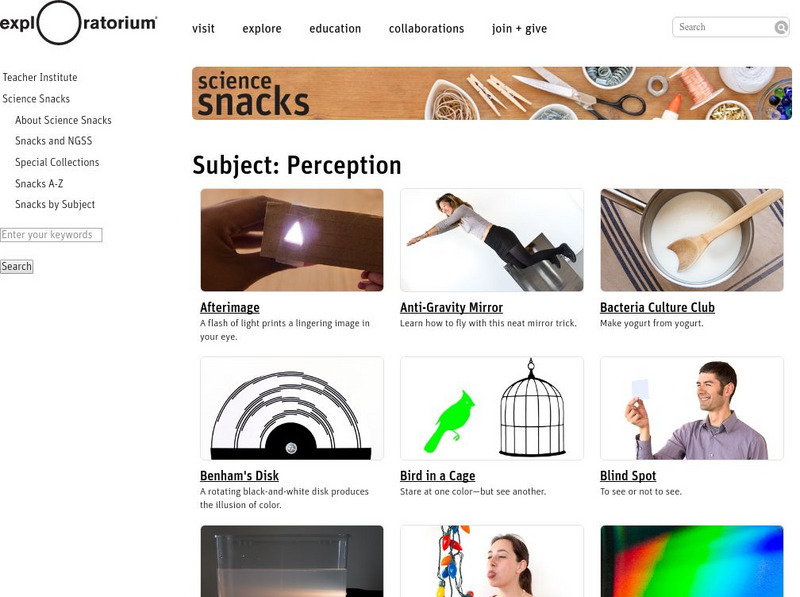
Exploratorium: Science Snacks: Perception
Try one of these 33 perception activities in your classroom.

Eastern Kentucky University
Eastern Kentucky University: Ornithology: Nervous System
This site, created by a biology professor at Eastern Kentucky University, provides an overview of the brain and nerve senses of the bird.
Curated OER
Kids Health: What's Visual Impairment
What's it like for people who are visually impaired? How does it happen and what can be done? Be sure to read the whole article and click on the tabs to the right for more information.
American Museum of Natural History
American Museum of Natural History: Optical Illusions and How They Work
What you see and what you think you see are different things. Find out what your brain doing behind-the-scenes!

abcteach
Abcteach: Senses Flashcards
[Free Registration/Login Required] Colorful flashcards of the 5 senses with your choice of Arial or D'Nealian lettering.
Smithsonian Institution
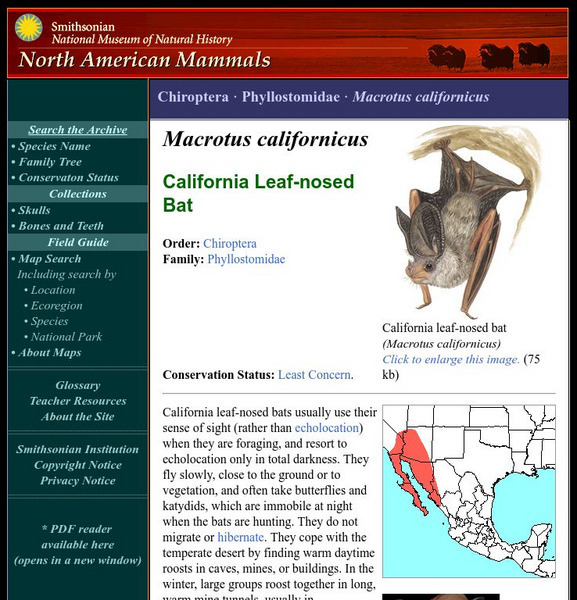
National Museum of Natural History: American Mammals: California Leaf Nosed Bat
California leaf-nosed bats usually use their sense of sight (rather than echolocation) when they are foraging, and resort to echolocation only in total darkness. They fly slowly, close to the ground or to vegetation, and often take...
Other
Media Visions: Meet Thomas Paine, a Visionary Revolutionist
This biographical article discusses Thomas Paine (1737-1809), English writer and social activist, who is best known for his popular essay, Common Sense, the pivotal call for American independence and democracy.
Science Education Resource Center at Carleton College
Serc: Backyard Science the Five Senses
Kindergarten learners will use their existing outdoor expertise to help them focus on the scientific study of their five senses in stations.
ABCya
Ab Cya: Five Senses
The Five Senses is an educational activity for kids to learn about taste, smell, vision, hearing, and touch. The lesson will introduce each of the five senses one at a time. Students will then be assessed through a multiple choice...

E-learning for Kids
E Learning for Kids: Science: Easter Island: Senses: Observation of Living Familiar Things
Students investigate how the senses are used to make observations about objects and things in the environment.

E-learning for Kids
E Learning for Kids: Science: Bikini Atoll: Senses: Observation of Familiar Materials and Objects
Students use their senses to identify and describe objects.
Natural History Museum
Natural History Museum: The Secret Life of Bats: Bat Senses
Part of an online exhibit on bats, this section focuses on bat senses: sight, olfaction (smell), echolocation, and hearing.
University of Washington
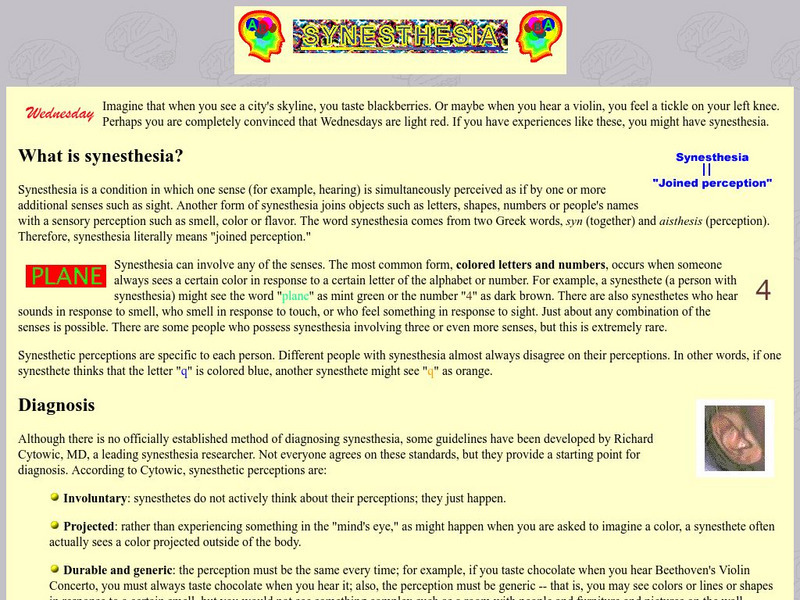
University of Washington: Synesthesia
Have you ever seen something and associated it with a taste? If so, you many have Synesthesia. This condition is not widely publicized but may be present in as many as 1 out of every 200 individuals. Learn more about "joined perception"...
Other popular searches
- The Sense of Sight
- Sense of Sight Activities
- Sense of Sight Assessment
- Sense of Sight Walk
- Lab Sense of Sight
- Sense of Sight Safety
- Sight Sense Of