Hi, what do you want to do?






Science Museum, London
Science Museum: Atomic Clocks
The first atomic clock was designed by Louis Essen in 1955. Find out about how it works and how atomic clock technology has developed.
Science Museum, London
Science Museum Online Stuff: Garrett Morgan
An excellent article about inventor Garrett Morgan including information about his two life-saving inventions: the Safety Hood, an early gas mask, and the traffic light.
Science Museum, London
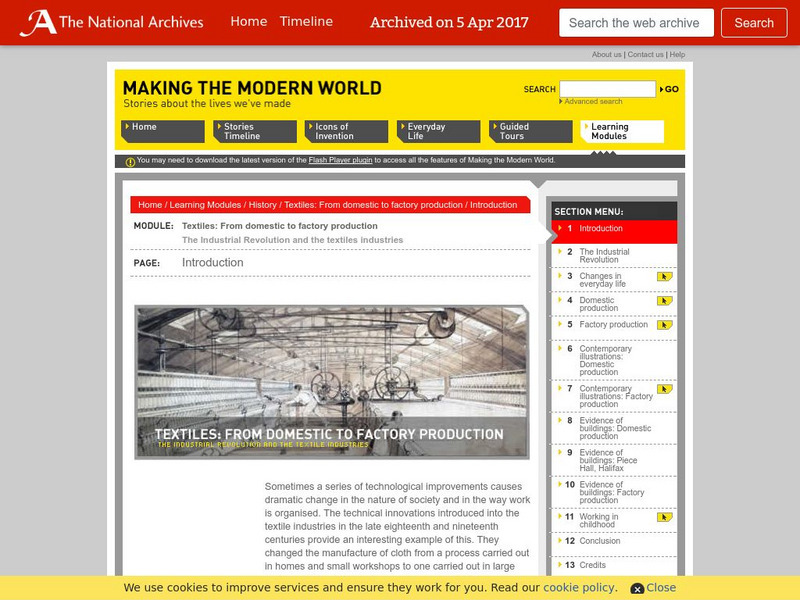
Science Museum: Making the Modern World: Textiles: Domestic v Factory Production
Twelve-part learning module uses text-based overviews and rich media cut-away scenes to explain the role of the textile industry in driving the Industrial Revolution forward in Britain.
The Franklin Institute
Franklin Institute and Science Museum: Seeing
Take a look at this sight and all of the activities it has to offer. Has great activities to use in the classroom as well as world wide web links.
Science Museum, London
Science Museum: Robot Bugs
Build a robot and watch how it moves. Activity is designed to help students learn how electrical circuits and switches control how things move.
Science Museum, London
Science Museum: Online Stuff: Marie Curie and the History of Radioactivity
Read about Nobel Prize winner, Marie Curie's life, and her historical work with radioactivity.
Canada Science and Technology Museum
Canadian Science and Engineering Hall of Fame
The Canada Science and Technology Museum pays tribute to Canadian scientists and innovators in its Canadian Science and Engineering Hall of Fame. Learn more about individual Hall of Fame members by clicking on their names. Among these...
American Institute of Biological Sciences
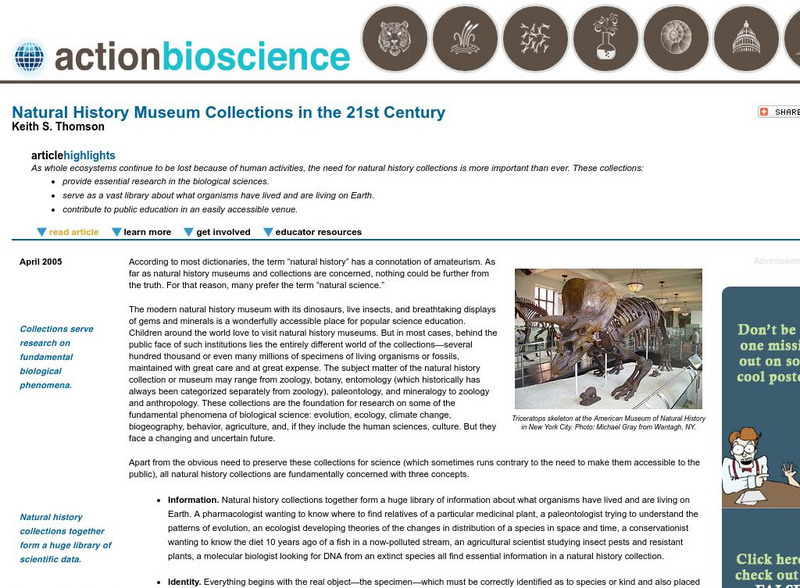
Action Bioscience: Natural History Museum Collections in the 21st Century
Discover why some people feel that natural history museums are more import now than they have ever been. Familiarize yourself with some of the challenges these museums are facing.
Children's Museum
The Children's Museum of Indianapolis: Sports Science and Wellness
This unit of study contains three lessons, each with three experiences that may be taught together or individually. Each lesson will connect to science and/or math standards, along with a health standard or sports connection.
Other
The Canadian Science and Engineering Hall of Fame Resource for Teachers
An interesting collection of science and engineering lesson plans and activities for students. Covers a wide range of grades.
Science Museum, London
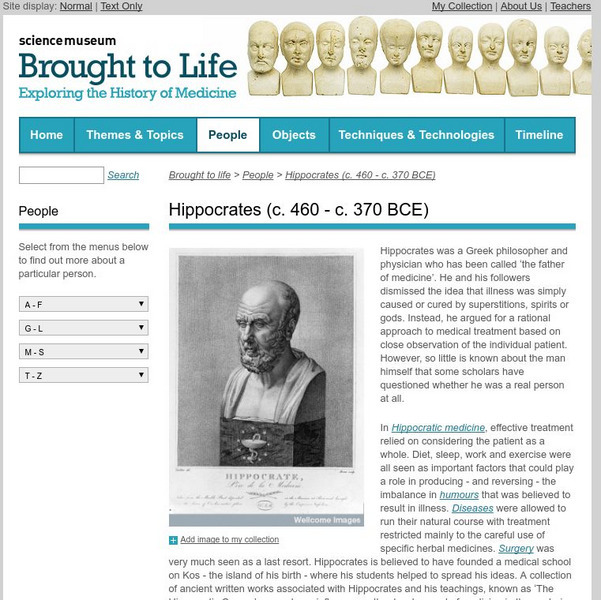
Science Museum: Brought to Life: Hippocrates (C. 460 C. 370 Bce)
A brief overview of Hippocrates and his ideas about effective medicine.
Science Museum, London
Science Museum: Typewriters
This detailed and thorough site traces the history of the typewriter beginning in the 1700's. The text is supplemented with pictures of old typewriters and an interesting commentary is made about the impact of the typewriter on the role...

University of California
Uc Museum of Paleontology: A Guide to Understanding Science 101
Improve your science teaching by taking this multi-part course that gives in-depth information about what science is, how it works, and how it is intertwined with our lives and with society more broadly. The course is broken up into...

University of California
Uc Museum of Paleontology: Understanding Science
A site that contains a resource database for how science really works. This is a good place for teachers to start as they start to plan for lessons in their classroom.
American Museum of Natural History
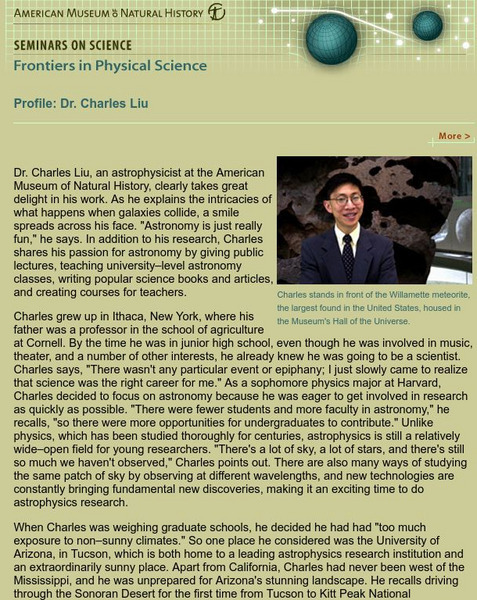
American Museum of Natural History: Profile: Dr. Charles Liu
A biography of Dr. Charles Liu, an astrophysicist at the American Museum of Natural History focused on his drive to become an astrophysicist.
Other
National Nuclear Science Week
Here's a site dedicated to National Nuclear Science Week, Jan. 23-27, 2012. Sponsored by the National Museum of Nuclear Science & History, this special week is focused on all parts of nuclear science. You can find activities, lesson...
Other
Uss Constitution Museum: Constructing a Warship
USS Constitution was built as a fighting machine and utilized the six simple machines of science to accomplish the many tasks required of her. Students will identify and manipulate these machines to create inventions that would have made...
Canada Science and Technology Museum
Canada Science and Technology Museum: Background Information for Light
Light! How do we see? What makes light? Find out everything you need to know through the Q&As on this site.

Natural History Museum
Natural History Museum (Uk): Biodiversity
Find a wealth of scientific information on the status of biodiversity in the world today, the threats it faces, and why it is critically important to preserve it.

University of Florida
Florida Museum of Natural History: Kitchen Science
This guide focuses on everyday substances and how we can change their properties by adding heat or cold, physically manipulating them, or mixing them together.
Other
Denver Museum of Nature and Science: Follow a Fossil
Students examine paleontology, the study of ancient life on Earth. Some topics explored are vertebrates, invertebrates, and plants.
Museum of Science
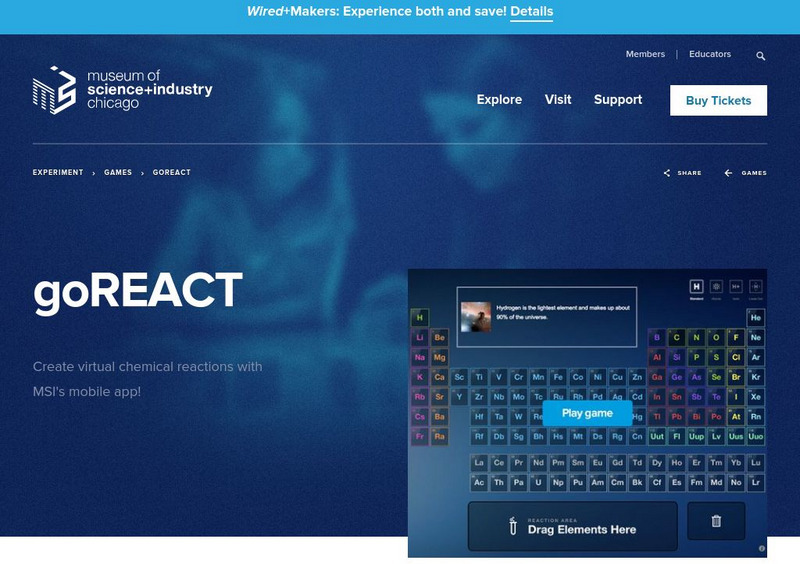
Museum of Science and Industry: Go React
Experience chemical reactions with this virtual drag-and-drop laboratory. This site allows you to create chemical reactions by combining elements from the Periodic Table.
Canada Science and Technology Museum
Canada Science and Technology Museum: Domestic Technology
Has technology helped to shape our society? This is not necessarily a connection that comes to mind when we think about inventions and scientific advances. Learn about the history of domestic technology and its effects on the evolution...
Other
National Museum of Australia: Banks' Florilegium: From Plant to Print
A series of plant specimen photographs from the ecosystems of Australia depicted as sketches and watercolors.