Hi, what do you want to do?






University of Arizona
Skittles & M&Ms Probability Experiment
Young scholars are introduced to the scientific method by hypothesizing, counting, analyzing and concluding which company packs candy more reliably - Skittles or M&Ms.

Curated OER
Great Questions for Tic Tac Toe
Fourth graders plan their own activities to reinforce the concepts being taught in school. The tic-tac-toe grid is used to help students create innovative learning activities to generate ideas.

Curated OER
What is Sound?
Second graders discuss sound and describe them. In this investigative lesson students observe sound through their eyes, bodies and ears.

Curated OER
It's In The Chocolate Chips
Middle schoolers investigate which brand of chocolate chip cookies contains the most chocolate. They analyze and compare data using Microsoft Word and Microsoft Excel. They communicate the results with Microsoft PowerPoint.

Curated OER
Percussion Instruments and Pitch
Students play string instruments to discover how the pitch changes on various string instruments. In this pitch lesson plan, students listen to video clips and play an online music game. Students become familiar with music...

Curated OER
Mystery Spill
Students investigate the cause of birds dying in Monterey Bay. In this scientific research lesson, students use various resources, scientific investigations, and vector analysis to solve an environmental mystery.

Curated OER
Medical Instrumentation
Students analyze how medical devices that help the human body function. They work in pairs or groups to draw multiple views of the medical device and describe how engineering is used by biomedial engineers.

Curated OER
One Square Foot
Students identify, describe, count, tally, and graph life found in one square foot of land.

Curated OER
The Lake Effect
Fourth graders conduct an experiment demonstrating the effects of water and air temperature on precipitation. They create graphs demonstrating their findings using Claris Works for Kids.

Curated OER
Bronze: Scientific Inquiry through Chinese Art
Students examine the use of bronze and porcelain in Chinese art and commerce through in-class activities, role play events, and small-group discussions in this exciting Social Studies/Arts lesson.

Curated OER
Paper: Scientific Inquiry Through Chinese Art
Students create replicas of Chinese hanging scrolls in an attempt to understand the technology behind the creation and use of paper in Ancient China. This three-day lesson includes enrichment ideas.

Curated OER
Silk: Scientific Inquiry Through Chinese Art
Students investigate the many uses of silk in Chinese society through in-class experiments, group projects, and hands-on learning in this cross-curricular lesson. There are four main activities included in this lesson.

Curated OER
Jade: Scientific Inquiry Through Chinese Art
Students discover the uses of Jade in Chinese art and society through in-class discussions, group projects, and internet research. Additional enrichment activities are included.

Curated OER
Comparing Ethnic Groups
Eleventh graders explore the relationship between the United States and the Native Americans from after the Civil War to the early 1900's. They evaluate the actions of the United States towards Native Americans and compare the actions to...

University of Southern California
California State Science Fair: What Makes a Good Science Fair Project?
A good first step to read. This set of recommendations or advice comes from the California State Science Fair Committee. Read carefully the first three paragraphs and the "Students are advised" paragraph.
CK-12 Foundation
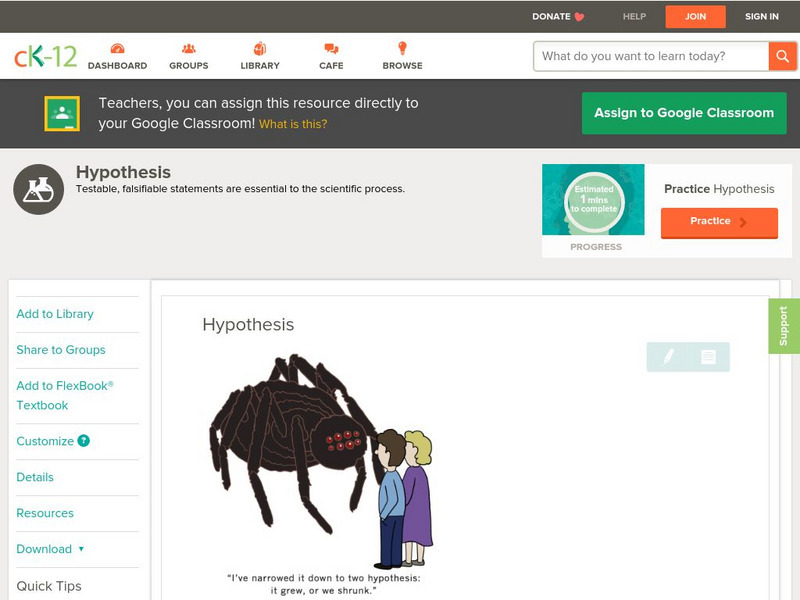
Ck 12: Physical Science: Hypothesis
[Free Registration/Login may be required to access all resource tools.] Explores the criteria of a scientific hypothesis and why a hypothesis cannot be proven true.

Science Buddies
Science Buddies: Scientific Method Variables/hypothesis
Find out what variables are in a scientific investigation and what the difference is between an independent, dependent, and controlled variable. Look at samples of different types of variables and find out what makes a good variable.
Utah Education Network
Uen: 1st Grade Act. 17: Observing Plants Through a Journal
This lesson engages students in learning about plant growth. Students will observe changes in a growing plant and then will write in their discovery journals to write observations and hypotheses about the plant growth. Students will also...
PBS
Pbs Learning Media: A Colorful Hypothesis
Use "Dinosaur Train" to illustrate and excite your students about creating a hypothesis. Website includes a video of "Dinosaur Train", a lesson plan, and student's handout. Lesson plan includes a lab where students can practice making...

Science Buddies
Science Buddies: Scientific Method Conclusion
The conclusion of a science experiment summarizes how your results supported or contradicted your hypothesis. See a sample of a conclusion and find out what makes a good conclusion.

Scholastic
Scholastic: Study Jams! Science: Scientific Inquiry: Outcomes and Predictions
A video and a short multiple-choice quiz on identifying possible outcomes and making predictions.
Science Struck
Science Struck: Real Difference Between Hypothesis and Prediction
Learn what a prediction and a hypothesis are in statistics and how they differ. Includes examples demonstrating the differences.
Science Education Resource Center at Carleton College
Serc: Arec: Model for Enhancing Science Literacy Using Field Geology
This course enhances science literacy by emphasizing the repeated practice of making observations, posing questions & developing hypotheses around a narrowly focused aspect of Minnesota Geology. Students construct new knowledge using...
Arizona State University
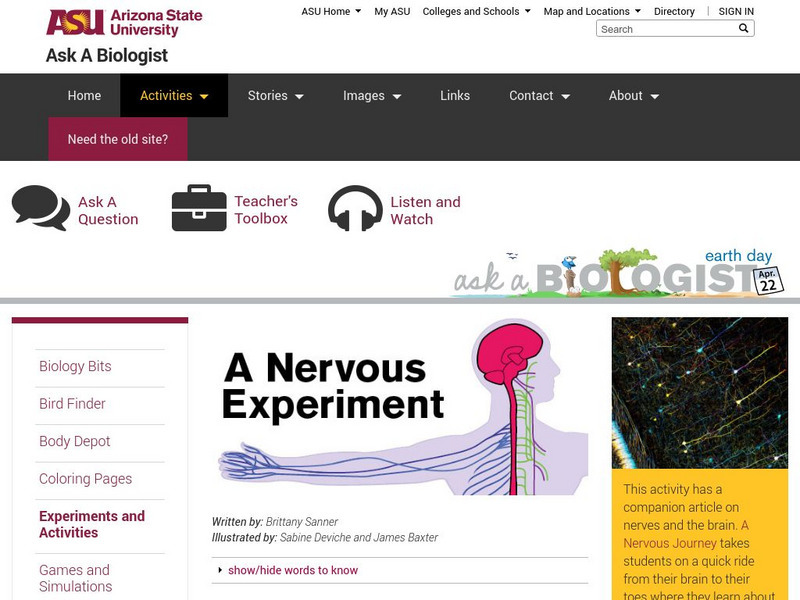
Arizona State University School of Life Sciences: A Nervous Experiment
How do you know when your hand touches something? How do you know if something brushes against your shoulder? Think about your fingertip, arm, and back. In which of these places might your nerves be closer together? Review the concept of...