Hi, what do you want to do?






NASA
Taking Apart the Light
Break down light into spectra. Scholars learn how atoms emit and absorb photons and come to understand how this process allows scientists to identify different atoms based on either absorption lines or emission lines. Learners then...

NASA
Blinded by the Light!
Pupils learn of multiple ways astronomers look for planets outside of the solar system. By completing a hands-on activity, scholars discover that trying to see the planets directly because of the glare from the nearby star is nearly...

NASA
Catch a Gravitational Wave, Dude!
It is cowabunga time! Pupils read an article about the NASA LISA mission on gravitational waves and conduct additional research on them. The class participates in a science bowl type competition about gravitational waves. Panels of four...

NASA
From Smoke Signals to Cell Phones: Tracing How Technologies Evolve
Explore the science of space exploration. Pupils consider technological advances in propulsion, communication, power, navigation, and imaging. They select one of these areas and create a timeline of historical progress that contributed...

NASA
Taking a Cold, Clear Look at the Universe
Take a look with another perspective. Pupils read to find out what portion of the electromagnetic spectrum a space telescope sees and the difficulties of viewing infrared radiation from other objects in space. Individuals discover how...

NASA
Speaking in Phases
Hear from deep space. Pupils learn how satellites transfer information back to Earth. They learn about three different ways to modulate radio waves and how a satellite sends information with only 0s and 1s. Using sound, class members...

PBS
Pbs Learning Media: Diamonds: The Science Behind the Sparkle
This illustrated essay from the NOVA Web site explains why the atomic structure of a diamond slows down light and produces a sparkle more brilliant than from any other colorless substance.
Creative Science Centre
Creative Science Centre: A Voice on a Sunbeam
Here is described a simple process to 'put a voice on a sunbeam' and transmit it over a distance. It is a fascinating example of amplitude modulation of light using sound vibrations. It then describes how the modulated light is detected...

Other
Aas Science News: Possible Orphan Black Hole
Article reports on the discovery of a supermassive object 90 million light-years from Earth that may be an orphan black hole.
Creative Science Centre
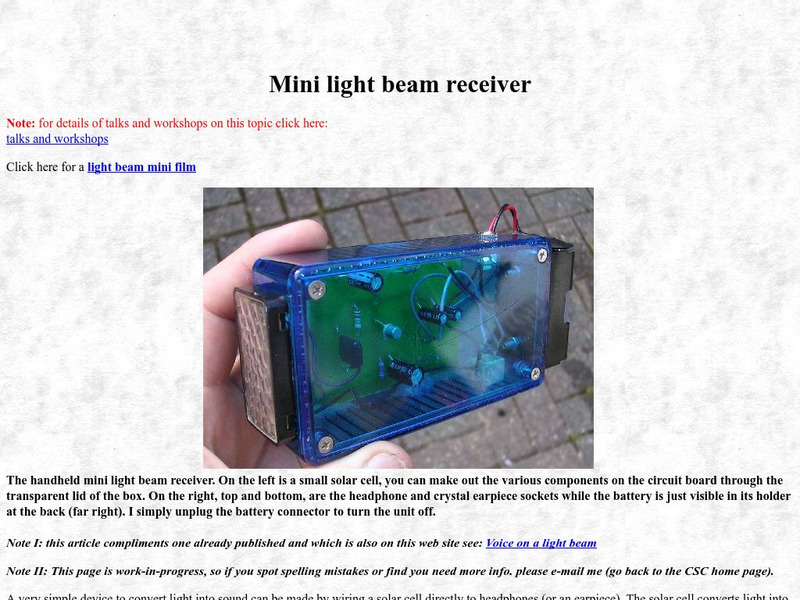
Creative Science Centre: Mini Light Beam Receiver
A very simple device to convert light into sound can be made by wiring a solar cell directly to headphones (or an earpiece). The solar cell converts light into electricity and the headphones convert electricity into sound. The limitation...

Open Curriculum
Open Curriculum: The Ray Model of Light
Students will understand the concept of the ray model of light and how light interacts with matter and reflections.

Open Curriculum
Open Curriculum: Light as a Particle
Students learn about the properties of light as a photon and the wave-particle duality.
Creative Science Centre
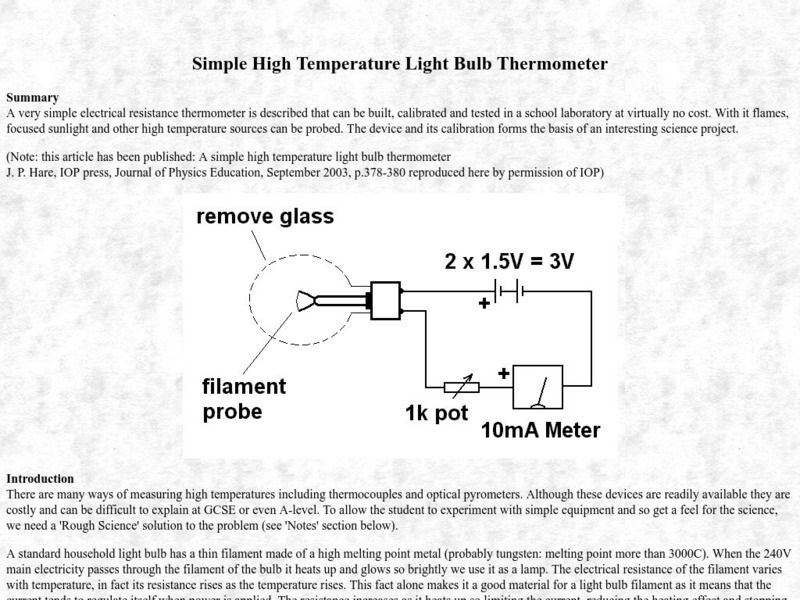
Creative Science Centre: Simple High Temperature Light Bulb Thermometer
A very simple electrical resistance thermometer is described that can be built, calibrated and tested in a school laboratory at virtually no cost. With it, flames, focused sunlight and other high temperature sources can be probed. The...
Creative Science Centre
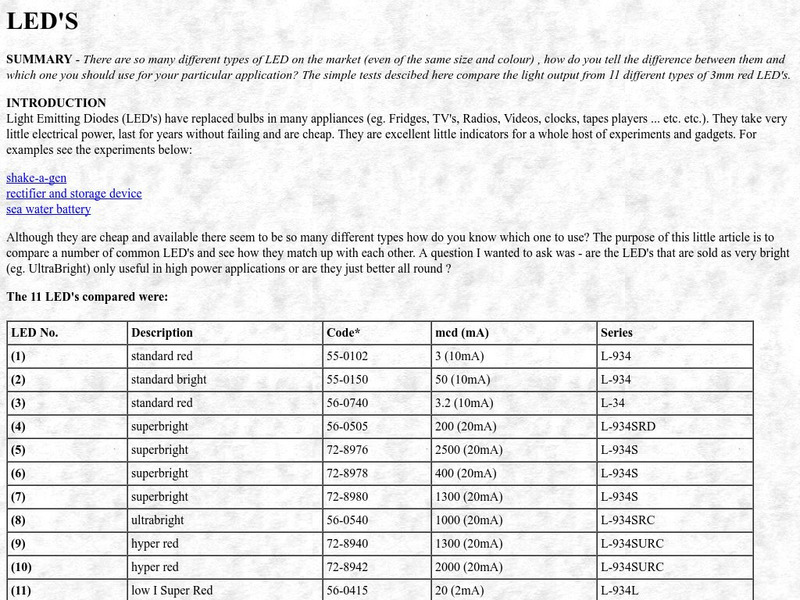
Creative Science Centre: Led's
There are so many different types of LEDs on the market (even of the same size and color), how do you tell the difference between them and which one you should use for your particular application? The simple tests descibed here compare...
Society for Science and the Public
Science News for Students: Breaking the Universal Speed Limit
Describes research into whether neutrinos travel faster than the speed of light.
Society for Science and the Public
Science News for Students: Neutrinos Not So Fast
Discusses the validity of research showing that neutrinos travel faster than the speed of light.
University of Alaska
Alaska Science Forum: Evidence Piling Up for Coastal Migration Route
One knife pulled from the sea may shed more light on the mysteries of the first Americans. Archaeologists are still shaping the new Coastal Migration Route theory one artifact at a time.
Creative Science Centre
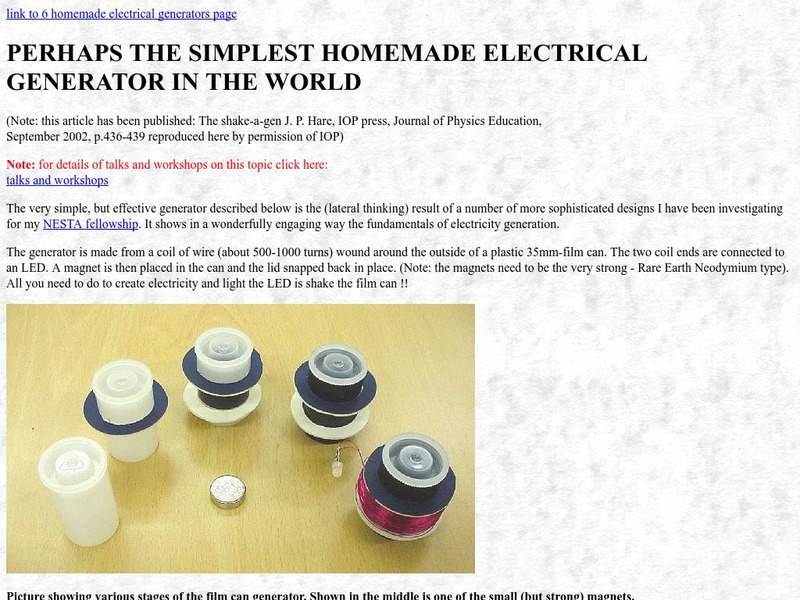
Creative Science Centre: Perhaps the Simplest Homemade Generator in the World
This very simple, but effective generator shows in a wonderfully engaging way the fundamentals of electricity generation. The generator is made from a coil of wire wound around the outside of a plastic 35mm-film can. The two coil ends...
Australian Broadcasting Corporation
Australian Broadcasting Corporation: News in Science: Chimp Dna Sheds Light on Humanity
From ABC News in Science, Richard Ingham's article sheds light on scientific research comparing and contrasting the DNA of Chimpanzees with the DNA of humans.
Creative Science Centre
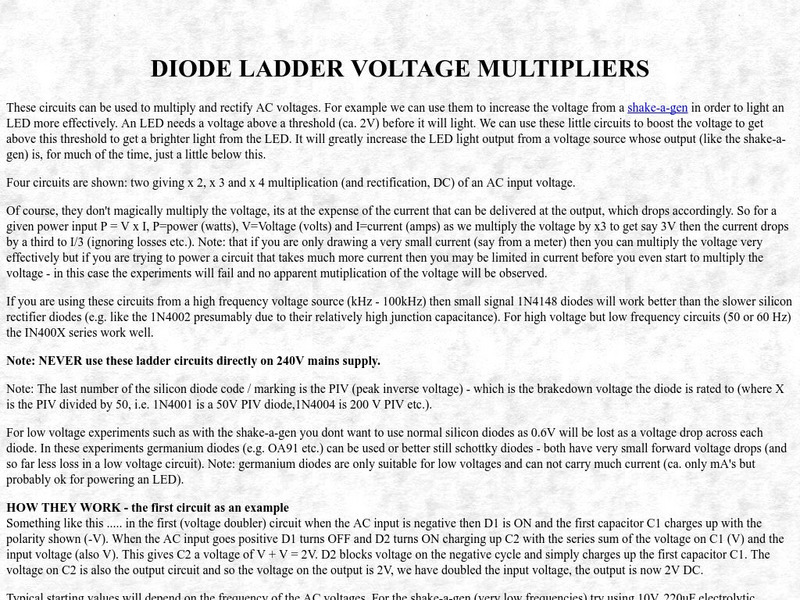
Creative Science Centre: Diode Ladder Voltage Multipliers
Explains the design of circuits that can be used to multiply and rectify AC voltages, e.g., to increase voltage in order to light an LED more effectively and get a brighter light from it.
Society for Science and the Public
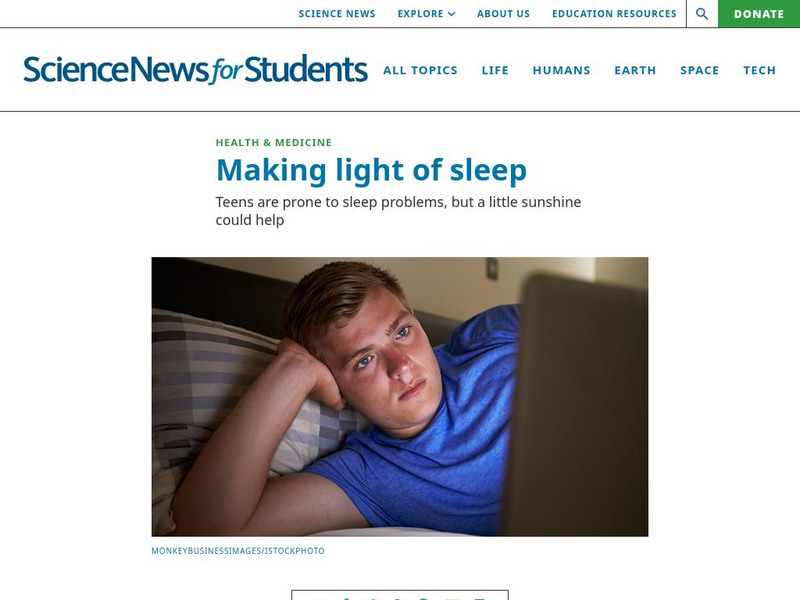
Science News for Students: Awake at Night
This article reviews how different types of light affect how young people sleep, the type of sleep they get and how long they sleep. It also gives suggestions on how to get into a pattern of good sleep.
Creative Science Centre
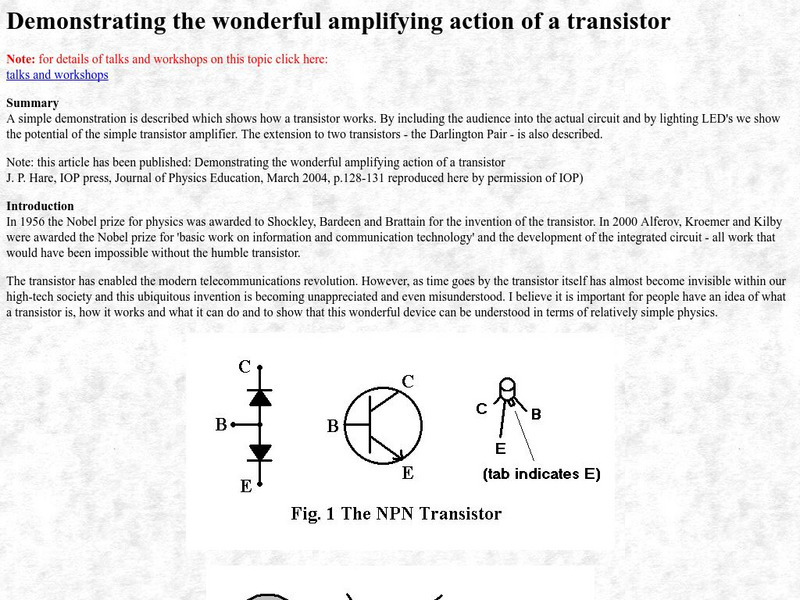
Creative Science Centre: Demonstrating the Amplifying Action of a Transistor
A simple demonstration is described which shows how a transistor works. By including the audience into the actual circuit and by lighting LED's it shows the potential of the simple transistor amplifier. The extension to two transistors -...
Creative Science Centre
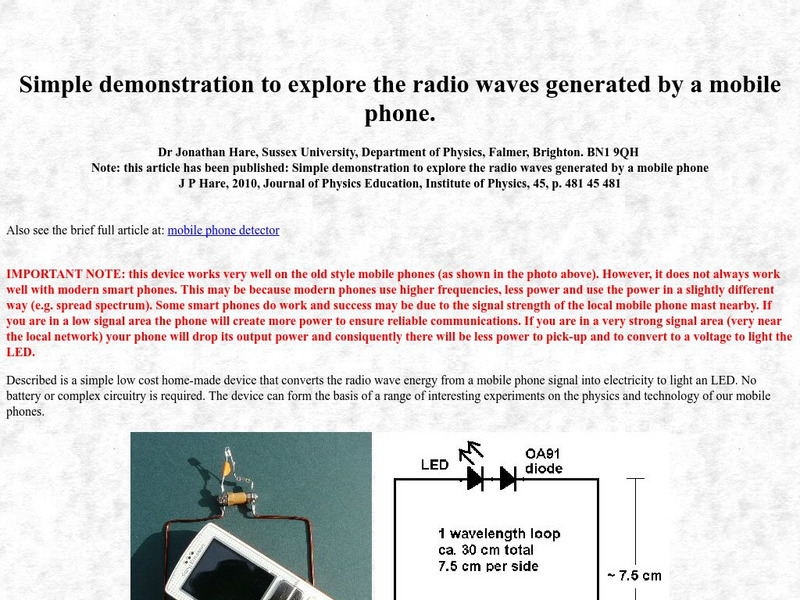
Creative Science Centre: Demonstration of Radio Waves Generated by Mobile Phone
Described is a simple low cost home-made device that converts the radio wave energy from a mobile phone signal into electricity to light an LED. No battery or complex circuitry is required. The device can form the basis of a range of...
Society for Science and the Public
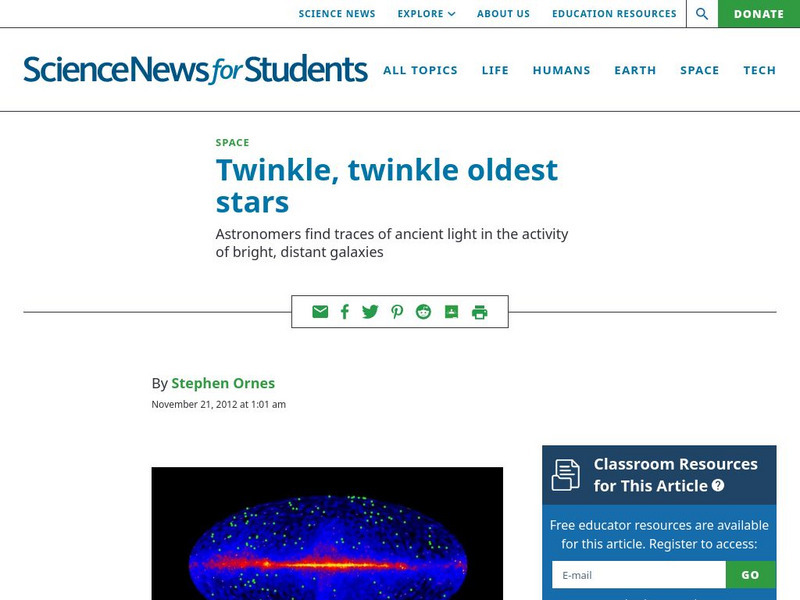
Science News for Students: Twinkle, Twinkle Oldest Stars
Astronomers have determined how super-bright galaxies can be used to detect the faint glow of "cosmic fog." Cosmic light is light that has left every star and now lingers in the universe, including light from stars that have burned out.
Other popular searches
- Science Light and Sound
- Science Light Refraction
- Christmas Science Light
- Science Light and Motion
- Science and Light Sources
- Science Light Reflection
- Science Light Sources
- Science Light and Dark
- Science Light and Shadows
- Physical Science Light
- Science Light Rays
- Science Light and Color