Hi, what do you want to do?






Canada Science and Technology Museum
Canada Science and Technology Museum: Background Information for Light
Light! How do we see? What makes light? Find out everything you need to know through the Q&As on this site.

Science Buddies
Science Buddies: Technicolor Shadows: Lessons in Light and Color
Is that right side of your brain yearning to express its artistic side? This is a project that blends art with science. Learn about light and colorful shadows in these experiments where you mix and match various colors of light to create...
Science Buddies
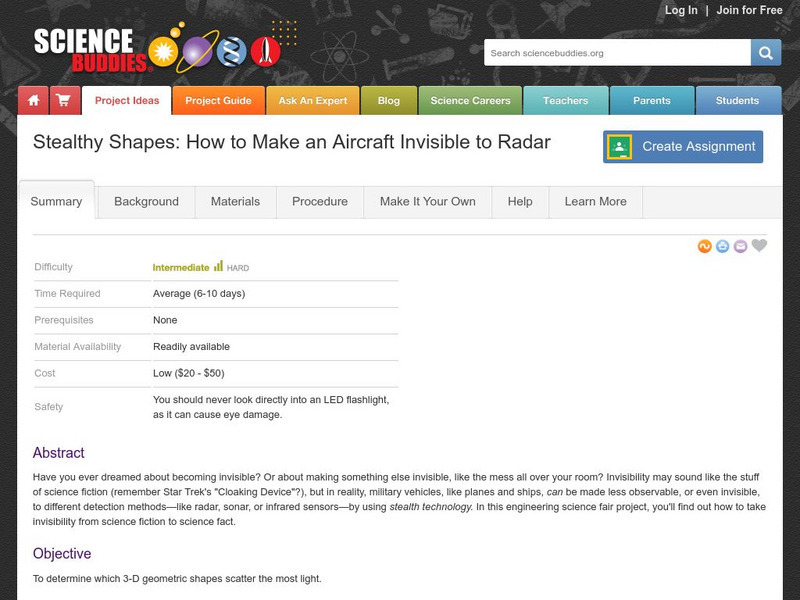
Science Buddies: Project Ideas: How to Make an Aircraft Invisible to Radar
In this engineering science fair project, students will determine which 3-D geometric shapes scatter light the most. The Science Buddies project ideas are set up consistently beginning with an abstract, objective, and introduction,...
Science Buddies
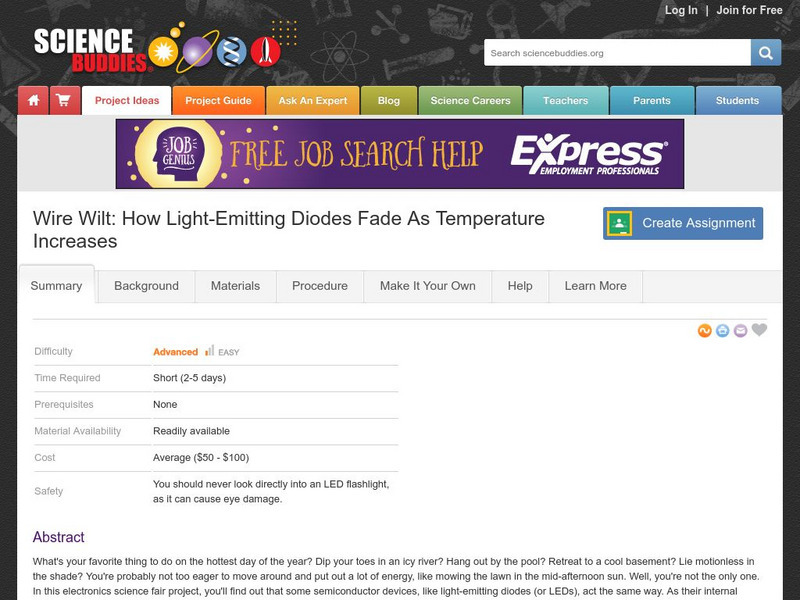
Science Buddies: Wire Wilt: Light Emitting Diodes Fade as Temperature Increases
In this electronics science fair project, students will investigate how the output of an LED flashlight changes as its temperature increases.
Science Buddies
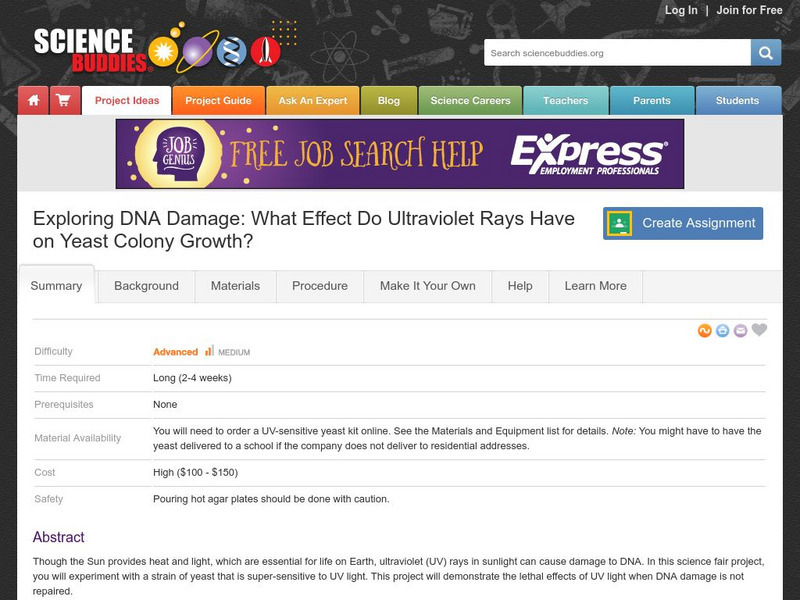
Science Buddies: Project Ideas: Dna Damage: Ultraviolet Rays and Yeast Colonies
In this biotechnology science fair project, investigate how DNA damage affects growth of yeast that are DNA-repair deficient. The Science Buddies project ideas are set up consistently beginning with an abstract, objective, and...
Science Buddies
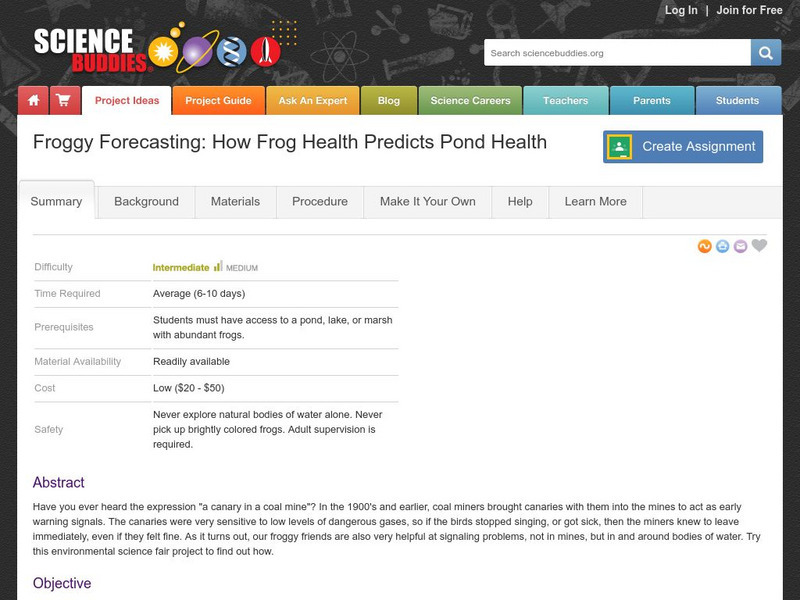
Science Buddies: Froggy Forecasting: How Frog Health Predicts Pond Health
Have you ever heard the expression "a canary in a coal mine"? In the 1900s and earlier, coal miners brought canaries with them into the mines to act as early warning signals. The canaries were very sensitive to low levels of dangerous...
Khan Academy
Khan Academy: Light and Photosynthetic Pigments
What is light energy? Here we'll learn about the properties of light and how pigments such as chlorophylls absorb light energy.

Science Buddies
Science Buddies: Mapping Troposhperic Ozone Levels Over Time
Ozone in the stratosphere protects the earth by absorbing harmful ultraviolet radiation from the sun. However, when ozone occurs in the troposphere, it is harmful to health. In this project you can use data from EPA monitoring stations...

Science Buddies
Science Buddies: Career Profile: Power Distributors and Dispatcher
Science Buddies profiles careers you perhaps never even considered. Do you know what a power distributor and dispatcher does? Someone has to control the flow of electricity along the transmission lines to be sure nothing takes the power...
Optical Society
Optical Society of America: Exploring the Science of Light: What Is Optics?
A collection of tutorials and interactive resources, from basic to advanced, that explain concepts related to the science of light.
Science Buddies
Science Buddies: Using a Laser to Measure the Speed of Light in Jello
Think it takes expensive, sophisticated equipment to measure the speed of light? Think again. Outfit yourself with a simple handheld laser pointer, a protractor, and Jell-O, and you're ready to get started.
Science Buddies
Science Buddies: Sliding Light: How to Make a Dimmer Switch With a Pencil
In this electronics science fair project, students will make a simple dimmer switch and investigate the relationship between the resistance in the circuit and the amount of light produced. The Science Buddies project ideas are set up...
Science Buddies
Science Buddies: Measuring Vibrational Frequency With Light
Strike a key on the piano, and you hear the string vibrating. Just about any object vibrates when it's knocked, but how much and how fast? This project helps you find out. You'll build a simple light-sensing circuit for measuring the...
NASA
Nasa: Tour of the Electromagnetic Spectrum: Visible Light
Visible light waves are the only electromagnetic waves we can see. We see these waves as the colors of the rainbow. Each color has a different wavelength. Red has the longest wavelength and violet has the shortest wavelength. When all...
PBS
Pbs Learning Media: Observing Refraction of Light
This video segment adapted from Shedding Light on Science illustrates how light changes speed, and thus direction, in a process known as refraction. Includes background reading and discussion questions. [2:05]

Creative Science Centre
Creative Science Centre: Newton's Experiments
A collection of projects that recreated Isaac Newton's experiments as he would have built them in the seventeenth century. The projects include the mechanical advantage possible using three levers, the trajectory of a projectile, air...
Science Buddies
Science Buddies: Using Laser Pointer to Measure Data Track Spacing on C Ds, Dv Ds
You've probably noticed the colorful patterns "reflecting" from the shiny surface of a CD disk. What you are seeing is actually diffraction of white light, and the rainbows of color are diffraction patterns. In this project you'll learn...
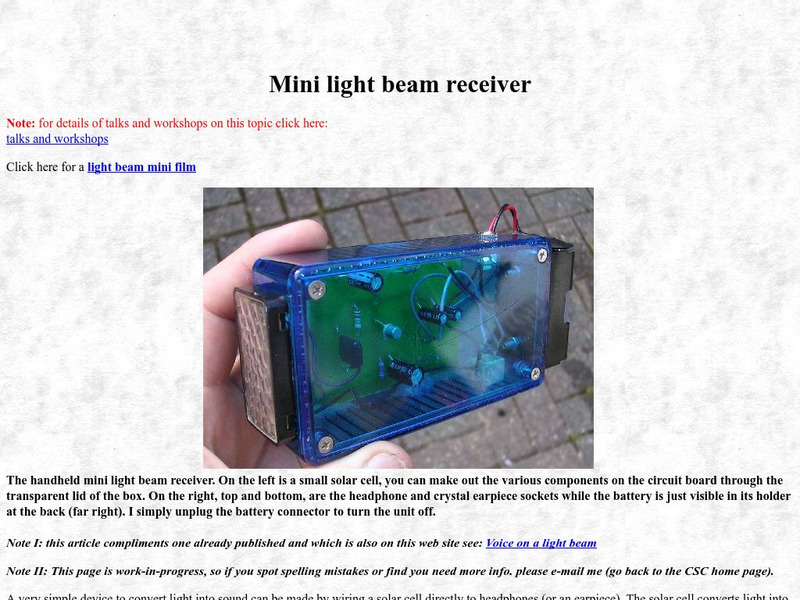
Creative Science Centre
Creative Science Centre: Mini Light Beam Receiver
A very simple device to convert light into sound can be made by wiring a solar cell directly to headphones (or an earpiece). The solar cell converts light into electricity and the headphones convert electricity into sound. The limitation...
Science Struck
Science Struck: How Does Light Travel Through Space and Other Media?
A detailed discussion of the nature of light, how it can travel through a vacuum, and how the speed of light is affected when light travels through a medium.

Open Curriculum
Open Curriculum: The Ray Model of Light
Students will understand the concept of the ray model of light and how light interacts with matter and reflections.
Science Buddies
Science Buddies: The Effect of Artificial Light on Migration Pattern of Daphnia
This elegant project employs a scientific approach that is particularly valuable in Environmental Science, but can be applied to other areas as well. The approach has three steps: 1) from your observations in the field, form a...
Exploratorium
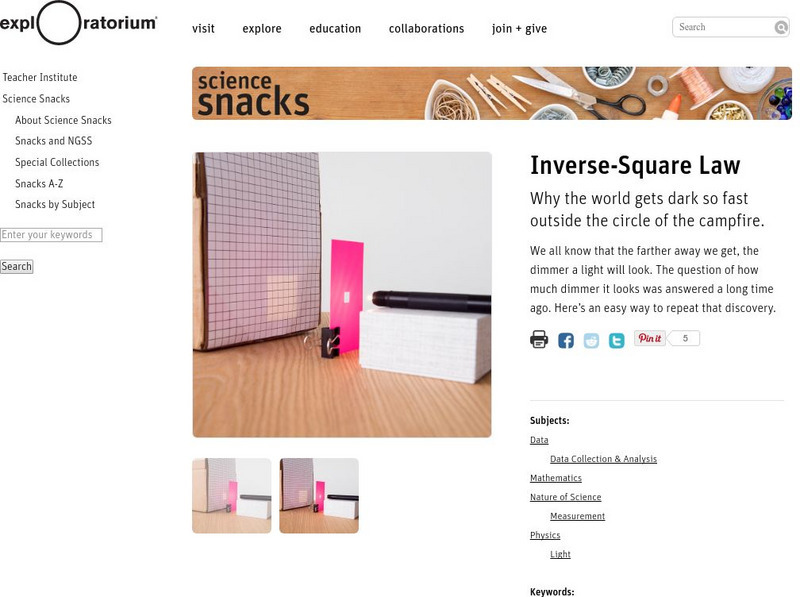
Exploratorium: Science Snacks: Inverse Square Law
Learn about how the intensity of light is governed by the inverse-square law with this activity. Activity has you experimenting to find that the intensity of light decreases as the inverse square of the distance.
Other
Ward's Science: Will the Light Shine?
Students will determine the effect of placing objects made with different materials in the path of a beam of light. This lesson plan includes background information, guiding questions, directions, and a chart to record data.
Science Buddies
Science Buddies: Rainbow Candy
Make your own rainbow candy in this fun STEM activity. You will do it without using any food coloring. Instead, you will use a light-bending phenomenon called diffraction.
Other popular searches
- Science Light and Sound
- Science Light Refraction
- Christmas Science Light
- Science Light and Motion
- Science and Light Sources
- Science Light Reflection
- Science Light Sources
- Science Light and Dark
- Science Light and Shadows
- Physical Science Light
- Science Light Rays
- Science Light and Color