Hi, what do you want to do?





Exploratorium
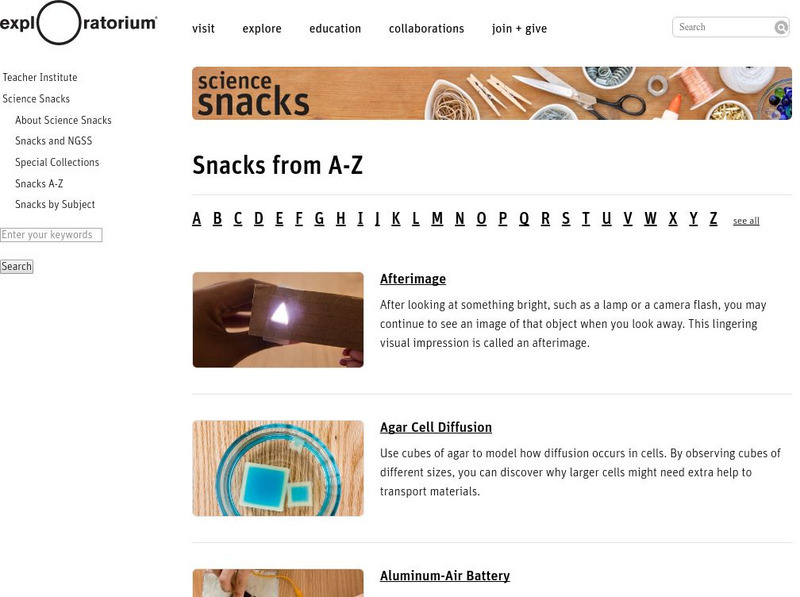
Exploratorium: Science Snacks: Snacks From a Z
Here is a monumental list of ideas for science fair projects and experiments, organized alphabetically. Every one of them is a link to a full page, with pictures, of information about the idea. This site is a goldmine.

Science Bob Pflugfelder
Science Bob: A Density Experiment You Can Drink
Science Bob provides instructions for a density experiment you can drink using common supplies with information on how it works.
Creative Science Centre
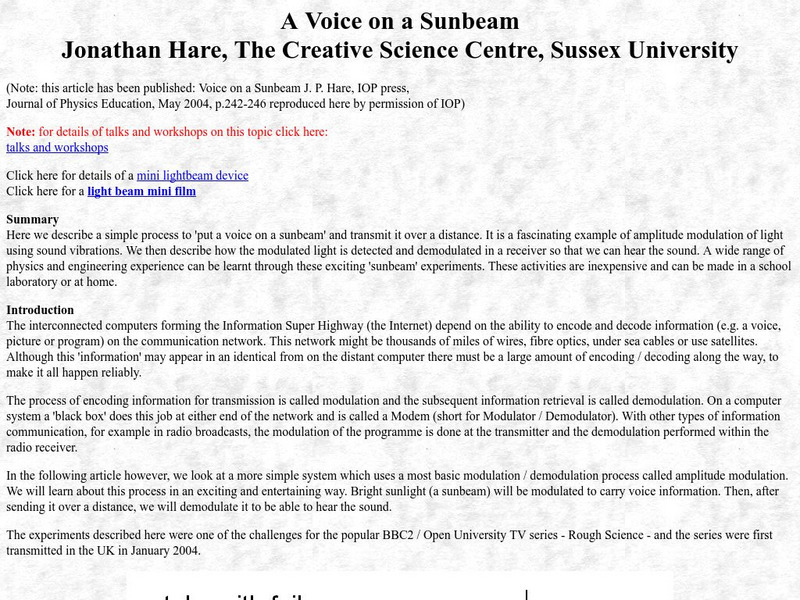
Creative Science Centre: A Voice on a Sunbeam
Here is described a simple process to 'put a voice on a sunbeam' and transmit it over a distance. It is a fascinating example of amplitude modulation of light using sound vibrations. It then describes how the modulated light is detected...
Vision Learning
Visionlearning: Culture of Science: Scientists and the Scientific Community
A look at the human side of science. Take a look at how background and motivation can lead to different perspectives, discoveries, and progress in science.
Science Buddies
Science Buddies: How Do Baseball Stadium Dimensions Affect Batting Statistics?
Here's a fun project that combines baseball and math. Major League baseball is played in ballparks that have their own individual quirks when it comes to the exact layout of the field. Fenway Park in Boston has the famous "Green Monster"...
Other
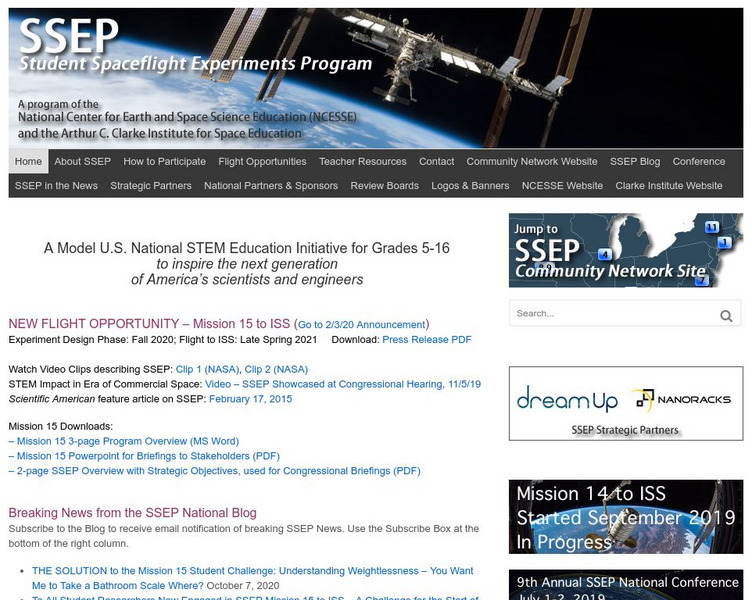
Ncesse: Student Spaceflight Experiments Program
A competition for students in Grades 5 and up, in which they design an experiment that would fly in space under conditions of microgravity. Winners in local competitions are chosen to submit their designs for inclusion in a...
Khan Academy
Khan Academy: Classic Experiments: Dna as the Genetic Material
Learn about the experiments by Frederick Griffith, Oswald Avery, Alfred Hershey, and Martha Chase that led to the discovery of DNA as the genetic material.
Khan Academy
Khan Academy: Mode of Dna Replication: Meselson Stahl Experiment
See a key historical experiment that demonstrated the semi-conservative mechanism of DNA replication.
Science Fun for Everyone
Science Fun: Explode a Bag
Science activity shows what happens when a bag can't hold any more carbon dioxide.
Other
Science Alive: Changing the Starch in "Yams" to Sugar
This lab activity provides students with the experience of using their own enzymes to convert starch to sugar (a disaccharide called maltose), then testing to see if the conversion has taken place.
Exploratorium
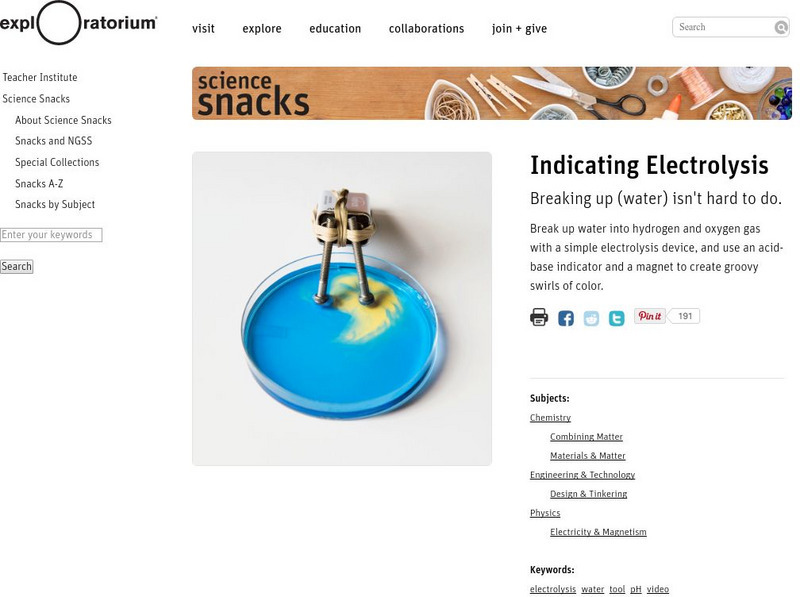
Exploratorium: Science Snacks: Indicating Electrolysis
This experiment and video demonstration shows how students can break up water into hydrogen and oxygen gas with a simple electrolysis device.
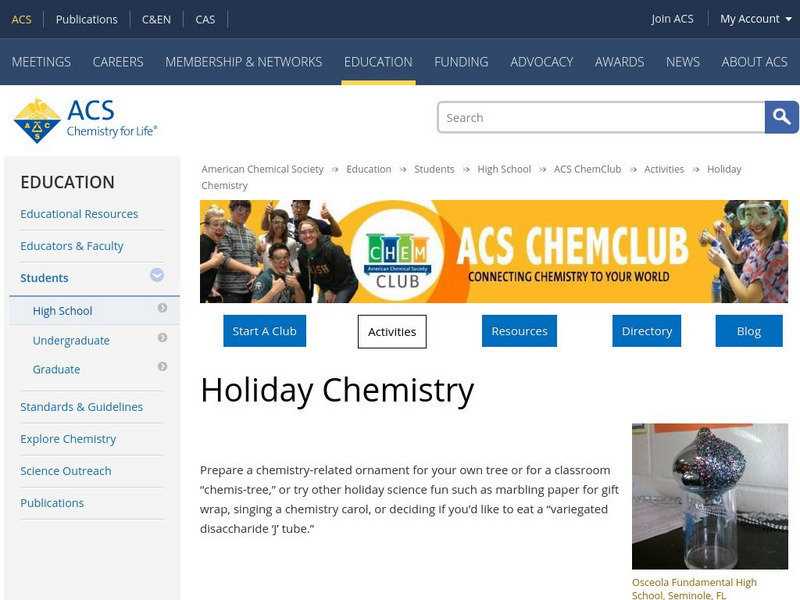
American Chemical Society
American Chemical Society: Holiday Chemistry
A collection of chemistry activities and experiments with a Christmas holiday theme.
Creative Science Centre
Creative Science Centre: Experiments With Homemade Batteries
Simple homemade batteries are described that can be made from items found in the home or school lab. These experiments help students understand how to wire them up, the origin of current, voltage and power, as well as the chemistry that...

Exploratorium
Exploratorium: Science Snacks: Lateral Inhibition
An activity that will have you questioning which is in control, your eyes or your brain? This activity has students constructing simple paper tubes to investigate how the eyes work.
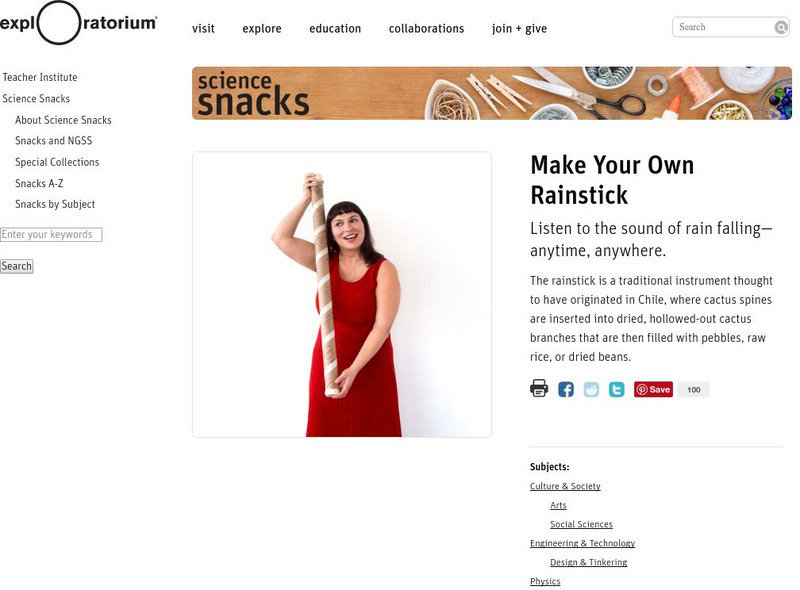
Exploratorium
Exploratorium: Science Snacks: Make Your Own Rainstick
Create a traditional instrument called a rainstick in this activity.
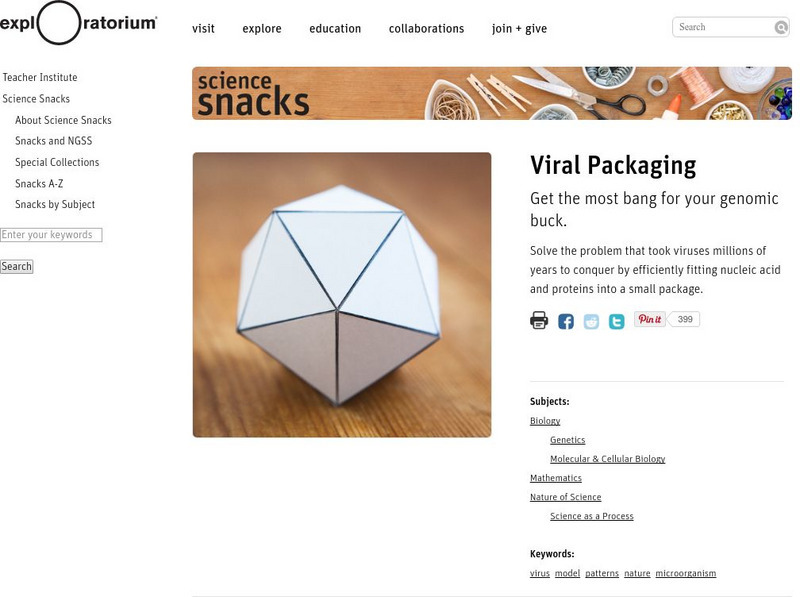
Exploratorium
Exploratorium: Science Snacks: Viral Packaging
Make an icosahedron, a shape with twenty triangular faces. This shape is used by most viruses to contain their genetic material in the most efficient way possible.
Exploratorium
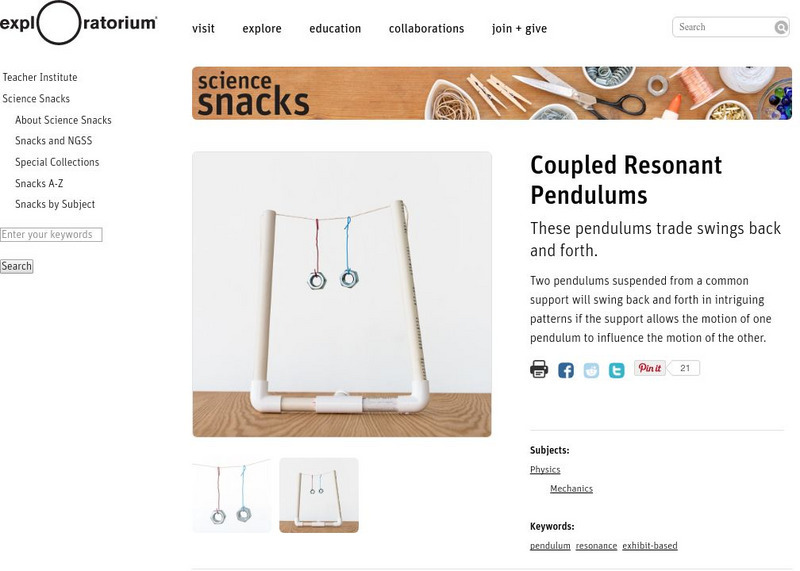
Exploratorium: Science Snacks: Coupled Resonant Pendulums
Understand about a pendulum's natural or resonant frequency in this activity where you create your own pendulums. Students make a pendulum out of PVC pipe, string, and hex nuts.

Exploratorium
Exploratorium: Science Snacks: Designer Ears
Why do animals' ears all look different? In this activity, you will research all shapes and function of ears to create "better" ears.
Exploratorium
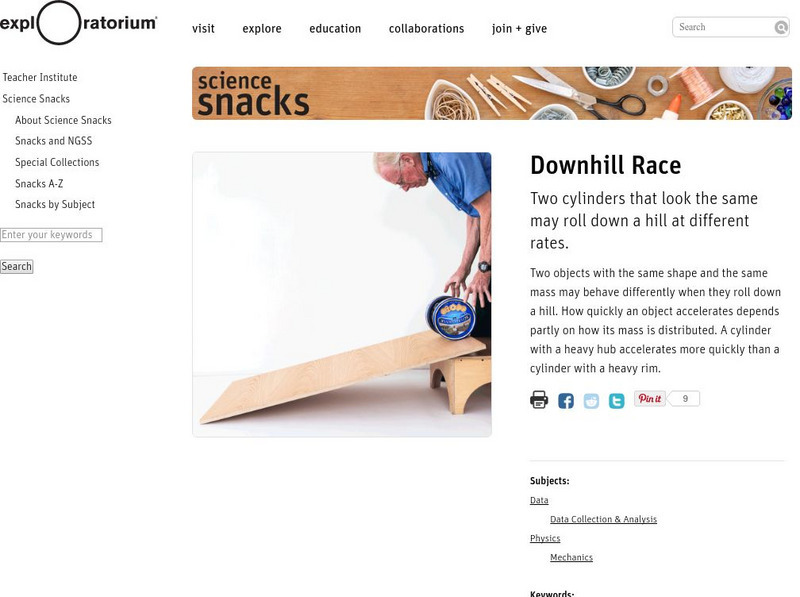
Exploratorium: Science Snacks: Downhill Race
An activity that explores how two cylinders that are identical in shape and mass may travel down a hill differently due to how their mass is distributed. Learn how the distribution of mass in an object can affect its translational...

Exploratorium
Exploratorium: Science Snacks: Giant Sieve Sorter
In this activity students will be creating a giant sieve! The sieve should allow some objects through but create a boundary to keep others out.
Exploratorium
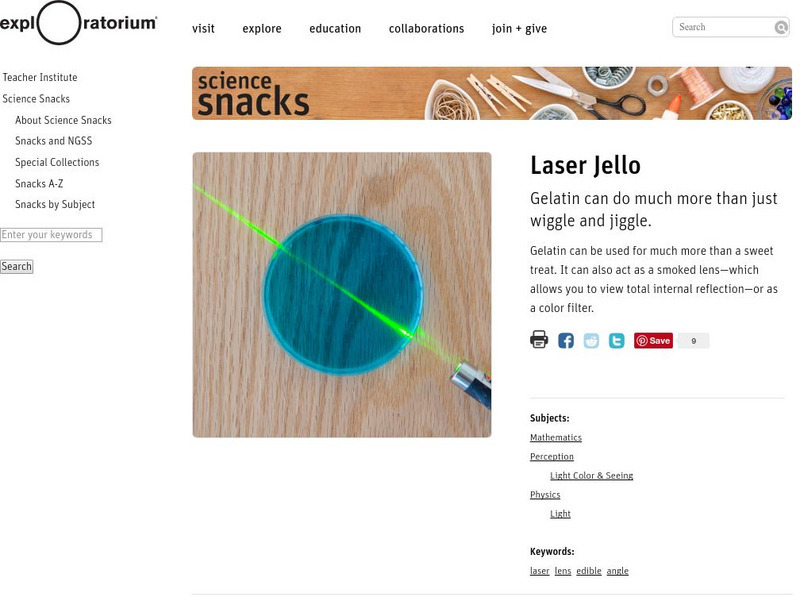
Exploratorium: Science Snacks: Laser Jello
View a total internal reflection by using gelatin and a laser with this activity.
Museum of Science
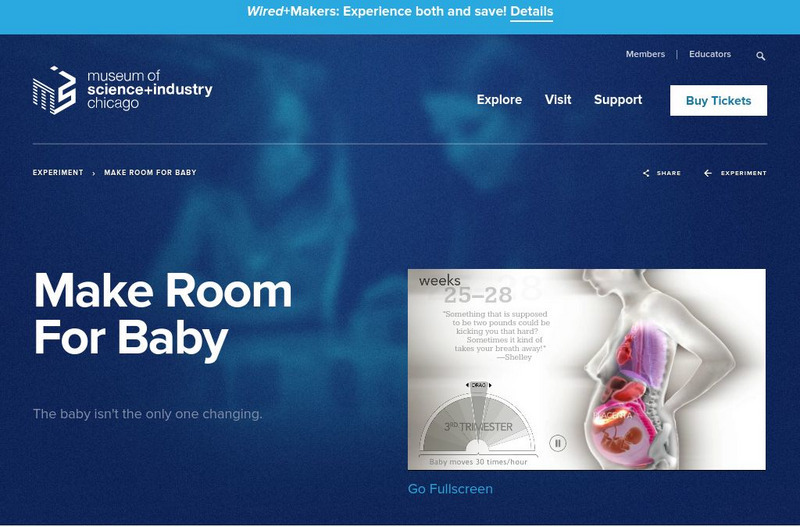
Museum of Science and Industry: Make Room for Baby
Explore the impact pregnancy on the mother's body with this interactive site.
Bill Nye
Bill Nye: Once in a Mega Moon
Try this at-home science experiment to learn why sometimes the Moon looks bigger than usual.
Harvard University
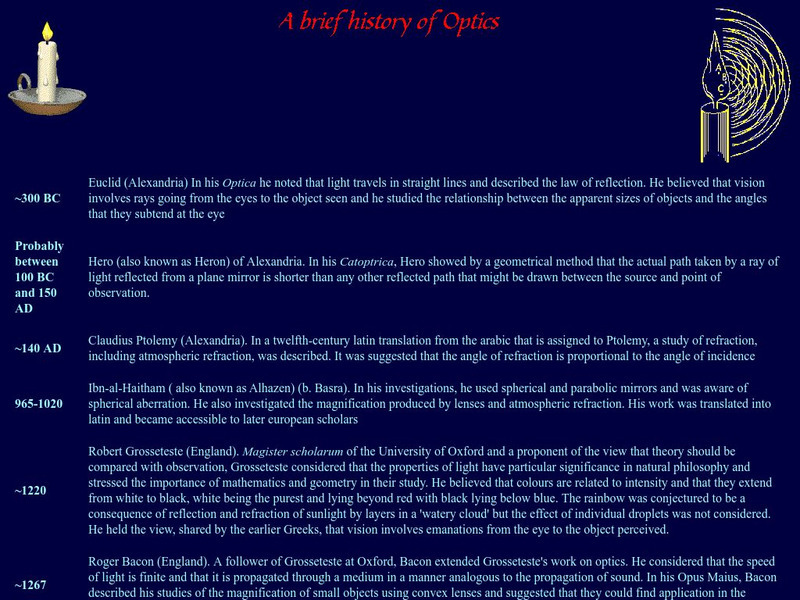
Web Science Resources: A Brief History of Optics
This timeline compiles an enormous amount of historical information from the field of optics. From 300 BCE to the present, strategic experiments, findings, and theories are described.
Other popular searches
- Gravity Science Experiment
- Life Science Experiments
- Designing a Science Experiment
- Egg Science Experiments
- Density Science Experiment
- Hands on Science Experiments
- Space Science Experiments
- Food Science Experiments
- 5 Minute Science Experiments
- Simple Science Experiments
- Air Science Experiments
- Fun Science Experiments