Hi, what do you want to do?





Ducksters
Ducksters: Chemistry for Kids: Solutions and Dissolving
On this site, students learn about solutions and dissolving in chemistry including interesting facts, examples, solubility, saturation, concentration, and what is a solution?

Crescent Public Schools
The Internet Science Room: The Periodic Table and Atomic Theory of Matter
A chemistry tutorial highlighting historical development of the atomic theory of matter and the periodic table of elements.
CK-12 Foundation
Ck 12: Physical Science: Valence Electrons
[Free Registration/Login may be required to access all resource tools.] Valence electrons, their variation in the periodic table and relation to reactivity and electrical conductivity of elements.
American Chemical Society
American Chemical Society: Hompage
ChemCenter, available from the American Chemical Society, provides chemistry news, reference sources and other public services.
Simon Fraser University
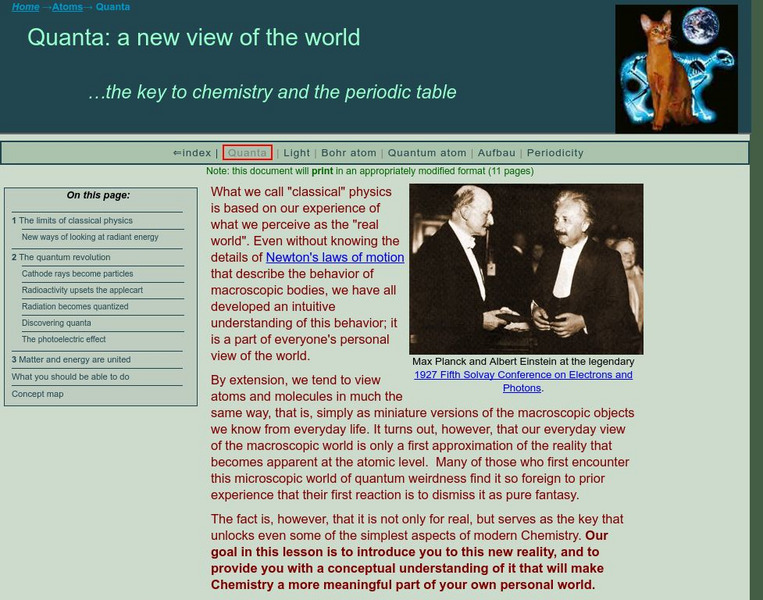
Chem1 Virtual Textbook: The Limits of Classical Physics
Acting as a subtopic of the General Chemistry Virtual Textbook's section on Atoms and the Periodic Table, this site discusses the limits associated with classical physics. Topics covered include light and heat with additional information...
Ducksters
Ducksters: Chemistry for Kids: Elements: Mercury
Kids learn about the element mercury and its chemistry including atomic weight, atom, uses, sources, name, and discovery. Plus properties and characteristics of mercury.
Ducksters
Ducksters: Kids Science: Molecules
Kid's learn about the science of the molecules. Tiny chemistry and compounds of atoms and elements make up all matter.

ClassFlow
Class Flow: Comparing and Contrasting Matter
[Free Registration/Login Required] This flipchart is a guided activity to help students compare different types of matter: atoms and molecules, elements and compounds, mixtures and solutions. It corresponds to Virginia science SOL 5.4.
PBS
Pbs Learning Media: Meaning of Matter
Matter is all around us, so it's a good idea to know what it is, and why it matters. Learn about matter, its categories, and its subcategories with this interactive lesson.
Ducksters
Ducksters: Chemistry for Kids: Chemical Bonding
Study chemical bonding in chemistry including atoms, valence electrons, ionic and covalent bonding, and how molecules are formed on this site!
Ducksters
Ducksters: Chemistry for Kids: Famous Chemists
Get some information about some famous chemists who made impacts on their fields! These scientists helped to develop the laws of chemistry and discovered many of the elements.
Ducksters
Ducksters: Chemistry for Kids: Naming Chemical Compounds
Learn about naming chemical compounds in chemistry including conventions, the order of the elements, metals, non-metals, acids, and examples on naming on this site.
Ducksters
Ducksters: Chemistry for Kids: Organic Chemistry
Kids learn about organic chemistry including the importance of carbon, organic molecules, compounds, hydrocarbons, synthesis, and functional groups.
Ducksters
Ducksters: Chemistry for Kids: Isotopes
Study the science of isotopes in chemistry including naming isotopes, hydrogen, examples, fun facts, unstable, and stable on this site.
Ducksters
Ducksters: Chemistry for Kids: Chemical Mixtures
Explore all about chemical mixtures on this site including solutions, alloys, suspensions, colloids, dissolving, examples, and facts.
Ducksters
Ducksters: Chemistry for Kids: Separating Mixtures
Kids learn about separating mixtures in chemistry including separation processes such as filtration, distillation, and the centrifuge.
Ducksters
Ducksters: Chemistry for Kids: Chemical Reactions
A site discussing chemical reactions in chemistry including reaction rate, types of reactions, reagents, reactants, catalysts, and inhibitors.
Science Struck
Science Struck: Explanation of John Dalton's Atomic Theory
Explains the basic tenets of Dalton's atomic theory.
Thomas Jefferson National Accelerator Facility
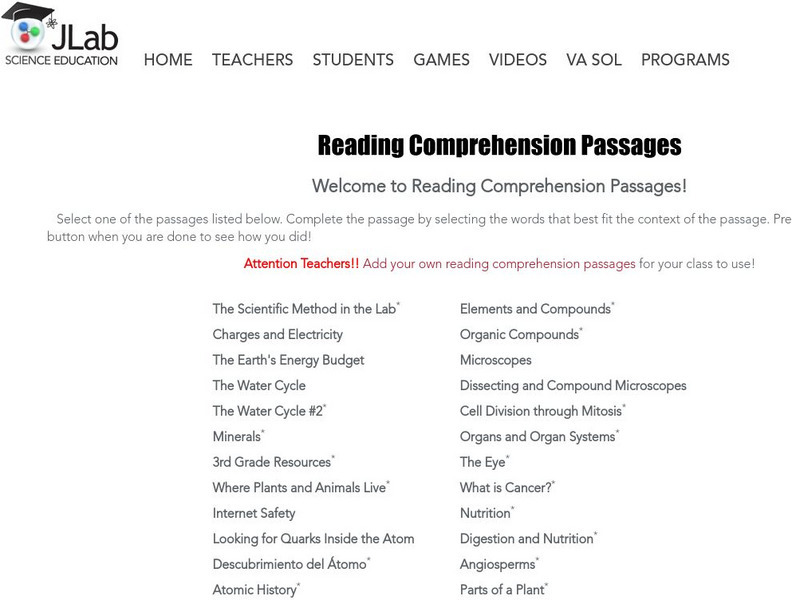
Jefferson Lab: Reading Comprehension Passages
Thirty-three cloze reading passages on various scientific passages including the scientific method, the water cycle, earth science, atoms, elements, cell division, body systems, and more.
Alabama Learning Exchange
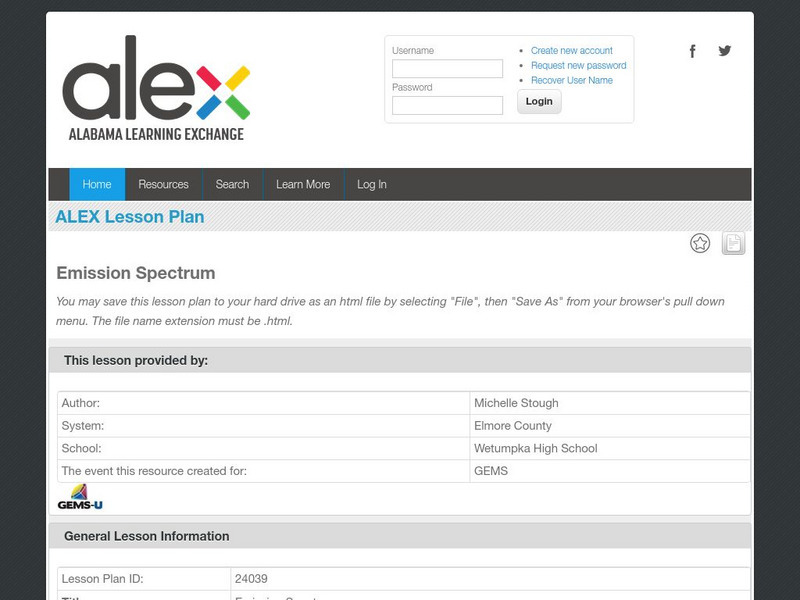
Alex: Emission Spectrum
We will reintroduce the students to the electromagnetic spectrum and visible light. We will talk about the states of electrons(ground and excited). The teacher will show a video link (Electrons in Atoms). We will then perform the science...