Hi, what do you want to do?






Curated OER
The Big Bang Theory
Young scholars will use scientific reasoning to formulate ideas about the formation of the universe using the Big Bang Theory. The use of critical thinking skills is part of the activity and the foundation of the scientific method will...

Curated OER
The Amazing and Beautiful Aurora
Students create an oil pastel painting. In this pastel painting lesson plan, students examine images of the aurora borealis. Students produce an original pastel painting of the aurora.

Curated OER
Get the Picture!
Astronomers practice downloading data from a high-energy satellite and translate the data into colored or shaded pixels. As a hands-on activity, they use pennies to simulate high-energy satellite data and they convert their penny...

Curated OER
Our Intriguing Star, the Sun!
Explore the sun in a lesson plan about space. The lesson spans ten weeks, with students performing activities to answer weekly questions about the Sun and Earth.

Curated OER
Exploring Place and Space
Young scholars explore number values by completing mathematical worksheets in class. In this decimals lesson plan, students identify the different place values a number has and the use of decimals to represent a fraction of a number....

EngageNY
Choice of Unit
Explore using units with scientific notation to communicate numbers effectively. Individuals choose appropriate units to express numbers in a real-life situation. In this 13th lesson of 15, participants convert numbers in scientific...

Curated OER
How Did the First Asteroid Come to be Discovered?
Students examine asteroids including how and when they were discovered. In this asteroid lesson students view a PowerPoint presentation on asteroids.

Curated OER
Lotto or Life: What Are the Chances?
Though the website does not seem to have the mentioned video, a reding and lottery style games simulate the chances of finding intelligent life somewhere other than Earth. Without the video, this lesson is short, but it can be a useful...

Curated OER
The Drake Equation
Young scholars use the Drake Equation to calculate the probability of sustaining life on various planets. Through the use of the equation, they determine whether intelligent and advanced civilizations can be developed on planets other...

Curated OER
Earth is Round?
Third graders discuss how Aristotle concluded that the Earth was round. As a class, they review theories about the Earth's shape and describe how life on Earth would be different if it were flat. Individually, they make a moon book in...

Curated OER
Exploring The Neighborhood of the Solar System
Learners explain why exploring the universe for life on other planets is an important field of study. They use mathematical formulas to calculate the temperatures of planets as it relates to their distance from the sun. Students use...

Curated OER
Da Vinci's Renaissance
Students study the Renaissance through an examination of the life and accomplishments of Leonardo Da Vinci.

Curated OER
The Letter Aa
Students explore letter Aa. In this letter recognition lesson, students participate in country, state, food, literature, physical education, colors, careers, music, and game activities that are linked to the main lesson page....

Curated OER
Coordinate Graphs
Learners use coordinate graphs in order to identify objects and their locations. They are shown how to plot the x and y coordinates and then are given values to be plotted during guided and independent practice. Students are assessed on...

Curated OER
Sun and Moon Poetry Baskets
Students write Sun and Moon poetry. In this poetry instructional activity, students research the sun and the moon. They write poetry and create two class baskets for descriptive words about each.

Curated OER
Taking Risks: Drug and Alcohol Abuse
Students discuss a video about drug and alcohol abuse and their connection to risk-taking. They answer questions on a risk factor sheet about the use of tobacco, drugs, and alcohol. They discuss long and short term goals and how not...

Curated OER
The Planets Terra Firma
Students explore the theories of the creation of the universe and examine the properties of celestial bodies. They analyze the relationship between the sun, Earth and the other planets.


Curated OER
Celestial Reflections: See Yourself in the Sky!
Students create a mirror/mirror frame using glass mosaic tiles, grout, and various other mosaic supplies.
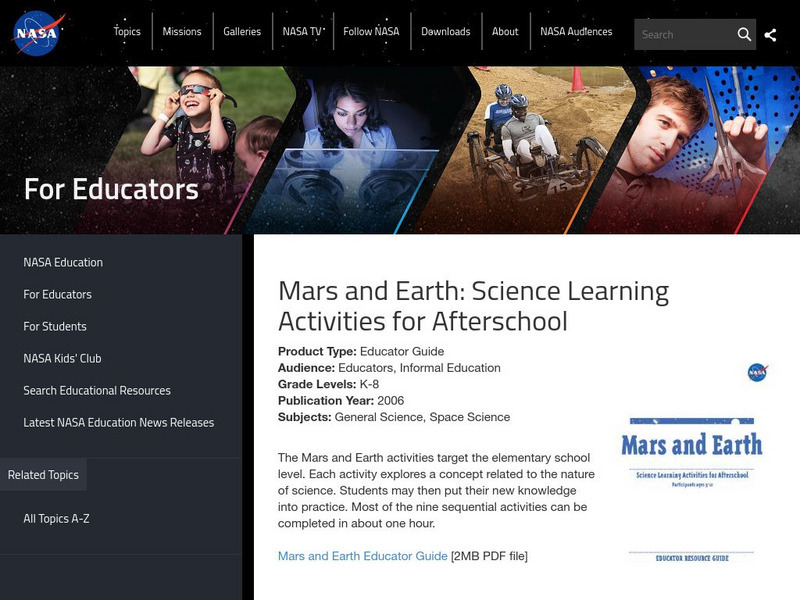
NASA
Nasa: Mars and Earth: Science Learning Activities for Afterschool
This set of activities teaches students about the big picture of science using Mars as an example: how to collect data, use evidence, and look at models.
Teachnology
Teachnology: Science Lesson Plans
Great lesson plans covering a wide-range of science-related subjects. A wonderful resource for wonderful teachers!
Science Buddies
Science Buddies: A Puzzling Parallax
Did you know that ancient astronomers could measure the distance to other stars? They could also distinguish between stars and planets. How could they do that without modern technology of telescopes? See if you can discover the link...
PBS
Pbs Teachers: Scientific American: Science in Paradise: Big Dish
Investigate the science of radio astronomy, and create a model of a curved reflecting dish that will work like the Arecibo detector to detect electromagnetic waves. Explore risk using a risk space grid.

Science Buddies
Science Buddies: Kinesthetic Astronomy: Earth's Rotation
This kinesthetic activity will demonstrate concepts like rotation and orbit, clarify movement and direction, and help students understand why earthlings see different things in the sky.
Other popular searches
- Astronomy and Space Science
- Space Science Astronomy
- Science Astronomy Stars
- Earth Science Astronomy
- Science Astronomy Graphing
- Life Science Astronomy
- "Astronomy and Space Science