Hi, what do you want to do?





Science Buddies
Science Buddies: Testing Ant Repellents
Has your house ever suffered an ant invasion? This project is an interesting way to investigate what substances are effective as ant repellents. The goal is to find substances that keep ants away, yet are safe for humans and the...
The Wonder of Science
The Wonder of Science: K Ess3 3: Environmental Solutions
This NSTA vetted source includes resources to teach ideas on reducing the impact of humans on the environment. Included are assessment ideas, videos, examples, lesson plans, and photos of student work.

Science Struck
Science Struck: The Amazon Rainforest Climate
Describes the ecology of the Amazon rainforest, the characteristics of its climate, the impact of human actions on this environment and the need for stronger conservation efforts to save the rainforests.
Science Buddies
Science Buddies: Cold Room? Heat It Up With a Homemade Solar Air Heater
Humans need food, water, and warm shelter to survive. But a lot of humans depend on fossil fuels to supply gas and electricity to heat our homes. But burning fossil fuels to create energy is harmful to the environment. In this science...
Science Buddies
Science Buddies: Career Profile: Animal Breeder
Do you think a career in animal breeding might be interesting? This article in Science Buddies gives a clear assessment of what you might expect in that career. Find out what education you need, what the work environment is like, and...
Science Buddies
Science Buddies: Home Sweet Biome: How Do Plants Grow in Different Environments?
In this science fair project you will learn about biomes and how different climatic conditions affect plant growth. This can explain why some plants and animals are similar in different areas of the country, and in other parts they are not.
Science Buddies
Science Buddies: How Does Soil Affect the P H of Water?
Did you know that soils can be alkaline, neutral, or acidic? Most plants grow best in soil near neutral pH, but some plants prefer slightly acidic and others slightly alkaline soil. What is the pH of the soil in your garden? What happens...
Science Buddies
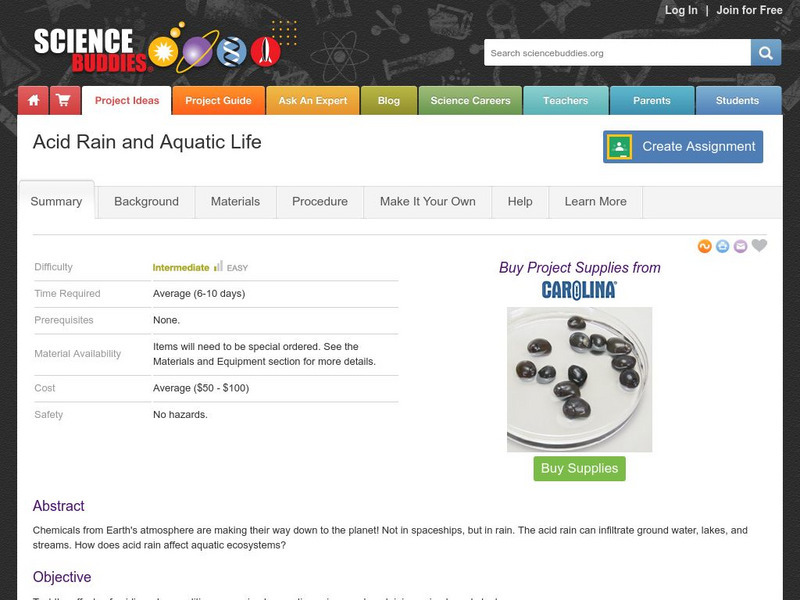
Science Buddies: Acid Rain and Aquatic Life
Chemicals from the Earth's atmosphere are making their way down to the planet. Not in spaceships, but in rain. The acid rain can infiltrate ground water, lakes, and streams. How does acid rain affect aquatic ecosystems?
Untamed Science
Untamed Science: Biology: World Biomes: Intertidal Zone: Aquatic Biome
Learn about the flora and fauna of the intertidal aquatic zone and the characteristics that describe this aquatic biome through reading and watching video clips. [6:42]
CK-12 Foundation
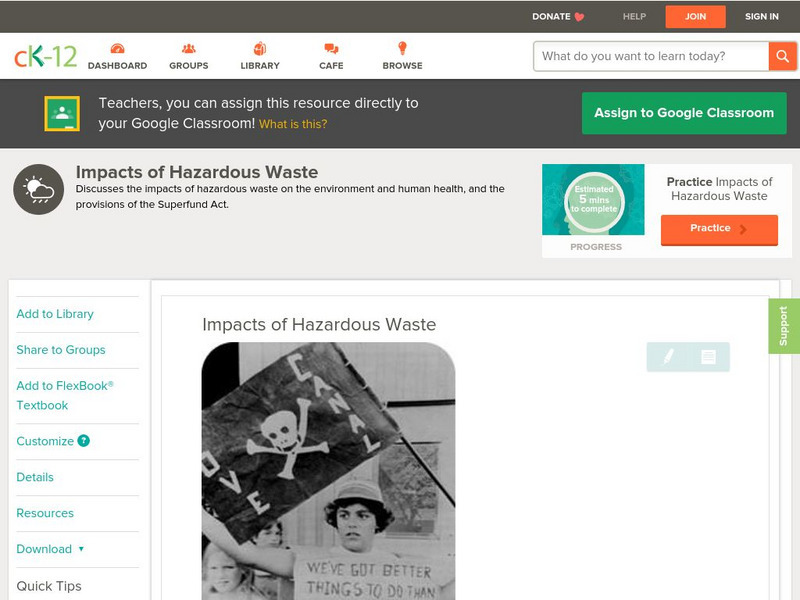
Ck 12: Earth Science: Impacts of Hazardous Waste
[Free Registration/Login may be required to access all resource tools.] Discusses the impacts of hazardous waste on the environment and human health, and the provisions of the Superfund Act.
Science Buddies
Science Buddies: It's Crowded in Here! A Study of Plant Population Density
Like humans, plants can be negatively affected by overcrowding. Unlike humans, plants cannot get up and move to a new environment or explore how to utilize new resources. This experiment will explore the effects of crowding (population...
Science Buddies
Science Buddies: Career Profile: Environmental Engineering Technician
Read about the environmental engineering technicians who do the hands-on work that is developed by the environmental engineer. Science Buddies offers a career profile which outlines the educational requirements and lays out the nature of...
Science Buddies
Science Buddies: Does Temperature Affect the Rate of Butterfly Development?
This is an interesting experiment for an Investigator who is 1) curious about insect metamorphosis and 2) patient. You'll need to set up different controlled environments for the chrysalides, and then check on them regularly as you wait...
Science Buddies
Science Buddies: Get Something for Nothing: Free Power From the Sun!
Taking advantage of free energy can reduce our dependence on fossil fuels, which are harmful to our environment. In this science fair project, you will work with a solar panel, which is a collector of free energy, and investigate how...
Science Buddies
Science Buddies: Bat Detector: Listen to the Secret Sounds of Bats
Sometimes bats can "whoosh" right by you, and not be seen. In this science fair project, you will be able to detect flying bats by listening in on the ultrasonic signals they produce to locate objects in their environment. The bat...
Science Buddies
Science Buddies: How Do Roots Grow When the Direction of Gravity Changes?
You might not know it, but plants are able to sense their environment and actually respond appropriately. One of the key parameters that every plant must respond to is the direction of gravity: stems go up (opposite to the pull of...
Georgia Department of Education
Ga Virtual Learning: Environmental Worldviews, Ethics, and Sustainability
Through this interactive module, history has shown that the multifaceted aspects of nature have been overlooked many times in the past. And thus, our pursuit to control our environment has failed and left us wanting. What does the future...
Other
Wikibooks: High School Earth Science/use and Conservation of Resources
Begins with a description of a case of missing plant nutrients that have been affecting Monongahela National Forest in West Virginia. Lists some of the benefits to humans of the natural resources in such a park. Then explains the...

Ducksters
Ducksters: Science for Kids: Food Chain and Web
Kids learn about the food chain and food web. How energy cycles and transfers through living organisms.

University of Utah
University of Utah: Genetic Science Learning Center: Meet the Microenvironments
Investigate the Great Salt Lake's islands, rivers, and man-made structures that define several diverse microenvironments.
The Wonder of Science
The Wonder of Science: 3 Ls4 1: Fossil Evidence of Past Environments
Work samples, phenomena, assessment templates, and videos that directly address standard 3-LS4-1: fossil evidence of past environments.
Utah Education Network
Uen: What's in the Dirt?
Third graders will observe changes in a small environment.

Ducksters
Ducksters: Environment for Kids: Wind Power
Kids learn about wind energy and how this renewable power can help the environment. Teach students about turbines that generate electricity from the wind.

Ducksters
Ducksters: Environment for Kids: Renewable Energy
Kids learn about renewable energy and how it can help the environment. Teach students about solar, wind, biomass, and geothermal energy.