Hi, what do you want to do?





US Environmental Protection Agency
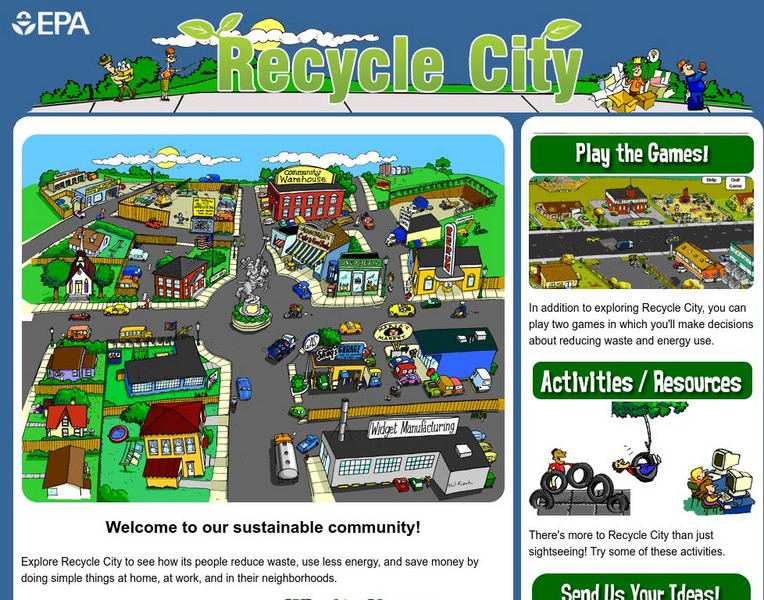
Epa: Recycle City
This interactive site allows students to implement recycling programs to transform "Dumptown" into "Recycle City". To make this simulation realistic, students must implement the programs within a budget.
Other
National Center for Electronics Recycling
The NCER is dedicated to the development and enhancement of a national infrastructure for the recycling of used electronics in the U.S. How does one recycle electronics? What web sites can provide help? Read the important information...
US Environmental Protection Agency
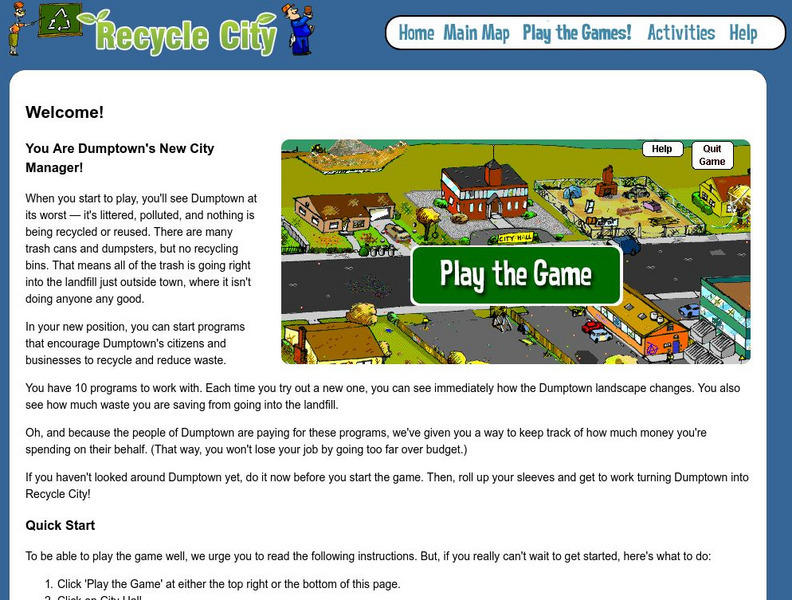
Epa: Dumptown Game
This fun game helps students learn ways to recycle, reduce waste, and compost. You can also create your own Recycle City Scavenger Hunt.
![Earth Care: Recycling Quiz: Primary [Pdf] Unknown Type](https://static.lp.lexp.cloud/images/attachment_defaults/resource/large/FPO-knovation.png "Earth Care: Recycling Quiz: Primary [Pdf] Unknown Type")
Better Planet Productions
Earth Care: Recycling Quiz: Primary [Pdf]
This recycling quiz for primary students is helpful for promoting discussion. Answers will vary depending on the recycling programs in your area.
US Environmental Protection Agency
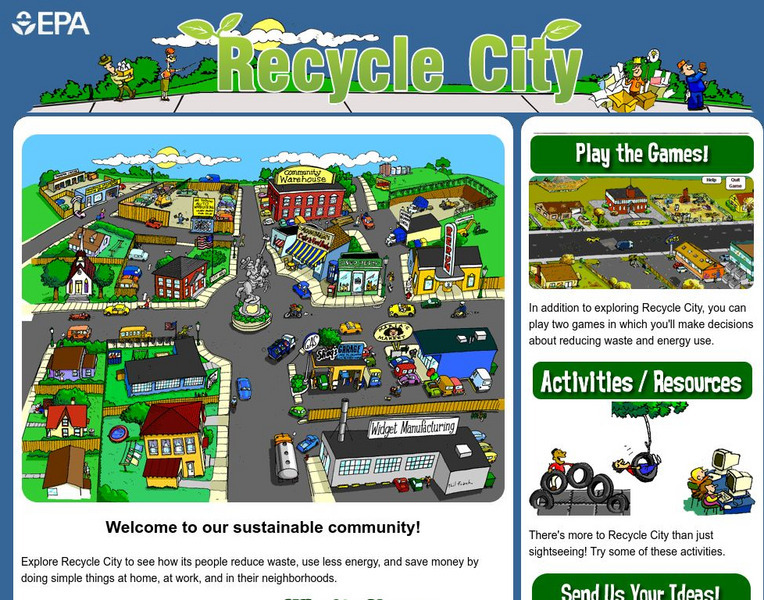
Epa: Recycle City
Explore the four neighborhoods of Recycle City to learn all the ways people there are recycling, reducing, and reusing materials. Take a look also at Dumptown, which is how Recycle City used to look, and see all the waste reduction...
TeachEngineering
Teach Engineering: Recycled Towers
Students learn about material reuse by designing and building the strongest and tallest towers they can, using only recycled materials. They follow design constraints and build their towers to withstand earthquake and high wind simulations.

Other
Recycling Council of Ontario: Waste Free Lunch Challenge
This site provides resources for educators to manage a litterless lunch program at their schools in order to promote environmental education objectives. Teachers register their classes and receive certificates at the end of the program.

TeachEngineering
Teach Engineering: Environment
Through 10 lessons and more than 20 hands-on activities, students are introduced to the concept of an environment and the many interactions within it. As they learn about natural and human-made environments, as well as renewable and...
TeachEngineering
Teach Engineering: Trash to Treasure!
Student teams use the engineering design process to create a useful product of their choice out of recyclable items and "trash." The class is given a "landfill" of reusable items, such as aluminum cans, cardboard, paper, juice boxes,...
TeachEngineering
Teach Engineering: Drawing Magnetic Fields
Students use a compass and a permanent magnet to trace the magnetic field lines produced by the magnet. By positioning the compass in enough spots around the magnet, the overall magnet field will be evident from the collection of arrows...
TeachEngineering
Teach Engineering: Clean Up This Mess
Students are challenged to design a method for separating steel from aluminum based on magnetic properties as is frequently done in recycling operations. To complicate the challenge, the magnet used to separate the steel must be able to...
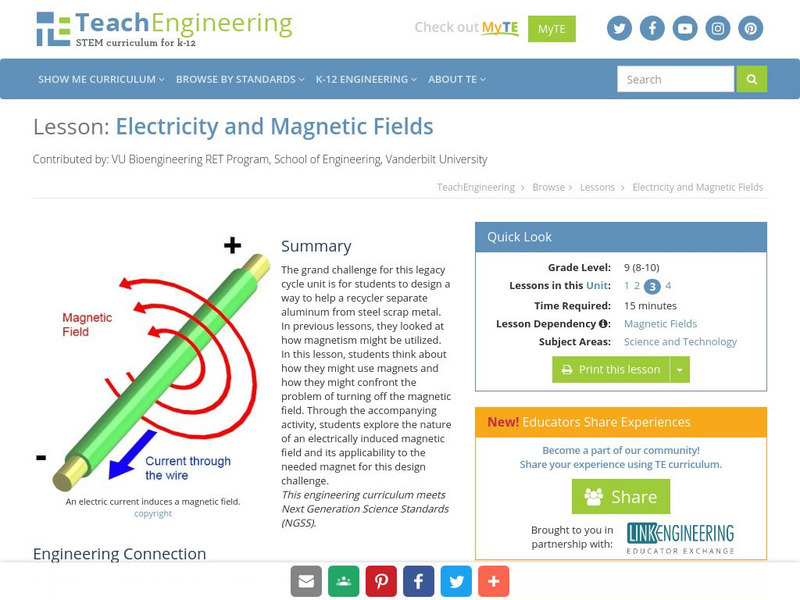
TeachEngineering
Teach Engineering: Electricity and Magnetic Fields
The grand challenge for this legacy cycle unit is for students to design a way to help a recycler separate aluminum from steel scrap metal. In previous lessons, they have looked at how magnetism might be utilized. In this lesson,...
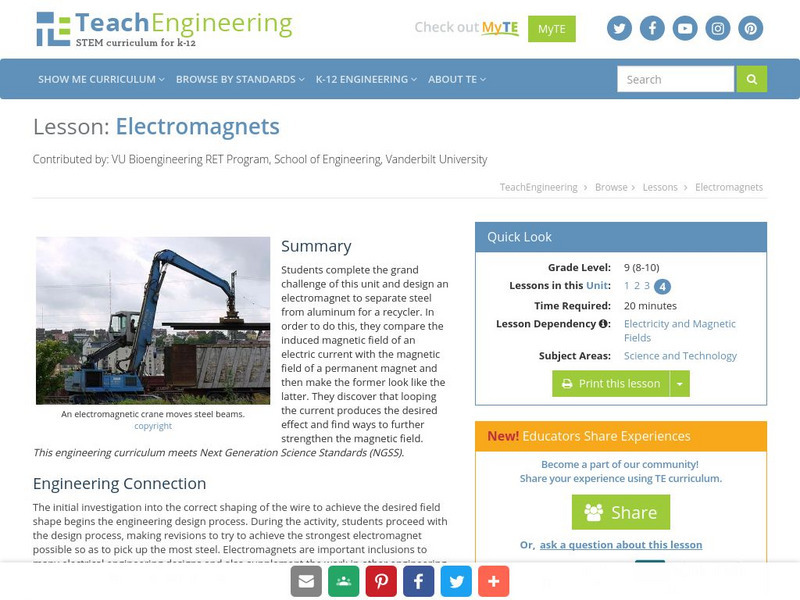
TeachEngineering
Teach Engineering: Electromagnets
In this activity, the students will complete the grand challenge and design an electromagnet to separate steel from aluminum for the recycler. In order to do this, students compare the induced magnetic field of an electric current with...
TeachEngineering
Teach Engineering: Building an Electromagnet
Students design and construct an electromagnet that must pick up 10 staples. They begin with only minimal guidance, and after the basic concept is understood, are informed of the properties that affect the strength of that magnet. They...
TeachEngineering
Teach Engineering: Human Water Cycle
Students learn about the human water cycle, or how humans impact the water cycle by settling down in civilizations. Specifically, they learn how people obtain, use and dispose of water. Students also learn about shortages of treated,...
TeachEngineering
Teach Engineering: Shades of Gray(water)
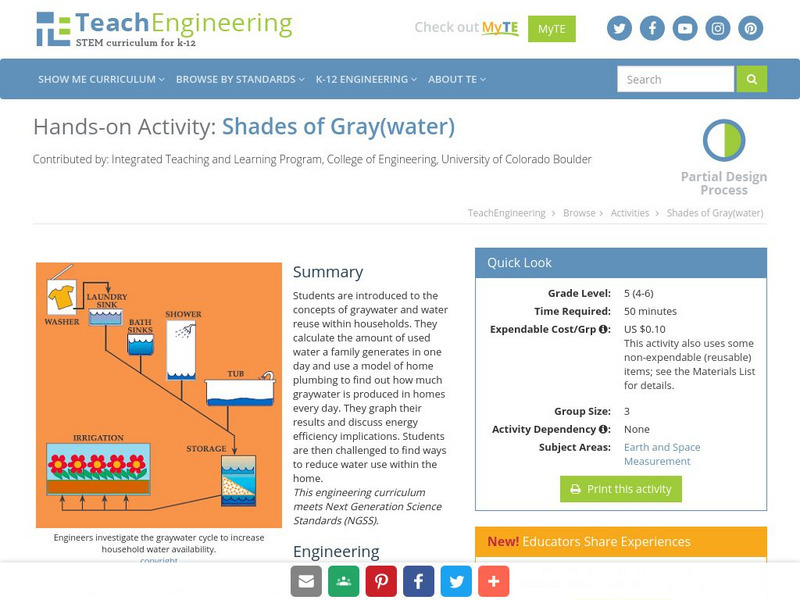
Students are introduced to the concepts of graywater and water reuse within households. They calculate the amount of used water a family generates in one day and use a model of home plumbing to find out how much graywater is produced in...
TeachEngineering
Teach Engineering: The Great Pacific Garbage Patch
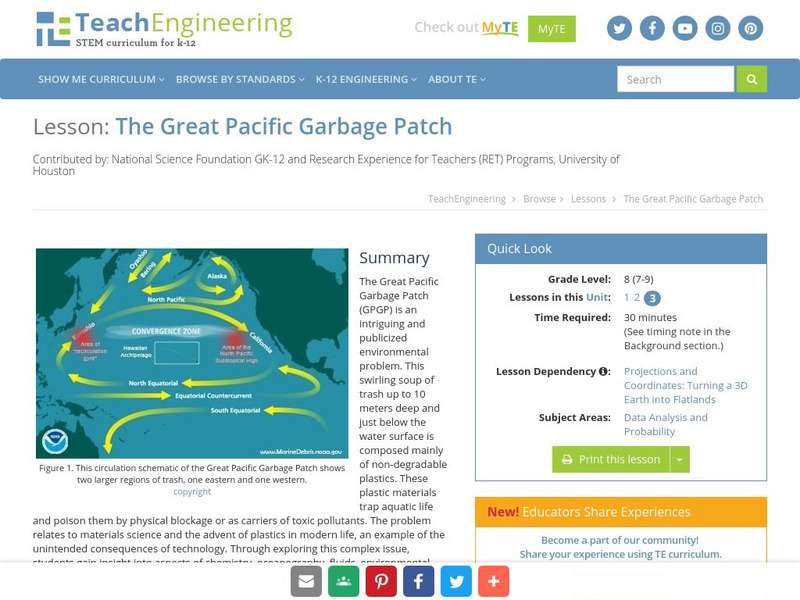
The Great Pacific Garbage Patch (GPGP) is an interesting and somewhat publicized environmental problem. A swirling soup of trash up to 10 meters deep and just below the water surface is composed mainly of non-degradable plastics. These...
Other
Kids for a Clean Environment
Don't just complain about what is happening to the environment, become involved in environmental issues and make a change. Here's an organization that is enabling kids to make those changes.

TeachEngineering
Teach Engineering: Design a Net Zero Energy Classroom
Students create a concept design of their very own net-zero energy classroom by pasting renewable energy and energy-efficiency items into and around a pretend classroom on a sheet of paper. They learn how these items (such as solar...