Hi, what do you want to do?






Utah Education Network
Uen: Trb 3:1 Investigation 6 Celestial Model
Third graders will gain an understanding of why stars appear to move across the night sky.
NASA
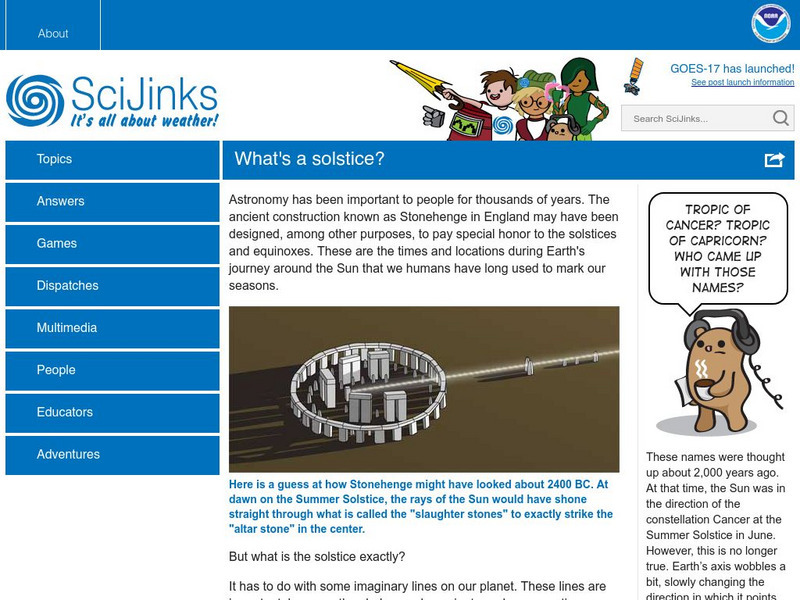
Nasa: Sci Jinks: What's a Solstice?
Find out how the Earth's tilted axis affects the seasons on the Earth.
PBS
Pbs Learning Media: Global Weather Machine
In this illustrated essay from NOVA Online, explore the cyclical process of weather creation and the effects of El Nino on the global weather system.
Utah Education Network
Uen: Measuring Wind Speed
Fourth graders measure wind speed over the course of a week and graph the results.

Georgia Department of Education
Ga Virtual Learning: The Moon
In this interactive tutorial students will explore what it is like on the Moon. Learn why the shape of the Moon seem to change and also about lunar eclipses. Discover why the tide changes twice a day and explore how the cycle of the Moon...
Better Lesson
Better Lesson: Our Stars
In this lesson, young scholars will observe and communicate how the stars are in the sky both day and night. The extremely detailed lesson includes photos and videos of the lesson in actions, examples of student's work, materials, parent...
Better Lesson
Better Lesson: Our Sky
What objects are in the day sky and the night sky? How do they seem to move? Come and explore with us as we discover the sun, moon, planets and stars! This detailed lesson plan includes pictures and videos of the lesson plan in action,...
TeachEngineering
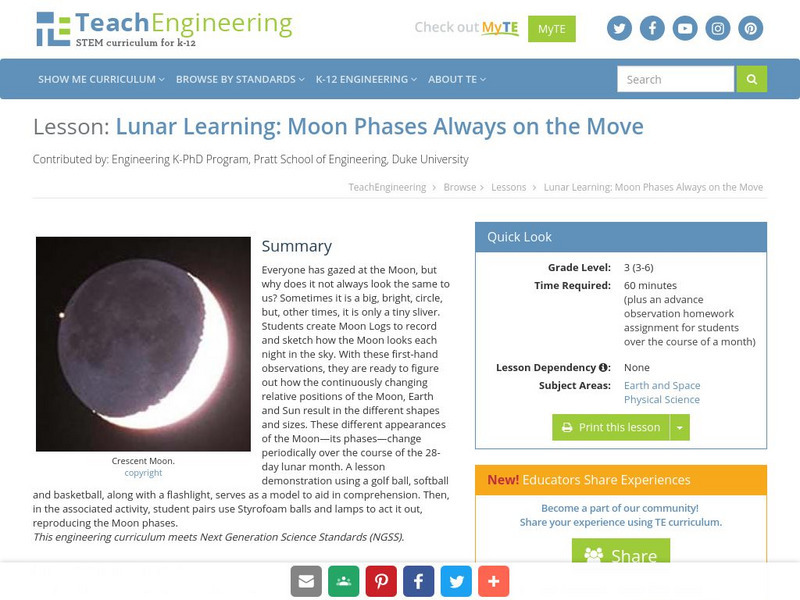
Teach Engineering: Lunar Learning
Why does the Moon not always look the same to us? Sometimes it is a big, bright, circle, but, other times, it is only a tiny sliver, if we can see it at all. The different shapes and sizes of the slivers of the Moon are referred to as...
TeachEngineering
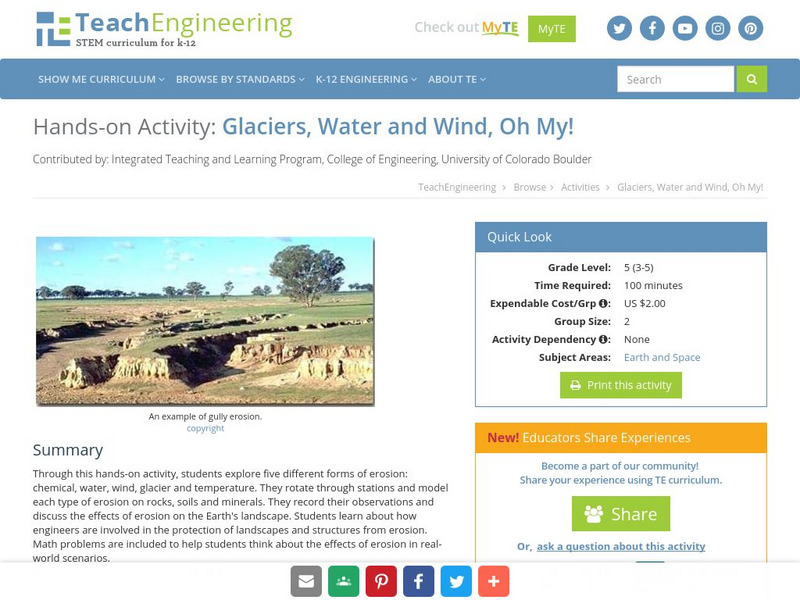
Teach Engineering: Glaciers, Water and Wind, Oh My!
This hands-on activity explores five different forms of erosion (chemical, water, wind, glacier and temperature). Students rotate through stations and model each type of erosion on rocks, soils and minerals. The students record their...
Read Works
Read Works: Article a Day Set: Time
[Free Registration/Login Required] This Article-A-Day-Set provides six articles related to "time." Students will learn about the days of the week and months of the year.
National High Magnetic Field Laboratory
Magnet Academy: Foucault's Disk
Leon Foucault, a French physicist much better known for his pendulum demonstrating the rotation of the Earth, also created in 1855 a device that illustrated how eddy currents work. (Java tutorial)
Other
Lee Trampleasure: Science Education: Coriolis Effect
Examine three examples of the Coriolis Effect with reference to wind. The effect is that when an object is moving perpendicular to the rotation of a sphere the object will appear to travel in a curved line. Prevailing winds will look as...
National Weather Service
National Weather Service: Jet Stream: The Jet Stream
The concept of jet streams is explained on this site. Read about why jet stream winds blow from west to east, what the polar jet and subtropical jet are, the role that the rotation of the Earth plays, etc.
Scholastic
Scholastic: Study Jams! Science: Weather & Climate: Seasons
A slideshow and a short multiple-choice quiz on the topic of seasons and how they are caused by the Earth's rotation and orbit.

Alabama Learning Exchange
Alex: Our Restless Planet
This unit will use demonstrations and student examples to help students gain an understanding of rotation, revolution, and orbit. Through hands-on activities students will explore the concepts of day and night. Technology will be...
Read Works
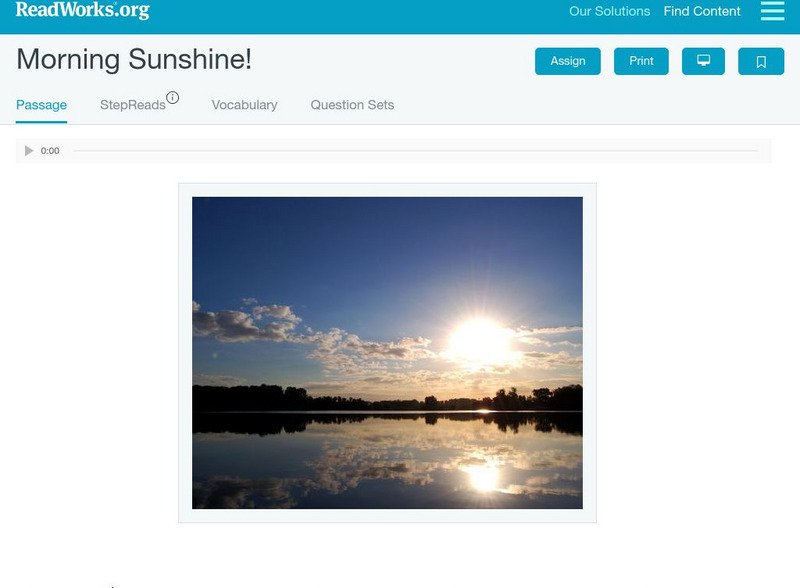
Read Works: Morning Sunshine
[Free Registration/Login Required] Students read about how the tilt of the Earth on its axis affects sunrises and sunstes. A question sheet is available to help students build skills in reading comprehension.
Ministerio de Educación (Spain)
Ministerio De Educacion: Astronomia Visible
This site has maps of the nearest stars and constellations. Earth and star daily rotation, proper motion of the stars and many other topics about the solar system are also shown.Read phonetically
E-learning for Kids
E Learning for Kids: Science: Rio De Janeiro: Day and Night: The Sun
Gabriella lives in Rio de Janeiro, Brazil. Help her learn more about the sun and identify the properties of the sun.
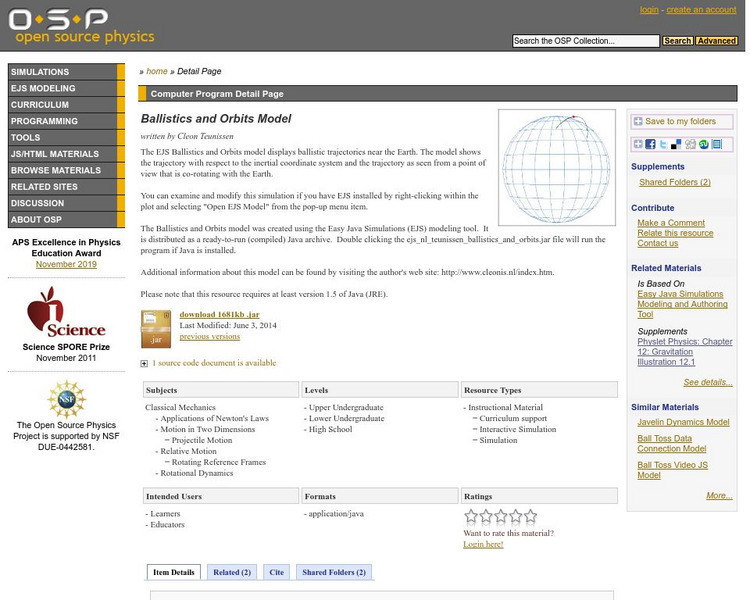
American Association of Physics Teachers
Com Padre Digital Library: Open Source Physics: Ballistics and Orbits Model
Experience a simulation of ballistic trajectories in relationship to Earth's orbit. Java 1.5 or more recent is required.
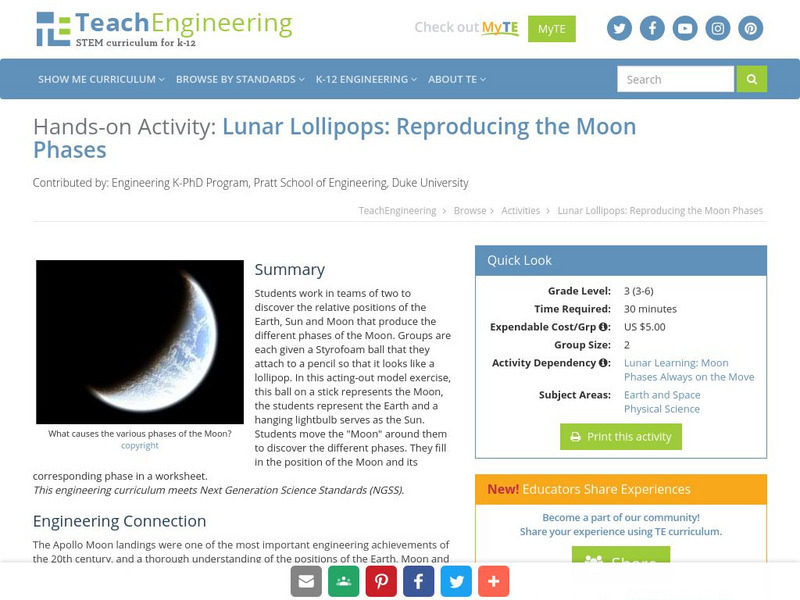
TeachEngineering
Teach Engineering: Lunar Lollipops
The students work in teams of two to discover the relative positions of the Earth, Sun and Moon that produce the different phases of the Moon. The students will be given a Styrofoam ball that they will attach to a pencil so that it looks...

Libre Text
Libre Text: The Coriolis Force
The Coriolis force is a central element of the dynamics of ocean and atmosphere flows.
Wikimedia
Wikipedia: The Black Hole
This site examines the black hole as an object in astrophysics. Delve into this comprehensive resource that covers this concept from its history, to qualitative physics, the reality of black holes, mathematical physics and more.

Other
Center for Science Education: Eye on the Sky: What Makes Day and Night?
This activity will allow you to model day and night cycles. A rotating student holding a map (provided) models the earth. A lamp is used to model the sun. Numerous worksheets (pdf) and additional website resources are also provided.
Cornell University
Cornell University: Astronomy: Eratosthenes
Learn how Greek mathematician Eratosthenes used geometry to estimate the circumference of the Earth.