Hi, what do you want to do?





Sophia Learning
Sophia: The Impact of Rhetorical Devices
This slideshow focuses on the impact of rhetorical devices and how they impact text. It explains eight common rhetorical devices: anaphora, asyndeton, chiasmus, direct address, hyperbaton, parallelism, polysyndeton, and rhetorical...

Sophia Learning
Sophia: Rhetorical Analysis of "So This Was Adolescence"
This PDF lesson plan prepares students for multiple portions of the AP Language and Composition exam (specifically, the multiple choice section and the rhetorical analysis prompt) by analyzing a brief text which students will be able to...
![Seymour Community School District: 10 Rhetorical Devices [Pdf] PPT](https://statictemp.lp.lexp.cloud/images/attachment_defaults/resource/large/FPO-knovation.png "Seymour Community School District: 10 Rhetorical Devices [Pdf] PPT")
Other
Seymour Community School District: 10 Rhetorical Devices [Pdf]
A slideshow discussing ten rhetorical devices, with links to examples, in-depth information, and a video. Covers logos, ethos, pathos, analogy, metaphor, irony, personification, rhetorical question, tricolon, and maxims. Presents a...
Sophia Learning
Sophia: Rhetorical Strategies
This lesson gives an overview of rhetorical strategies.
Sophia Learning
Sophia: Hypophora
A six-slide presentation introducing hypophora and explaining its use as a rhetorical device.
Sophia Learning
Sophia: Understatement
A four-slide document introducing understatement and explaining how it can be used as a rhetorical device.
Sophia Learning
Sophia: Hyperbole
A five-slide presentation introducing hyperbole and explaining its use as a rhetorical device.
Sophia Learning
Sophia: Hypophora
This lesson introduces hypophora as a rhetorical device. This tutorial lesson shares a short slideshow with the lesson's content.
Sophia Learning
Sophia: Types of Questions
This slideshow lesson focuses on types of questions; it provides background, purpose, and a list of the seven types of questions: rhetorical, direct or interrogative, indirect, open-ended, closed, and embedded. It provides background and...
Sophia Learning
Sophia: Hyperbole
This lesson introduces hyperbole as a rhetorical device. This tutorial lesson shares a short slideshow with the lesson's content.

Curated OER
Web Gallery of Art: Costume of the Allegorical Figure "Rhetoric"
An image of "Costume of the allegorical figure "Rhetoric"", created by Giuseppe Arcimboldo in 1585 (Pen, blue wash on white paper, 304 x 205 mm).
Sophia Learning
Sophia: Oxymorons
This slideshow focuses on oxymoron by defining the term, discussing its purpose, and providing examples. L.9-10.5a Figures of Speech
Georgia Department of Education
Ga Virtual Learning: Informative Speech Critique Sheet (Pdf)
This PDF is a critique form for evaluating informative speeches. SL.9-10.3 Eval Presentation. CCSS.ELA-LiteracySL.3, SL.9-10.3 Eval Presentation
Sophia Learning
Sophia: Parallel Structure in Pairs
This lesson discusses the importance of parallel construction in pairs and comparisons or contrasts. This tutorial lesson shares a short slideshow with the lesson's content.
Tom Richey
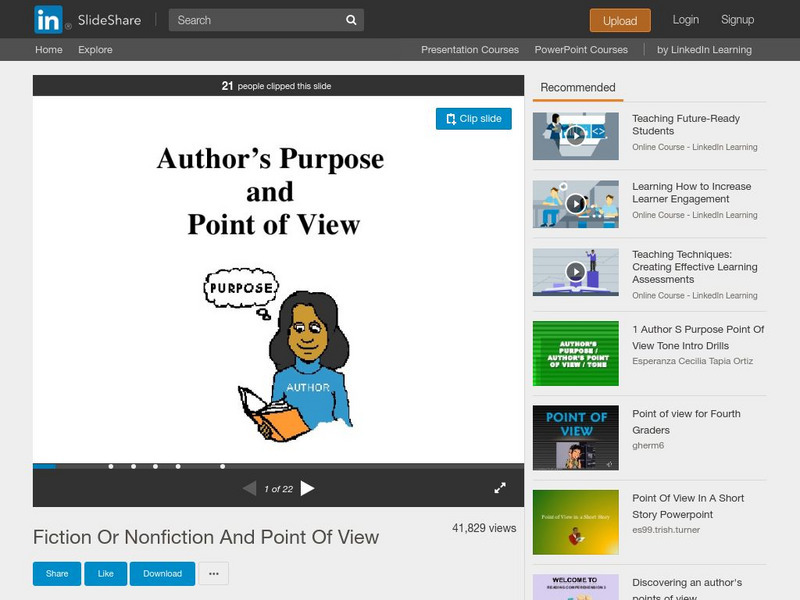
Slide Share: Author's Purpose and Point of View
This downloadable slideshow focuses on how an author's purpose and point of view work together in fiction and nonfiction, and how to identify the point of view.
Sophia Learning
Sophia: Incorporating Questions in Writing
This lesson goes over how to incorporate questions in a composition.
Curated OER
Educational Technology Clearinghouse: Clip Art Etc: Aristotle
Aristotle was a Greek philosopher, a student of Plato and teacher of Alexander the Great. He wrote on many subjects, including physics, metaphysics, poetry, theater, music, logic, rhetoric, politics, government, ethics, biology and zoology.
Curated OER
Educational Technology Clearinghouse: Clip Art Etc: William Lowndes Yancey
William Lowndes Yancey (August 10, 1814 - July 27, 1863) was a journalist, politician, orator, diplomat and an American leader of the Southern secession movement. A member of the group known as the Fire-Eaters, Yancey was one of the most...
Curated OER
Educational Technology Clearinghouse: Clip Art Etc: Euripides
Euripides was born in the island of Salamis, in B.C. 480, his parents having been among those who fled thither at the time of the invasion of Attica by Xerxes. He studied rhetoric under Prodicus, and physics under Anaxagoras. - Smith, 1882
Curated OER
Educational Technology Clearinghouse: Clip Art Etc: Sculpture of Demosthenes
Demosthenes was a prominent Greek statesman and orator of ancient Athens. His orations constitute a significant expression of contemporary Athenian intellectual prowess and provide an insight into the politics and culture of ancient...
Curated OER
Educational Technology Clearinghouse: Clip Art Etc: Statue of Aristotle
Aristotle was a Greek philosopher, a student of Plato and teacher of Alexander the Great. He wrote on many subjects, including physics, metaphysics, poetry, theater, music, logic, rhetoric, politics, government, ethics, biology and zoology.
Other popular searches
- Rhetorical Devices
- Public Speaking Rhetoric
- Gettysburg Address Rhetoric
- Rhetorical Questions
- Speech and Rhetoric
- Rhetorical Analysis
- Rhetoric Logos Pathos Ethos
- Political Rhetoric
- Speeches Rhetoric
- Rhetorical Devices in Songs
- Speech Rhetorical Devices
- Rhetorical Strategies