Hi, what do you want to do?






Physics Classroom
The Physics Classroom: Ray Diagrams for Concave Mirrors Case D
Ray diagrams are useful tools for determining the location of an image as produced by a concave mirror. Of all the rays which emanate from the top of the object arrow and are incident to the mirror, there are two rays whose behavior at...
Walter Fendt
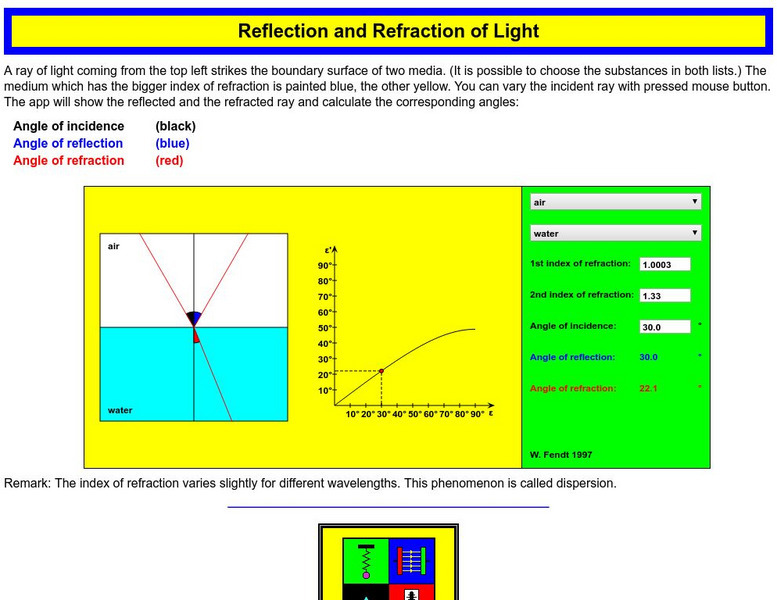
Walter Fendt: Reflection and Refraction of Light
Defines the refraction of light and provides an applet for investigating it.
Walter Fendt
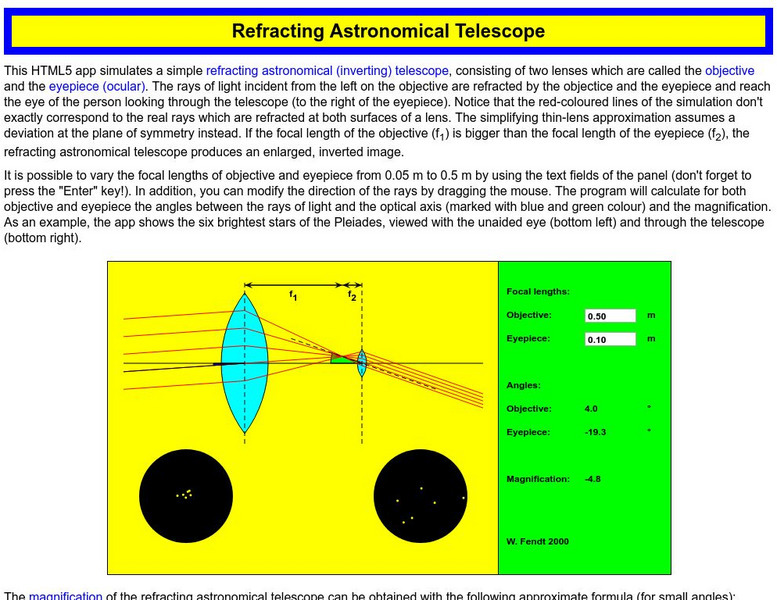
Walter Fendt: Refracting Astronomical Telescope
An app for investigating the operation of a refracting telescope. The location of the eyepiece and objective lens can be altered, and the focal point and path of light through the lenses can be observed.
Georgia Department of Education
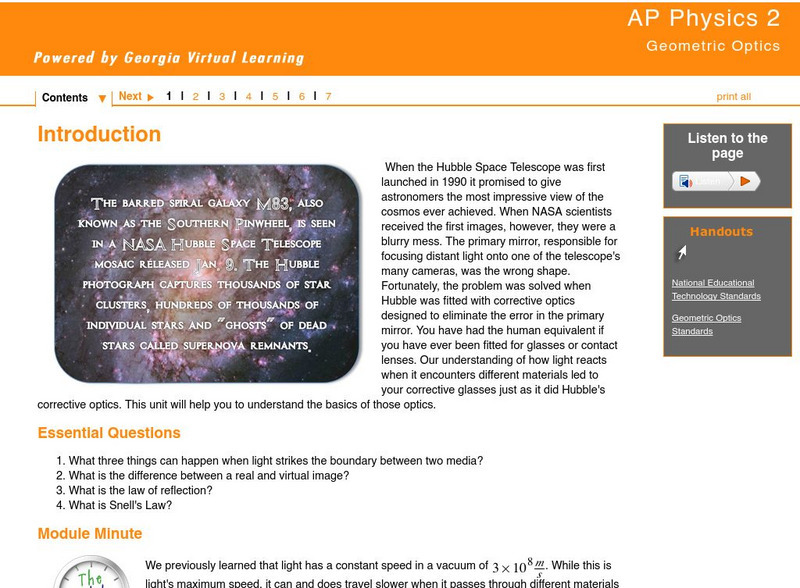
Ga Virtual Learning: Geometric Optics
This interactive unit will help students to understand the basics of geometric optics. Learn what happens when light strikes the boundary between two media as well as the difference between a real and virtual image? Also explore the law...
Georgia State University
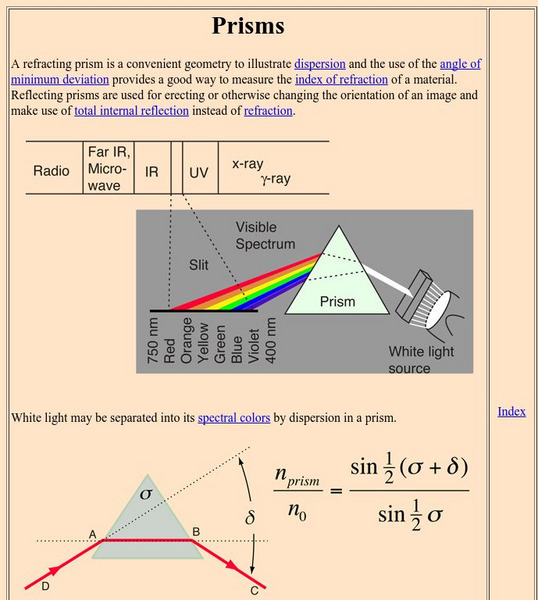
Georgia State University: Hyper Physics: Prisms
This physics department site explains how prisms work and their purpose in the dispersion of light. Explains the angle of deviation and includes an interactive form in which visitors calculate the angle of deviation and receive immediate...
BBC
Bbc: Gcse Bitesize: General Properties of Waves
Light travels as waves. Waves can be described by their amplitude, wavelength and frequency. The speed of a wave can be calculated from its frequency and wavelength.
Physics Classroom
The Physics Classroom: Refraction/ray Model of Light: Determination of N Values
Through illustrated examples and interactive practice problems, students explore the details of Snell's Law.
Physics Classroom
The Physics Classroom: Refraction and the Ray Model of Light: Converging Lenses
The purpose of this tutorial is to summarize object-image relationships by dividing the possible object locations into five general areas or points.
Physics Classroom
The Physics Classroom: Refraction/ray Model of Light: The Mathematics of Lenses
Using the Lens Equation and the Magnification Equations, students determine numerical information about image distance and image size.
Physics Classroom
The Physics Classroom: Refraction/ray Model of Light: Image Formation Revisited
Students take an in-depth look at the physics behind image formation.
Georgia State University
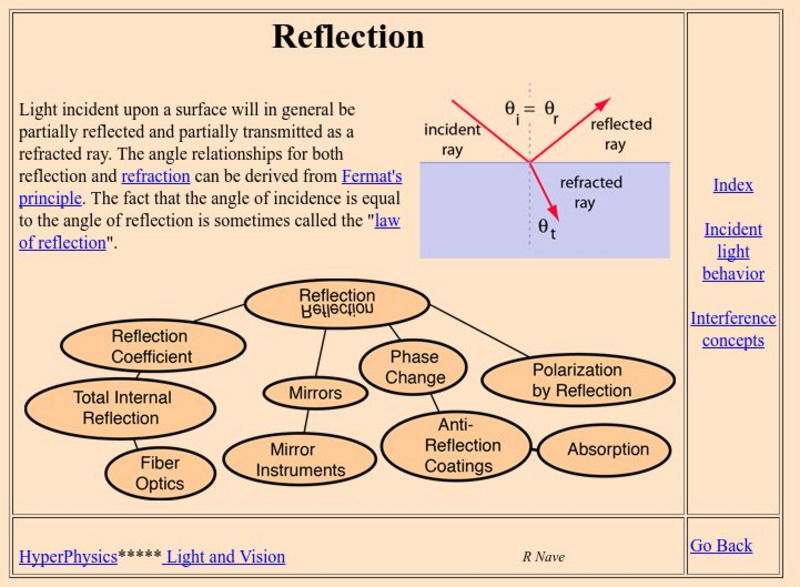
Georgia State University: Hyper Physics: Behavior of Incident Light
This site from Georgia State University is an indexing page for several other pages on the topic of reflection. Topics are treated in an understandable manner and utilize meaningful graphics.
Georgia State University
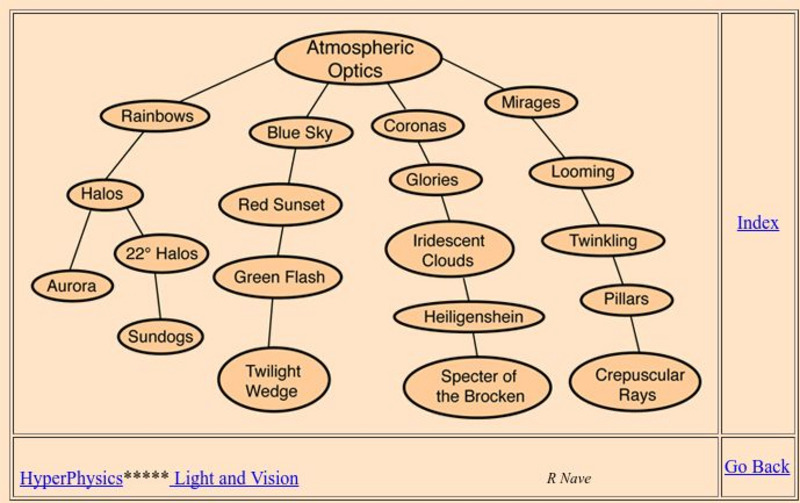
Georgia State University: Hyper Physics: Atmospheric Optics Concepts
This physics department site features an indexing page for a variety of pages pertaining to atmospheric optics. Topics include rainbows, halos, auroras, mirages, star twinkling, sunsets, green flashes, coronas, and more. Excellent...
Physics Classroom
The Physics Classroom: Refraction and the Ray Model of Light: Anatomy of the Eye
This tutorial looks at the anatomy of the eye and how the sense of sight works. This is the first part of a learning module. Subsequent sections cover how images are formed and detected, the concept of accommodation where the eye adjusts...
Boston University
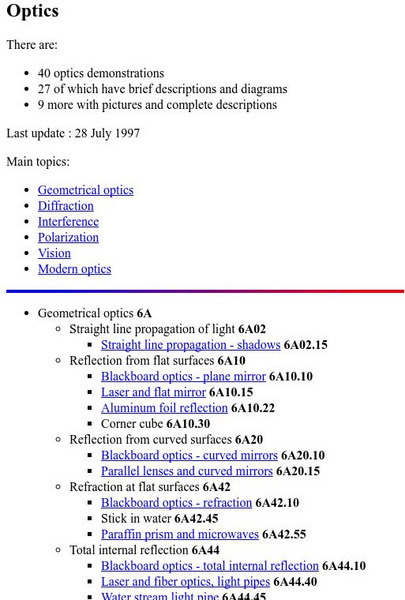
Bu: Optics: Geometric Optics
Several short descriptions of demonstrations which illustrate principles of geometric optics (many of which focus upon refraction).
University of Maryland
Optics Highlights: The Telescope
Part of an anecdotal history of optics and the study of light. Extremely thorough treatment of the invention of the telescope. Includes a short biographical sketch and discusses the work of Isaac Newton which focuses on his contribution...

University of Maryland
Optics Highlights: The Microscope
Part of an anecdotal history of optics and the study of light. Extremely thorough treatment of the scientific findings and developments which led to the invention and refinement of the microscope. Includes a short biographical sketch and...
Cosmo Learning
Cosmo Learning: Applied Science and Technology 210: Electrical Engineering
A collection of video lectures from a course that explores the application of electrical engineering topics. Webpage includes twenty-eight lectures from a professor at the University of California, Berkeley. Lectures vary in length and...
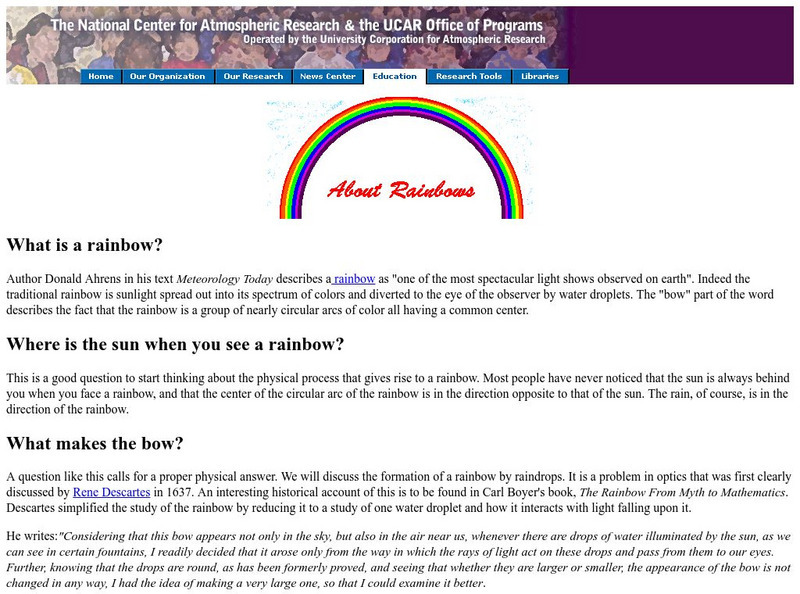
University Corporation for Atmospheric Research
Ucar: About Rainbows
This site from the University Corporation of Atmospheric Research provides an illustrated article about the phenomenon of rainbows.
Physics Classroom
The Physics Classroom: Refraction and the Ray Model of Light: Anatomy of a Lens
Illustrated diagrams in this tutorial help students understand the properties and functions of lenses.
Physics Classroom
The Physics Classroom: Refraction/ray Model of Light: Image Formation/detection
Students discover the four parts of the eye are the most instrumental in the task of producing images that are discernible by the brain.
Physics Classroom
The Physics Classroom: Refraction/ray Model of Light: Farsightedness/correction
A brief introduction to the physics side of farsightedness, and how lenses correct this vision defect.
Physics Classroom
The Physics Classroom: Refraction/ray Model of Light: Nearsightedness/correction
A brief introduction to the physics side of nearsightedness, and how lenses correct this vision defect.
Physics Classroom
The Physics Classroom: Lesson 3: Concave Mirrors
Lesson 3 of this tutorial on refraction is on concave mirrors. Content that is covered includes the anatomy of curved mirrors, reflection of light and image formation, ray diagrams, image characteristics for concave mirrors, plus more.

Khan Academy
Khan Academy: Thin Lens Sign Conventions
Have you ever wondered why some people need glasses and others don't? It's because of the way light is focused by the lens in your eye. This lens, like magnifying glasses, eyeglasses, and contact lenses, is considered a thin lens.