Hi, what do you want to do?





TeachEngineering
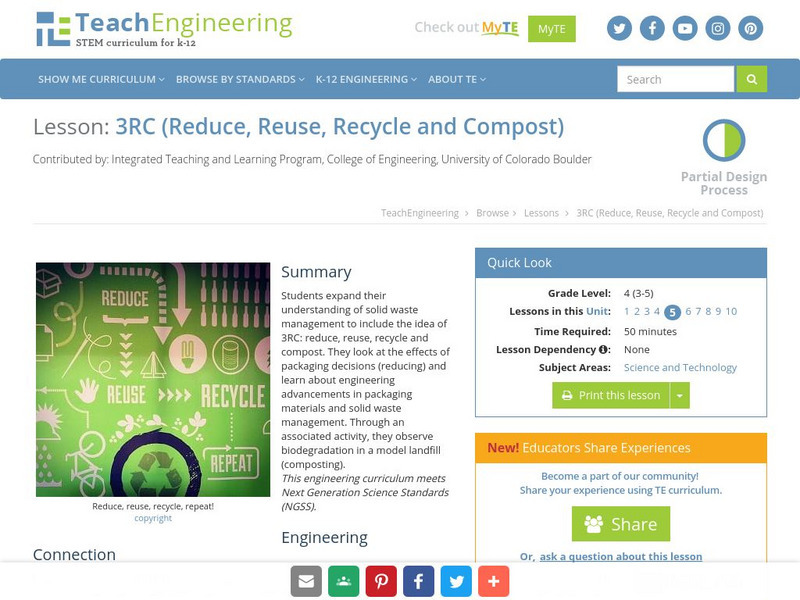
Teach Engineering: 3 Rc (Reduce, Reuse, Recycle and Compost)
In this lesson, students expand their understanding of solid waste management to include the idea of 3RC (reduce, reuse, recycle and compost). They will look at the effects of packaging decisions (reducing) and learn about engineering...

Other
Recycling Council of Ontario: Waste Free Lunch Challenge
This site provides resources for educators to manage a litterless lunch program at their schools in order to promote environmental education objectives. Teachers register their classes and receive certificates at the end of the program.
Science Buddies
Science Buddies: The Big Dig
Even though many cities have recycling programs, a lot of trash still ends up in the dump. Find out which materials will break down and which materials won't. Will the results of this experiment change which products you often buy?
TeachEngineering
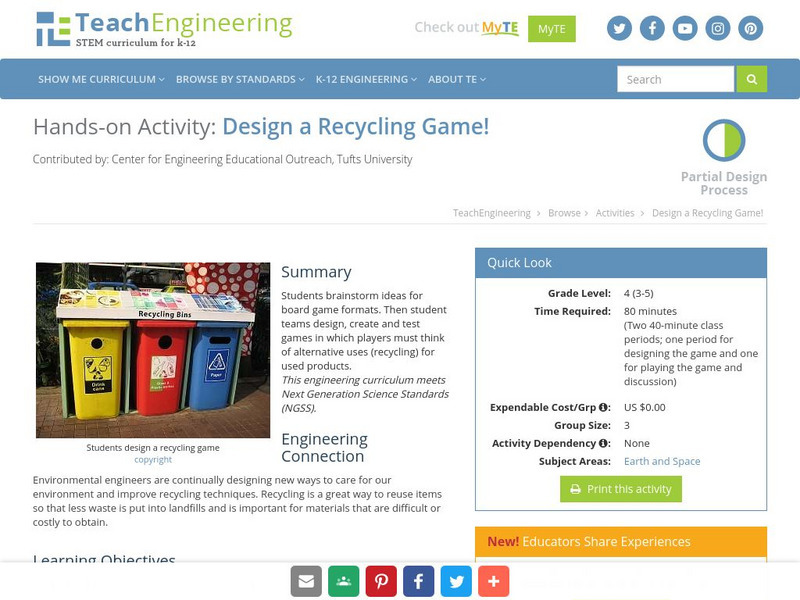
Teach Engineering: Design a Recycling Game!
Students will design a game where players try to come up with alternative uses for used products. Students will brainstorm ideas for an effective board game format.

PBS
Pbs Online News Hour Extra: Analyzing Your School?s Energy Consumption
The resource is a lesson plan that compares a school's energy consumption with that of a LEED certified school. In addition, learners identify areas that are within the school's capacity of change and audit the school?s recycling...
US Environmental Protection Agency
Epa: Land, Waste, and Cleanup Topics
This site is loaded with information on solid waste and hazardous waste. It includes industries' effects on the environment, waste programs, treatment, control, pollution prevention, recycling, and cleanup programs.

TeachEngineering
Teach Engineering: Environment
Through 10 lessons and more than 20 hands-on activities, students are introduced to the concept of an environment and the many interactions within it. As they learn about natural and human-made environments, as well as renewable and...
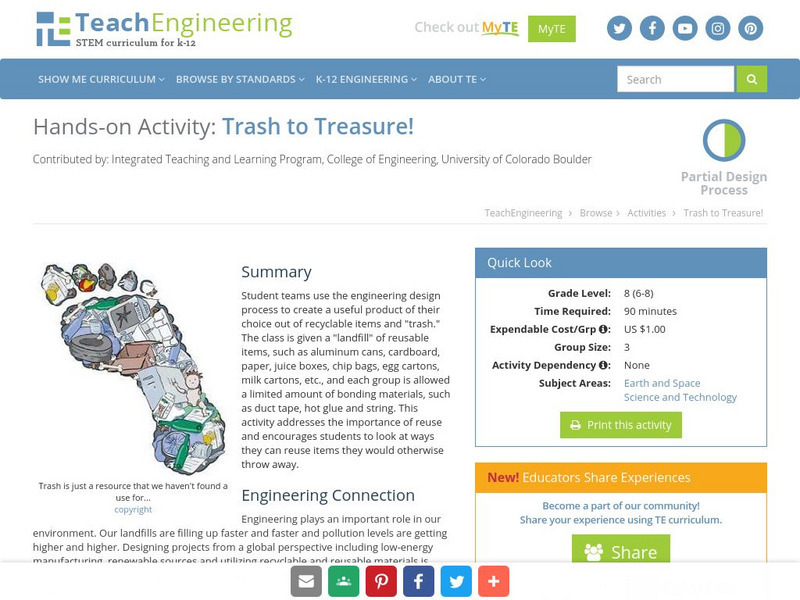
TeachEngineering
Teach Engineering: Trash to Treasure!
Student teams use the engineering design process to create a useful product of their choice out of recyclable items and "trash." The class is given a "landfill" of reusable items, such as aluminum cans, cardboard, paper, juice boxes,...
TeachEngineering
Teach Engineering: It's All in the Package
In this activity, students explore the concept of "reducing" solid waste and how it relates to product packaging and engineering advancements in packaging materials. Students read about and evaluate the highly publicized packaging...
TeachEngineering
Teach Engineering: Drawing Magnetic Fields
Students use a compass and a permanent magnet to trace the magnetic field lines produced by the magnet. By positioning the compass in enough spots around the magnet, the overall magnet field will be evident from the collection of arrows...
TeachEngineering
Teach Engineering: Clean Up This Mess
Students are challenged to design a method for separating steel from aluminum based on magnetic properties as is frequently done in recycling operations. To complicate the challenge, the magnet used to separate the steel must be able to...
TeachEngineering
Teach Engineering: Electricity and Magnetic Fields
The grand challenge for this legacy cycle unit is for students to design a way to help a recycler separate aluminum from steel scrap metal. In previous lessons, they have looked at how magnetism might be utilized. In this lesson,...
TeachEngineering
Teach Engineering: Electromagnets
In this activity, the students will complete the grand challenge and design an electromagnet to separate steel from aluminum for the recycler. In order to do this, students compare the induced magnetic field of an electric current with...
TeachEngineering
Teach Engineering: Building an Electromagnet
Students design and construct an electromagnet that must pick up 10 staples. They begin with only minimal guidance, and after the basic concept is understood, are informed of the properties that affect the strength of that magnet. They...
TeachEngineering
Teach Engineering: Human Water Cycle
Students learn about the human water cycle, or how humans impact the water cycle by settling down in civilizations. Specifically, they learn how people obtain, use and dispose of water. Students also learn about shortages of treated,...
Council for Economic Education
Econ Ed Link: Dumptown, Usa: Making a Ton of Difference
The amount of trash produced in the United States is mounting with each passing year. Communities are finding it increasingly difficult and costly to handle trash disposal. Recycling is considered a key solution to the garbage problem....
TeachEngineering
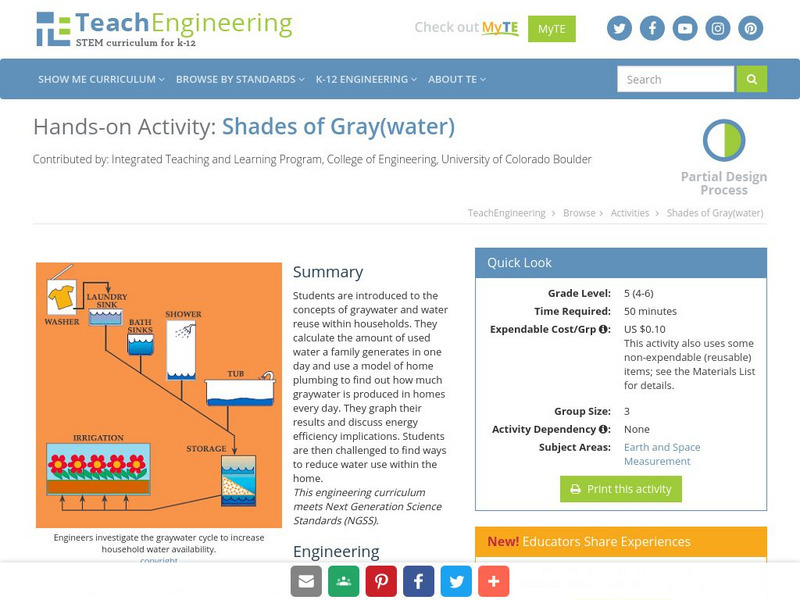
Teach Engineering: Shades of Gray(water)
Students are introduced to the concepts of graywater and water reuse within households. They calculate the amount of used water a family generates in one day and use a model of home plumbing to find out how much graywater is produced in...
TeachEngineering
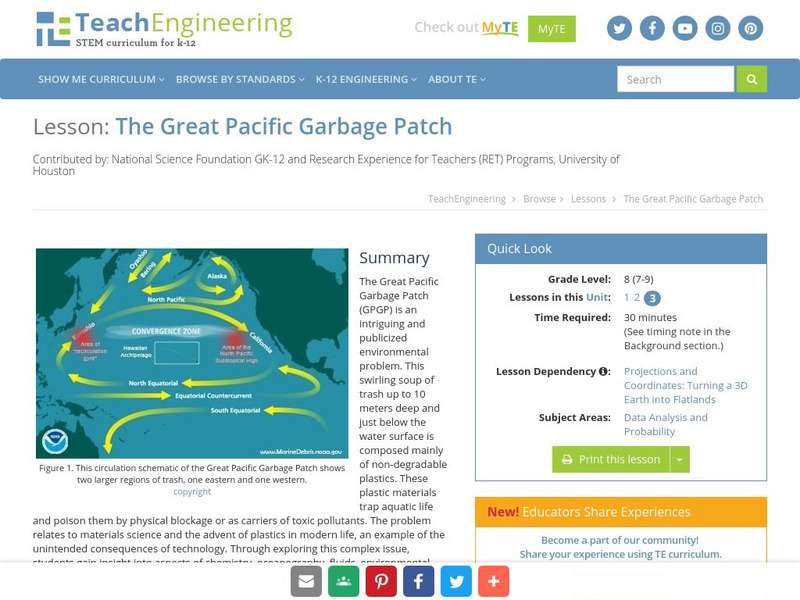
Teach Engineering: The Great Pacific Garbage Patch
The Great Pacific Garbage Patch (GPGP) is an interesting and somewhat publicized environmental problem. A swirling soup of trash up to 10 meters deep and just below the water surface is composed mainly of non-degradable plastics. These...
TeachEngineering
Teach Engineering: Trash Talkin'
In this activity, students collect, categorize, weigh and analyze classroom solid waste. The class collects waste for a week and then student groups spend a day sorting and analyzing the garbage with respect to recyclable and non...
Other
Kids for a Clean Environment
Don't just complain about what is happening to the environment, become involved in environmental issues and make a change. Here's an organization that is enabling kids to make those changes.

TeachEngineering
Teach Engineering: Design a Net Zero Energy Classroom
Students create a concept design of their very own net-zero energy classroom by pasting renewable energy and energy-efficiency items into and around a pretend classroom on a sheet of paper. They learn how these items (such as solar...
TeachEngineering
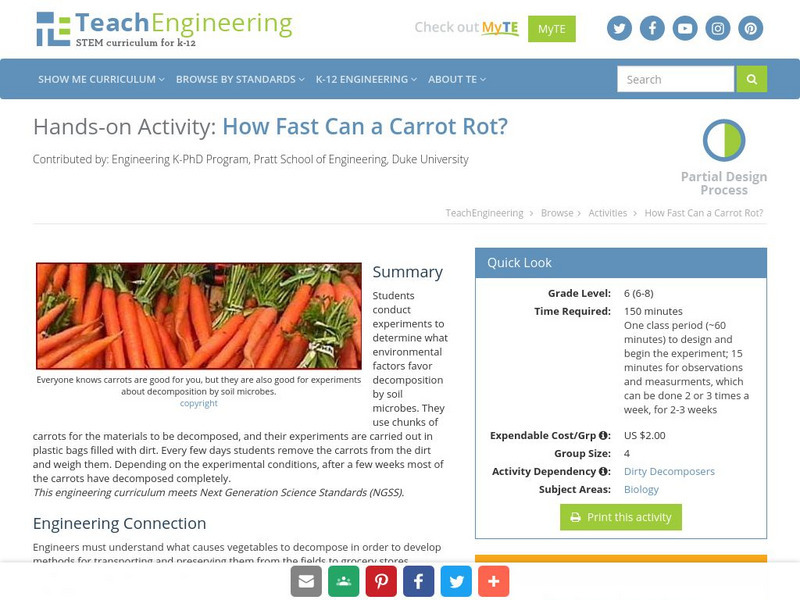
Teach Engineering: How Fast Can a Carrot Rot?
Students conduct experiments to determine what environmental factors favor decomposition by soil microbes. They use chunks of carrots for the materials to be decomposed, and their experiments are carried out in plastic bags filled with...

TeachEngineering
Teach Engineering: Designing a Package That Works
The goal is for students to understand the basics of engineering associated with the packaging of items to preserve, market, and safely deliver products. The packaging for each type of use varies. While observing and thinking about all...
TeachEngineering
Teach Engineering: Dirty Decomposers
Students design and conduct experiments to determine what environmental factors favor decomposition by soil microbes. They use chunks of carrots for the materials to be decomposed, and their experiments are carried out in plastic bags...